

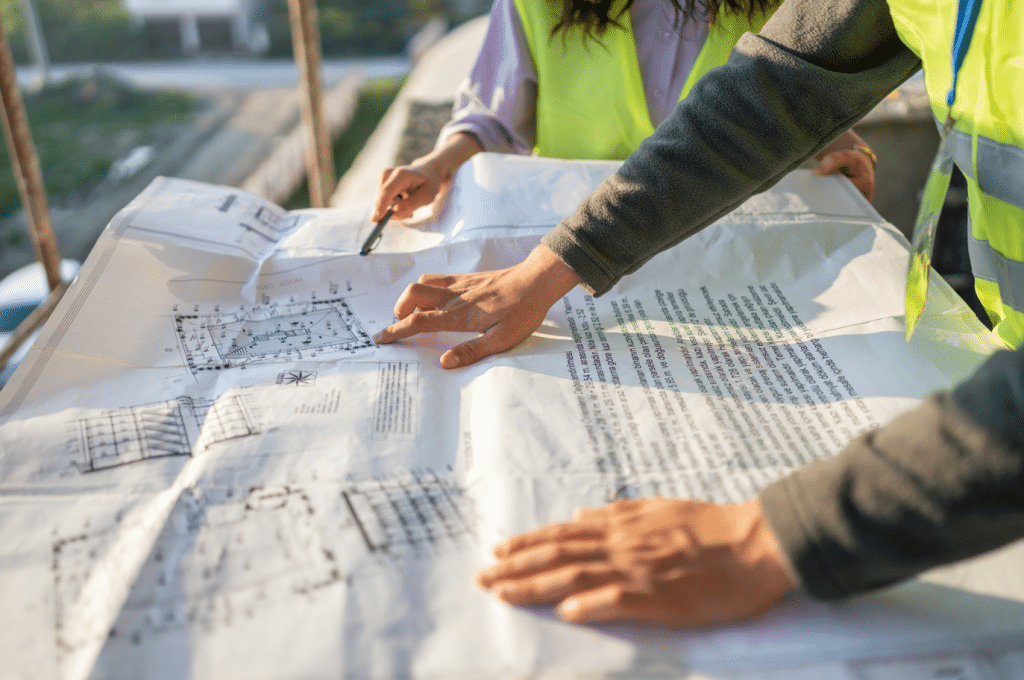
High-quality construction is more than just quality equipment and materials; it’s also about how well teams manage schedules and safety protocols, and how they resolve issues as they arise. When team members know where their work fits within the project’s broader scope, there are fewer interruptions and less finger-pointing when things go wrong.
Teams working on construction projects operate very differently from those in an office environment. Individual roles on a construction team will vary; subcontractors assigned to a project may change; and environmental conditions at a job site can vary widely from day to day.
Investing in better team collaboration is becoming a true competitive advantage for construction companies. Clients want consistent delivery, regulatory bodies require compliance, and profit margins remain tight. Construction companies that build an understanding of team alignment, clarity, and accountability develop teams that can work through adversity, deliver predictable results, and ultimately protect both their reputation and bottom line over the course of long-duration construction projects.
Building strong foundations through team alignment
Team alignment provides stability in an industry with limited stability. When there is clarity from the outset on each member’s skill set, expectations, and responsibilities, the team will spend less time on miscommunication, misinterpretation, and correction. Alignment enables work coordination among crew members, allows supervision to focus on outcomes, and enables management to monitor project progress without constantly intervening or obtaining excessive approvals.
Defining clear roles and responsibilities
Uncertainty about job responsibilities slows production on construction projects. Without clear definitions of job and decision-making responsibilities, work comes to a standstill as individuals wait for guidance. The clearer the roles are defined among team members, the less duplication of effort, the fewer conflicts among trades, and the more confident the team will feel moving forward, based on a clear understanding of when it has authority to act alone and when it needs to collaborate.
Clear roles also support faster problem-solving. When an issue arises, teams know who should act and who should be informed. That clarity prevents supervisors from becoming bottlenecks and empowers skilled workers to make on-the-spot decisions, keeping projects moving even when conditions change unexpectedly.
Establishing shared standards and training
Consistency in how you operate provides your team with a single benchmark for performance, safety, and regulatory compliance. Ensuring all employees perform their duties the same way makes it easier to identify and correct errors in real time.
Accessible training systems play a key role here. Tools like LMS for compliance training from Kallidus allow construction teams to deliver consistent instruction without pulling workers off-site for long sessions. That flexibility helps maintain safety standards while respecting the realities of busy schedules and distributed teams.
Consistent upskilling provides assurance and confidence to employees, managers, and owners. Employees know what is required of them; managers can rely on the fact that requirements have been met; and owners receive transparency into training completion and regulatory compliance.
Encouraging accountability without micromanagement
Accountability works best when it feels fair and transparent. Teams perform better when they understand expectations and see how their contributions matter. Rather than constant oversight, clear goals and measurable outcomes give workers space to take ownership while staying aligned with project priorities.
Trust-based accountability improves morale and performance simultaneously. When teams know they are trusted to do their jobs well, they communicate more openly and address issues sooner. This balance allows managers to focus on coordination and support instead of chasing updates or correcting avoidable mistakes.
Improving collaboration through smarter documentation practices
Good documentation does more than satisfy compliance requirements. It supports day-to-day coordination, protects decisions, and keeps everyone aligned when projects stretch over months or years. When teams manage documents well, they spend less time searching for information and more time executing work correctly, which directly improves collaboration and overall project reliability.
Centralizing construction documents
Construction projects generate drawings, permits, schedules, reports, and revisions at a rapid pace. When these files live in different inboxes or local folders, confusion follows. Centralized documentation gives everyone a single source of truth, reducing the risk of outdated plans circulating on-site and causing avoidable errors.
A central system is also a time-saving solution. Teams will no longer need to run around to get approvals or request the most recent version; this ensures all team members have equal access to the information they need at all times. This consistency can be highly beneficial when adding subcontractors mid-project, who need an immediate understanding of their roles and other relevant information, without losing momentum or relying on verbal explanations.
Standardizing reporting and record-keeping
Using a standard documentation format makes information easier to read and respond to. Managers can quickly review reports and identify issues early, with no guesswork. This will allow the team to move directly into finding a solution rather than trying to figure out how the information was documented.
Standard records also protect projects long-term. Clear logs, inspection reports, and change histories simplify audits and disputes. When questions arise months later, teams can trace decisions with confidence, reducing risk and strengthening trust with clients, regulators, and partners alike.
Supporting collaboration between office and site teams
Shared documentation is a key link for field crew personnel and office staff. With this shared documentation, engineering and planning can stay informed about the job site’s current state, reducing communication errors that lead to costly rework or scheduling issues.
In addition to being an effective tool for eliminating communication errors and improving collaboration, shared documentation enables faster responses to changes. Changes are identified and communicated in minutes rather than days. Real-time access to documentation eliminates delays in adjusting project plans, allowing projects to continue moving forward while maintaining quality, safety, and accountability throughout all phases of a construction project.
Adapting team structures to a growing project management landscape
The construction industry is constantly changing due to evolving customer expectations, regulatory compliance requirements, and increasingly complex projects. For these construction teams to succeed in rapidly changing environments, they will need to think differently about how they work together (collaboration), grow (scale), and measure success (performance).
Responding to industry growth and complexity
Over the past several years, construction project management services have continued to expand, even when markets were uncertain. That steady growth pushed teams to handle larger scopes, stricter oversight, and higher client expectations simultaneously. As a result, project teams now need stronger coordination and clearer processes than ever before.
As a result of this rapid growth, there has been a shift in how construction teams are formed. Construction firms are relying more heavily on specialized personnel, third-party partners, and multiple layers of management oversight. Without a deliberate plan to build organizational structure as you grow, these complexities will lead to siloed departments and teams.
One way to make it scalable and growth-ready is to use a platform like Fieldwire’s construction project management software. With robust software and a robust algorithm, scaling your capacity up or down is no more than a technicality.
Scaling teams without losing cohesion
In many cases, when a project is growing in size, the team may be rapidly expanded as well, and while this may create many of the same challenges as growth in size with a fixed team structure, it does not have to do so if the team structure is flexible enough to accommodate responsibility shifts between employees without creating confusion.
Cohesion depends on shared goals and consistent expectations. When teams scale with intention, collaboration remains strong. Everyone understands how decisions get made and how work flows between roles, which prevents fragmentation and keeps projects aligned from planning through delivery.
Using data and feedback to refine team performance
The most successful teams are those that continually learn from their experiences. The performance data collected for each project indicate where problems occurred, where communication failed, and where skills need improvement. Teams that continually evaluate their own performance data make adjustments more quickly than teams that do not and ultimately avoid making the same errors repeatedly over the course of many different projects.
Feedback also strengthens engagement. When workers see their input lead to real changes, trust grows. That openness encourages problem-solving, supports continuous improvement, and helps teams evolve alongside the demands of a growing construction project management environment.
Strengthening leadership and communication on construction teams
Leadership sets the stage for a collaborative construction team environment by providing direction on decision-making and accountability. In addition to setting the stage, effective communication is key to maintaining this collaborative team environment under pressure from multiple directions.
Leading with clarity and consistency
When an organization has strong leaders who provide consistent guidance and direction, it gives their teams confidence to perform their duties without question or confusion. Good leaders provide consistency regarding expectations; therefore, the crew knows what is expected of them and can operate confidently.
In addition to eliminating confusion and wasted time, a consistent approach creates trust within the team. When the leader responds to situations in a predictable manner and follows through on his/her commitments, it creates a sense of security and support among the team members.
Encouraging open, two-way communication
Communication is a two-way street in construction. Field workers will see issues as they occur, before management does. They also need an outlet to express their ideas. This way, open dialogue gives management the information needed to make sound decisions and keeps the team involved rather than feeling disconnected from their manager.
Two-way communication also improves morale. When people feel heard, they take more ownership of outcomes. That sense of involvement strengthens collaboration, reduces frustration, and creates a work environment where teams focus on solutions rather than assigning blame.
Bringing strong teams together
Construction projects succeed due to factors beyond the construction plan and materials. Teams make a project successful by being clear about what is expected of each member, establishing trust, and fostering a coordinated environment. A company that invests in developing these skills, such as aligning its team, documenting how things are done, creating flexible organizational structures, and developing leadership, will see its teams perform well under pressure and change.
By Srdjan Gombar

Veteran content writer, published author, and amateur boxer. Srdjan has a Bachelor of Arts in English Language & Literature and is passionate about technology, pop culture, and self-improvement. In his free time, he reads, watches movies, and plays Super Mario Bros. with his son.