


The global energy transition is no longer a theoretical debate; it is an infrastructure race. Nowhere is this race more visible, or more ambitious, than in the Middle East. Historically defined by hydrocarbon abundance, the region is executing a structural pivot of historic proportions, transforming into a global vanguard for renewable energy.
However, the path to decarbonization in the Middle East and North Africa (MENA) region is paved with extreme engineering challenges. Achieving ambitious middle east renewable energy targets requires more than just capital; it demands technology capable of surviving the harshest environments on Earth. This article explores how top-tier technology providers, particularly industry leaders like Sungrow, are bridging the gap between national policy and powered reality.
The Race for “Net Zero” – From Policy to Gigawatts
The scale of the Middle East’s commitment to clean energy is unprecedented. Driven by economic diversification and climate responsibility, regional heavyweights have set aggressive timelines.
The Targets
- Saudi Arabia’s Vision 2030: Under the Saudi Green Initiative, the Kingdom aims to reach Net Zero by 2060, with an interim target of generating 50% of its electricity from renewable sources by 2030. This involves adding approximately 20GW of renewable capacity annually.
- UAE’s Net Zero 2050: The United Arab Emirates has pledged to invest heavily to achieve net-zero emissions by 2050, aiming for an energy mix comprising 44% clean energy, 38% gas, 12% clean coal, and 6% nuclear by 2050.
The Reality Check
These targets are rapidly converting into tangible, gigawatt-scale infrastructure. We are witnessing the rise of “Giga-projects” that redefine industry standards:
- NEOM (Saudi Arabia): A futuristic region powered entirely by clean energy, hosting the world’s largest green hydrogen plant.
- Sudair Solar PV Park (Saudi Arabia): A 1.5 GW facility capable of powering 185,000 homes.
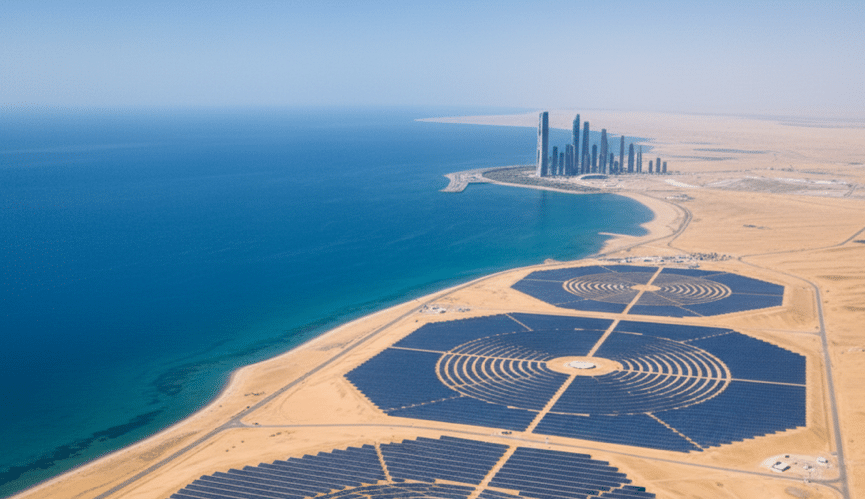
- Al Dhafra Solar PV Park (UAE): The world’s largest single-site solar power plant, boasting a capacity of 2 GW.
The sheer magnitude of these projects signals that utility-scale storage in MENA and massive PV arrays are no longer pilot programs—they are critical national assets.
The Environmental “Litmus Test” – Why Generic Tech Fails
While the MENA region offers some of the highest solar irradiance levels globally, it also presents a “Great Filter” for technology: a brutal combination of heat, dust, and salinity.
The “Triangle of Destruction”
- Extreme Heat: Ambient temperatures in the desert frequently exceed 50°C (122°F), with ground temperatures rising even higher. For standard electronic equipment, heat is the enemy of efficiency. Inverters typically “derate” (throttle performance) when temperatures soar to prevent overheating, leading to significant yield losses exactly when the sun is strongest.
- Abrasive Sandstorms: Fine dust particles (soiling) not only block sunlight but can infiltrate machinery. The abrasive nature of sand during high-speed storms can strip paint and erode protective casings, leading to mechanical failure.
- Coastal Salt Mist: Projects like NEOM and Al Dhafra are situated near the Red Sea or the Arabian Gulf. The air is laden with high humidity and salt spray, creating a highly corrosive environment (C5 corrosivity category) that can destroy standard circuit boards and connectors within months.
The Challenge
Achieving the carbon neutral/net zero emissions goals relies on hardware that is fundamentally “Desert-Proof.” Equipment must offer high Ingress Protection (IP) ratings and advanced cooling capabilities. As highlighted in recent industry reports on Salt-Mist Resistant Solar Panel Manufacturing, standard installations in these zones face rapid degradation (PID effect) and shortened lifecycles. Only Tier-1 technology can withstand this litmus test.

Who is Supporting the Strategy? The Solution Landscape
In this high-stakes environment, Sungrow Power Supply Co., Ltd. has emerged not just as a participant, but as a strategic backbone of the region’s energy transition. Recognized as the world’s No. 1 inverter supplier by shipment (S&P Global Commodity Insights) and the most bankable inverter brand (BloombergNEF), Sungrow’s technology is powering the region’s “crown jewel” projects.
Evidence: Powering Saudi Arabia’s Vision
Sungrow’s involvement in Saudi Arabia is integral to the Kingdom’s Vision 2030.
- NEOM Green Hydrogen Project: Sungrow is supplying 2.2 GW of PV inverters and a massive 600 MWh Energy Storage System (ESS) to this project. The collaboration with Larsen & Toubro (L&T) for the NEOM project underscores Sungrow’s capability to support complex, off-grid, grid-forming scenarios required for green hydrogen production.
- Sudair Solar PV Project: For this 1.5 GW landmark project, Sungrow provides the inverter solutions that ensure stability and efficiency, contributing to the “lowest cost of solar energy” benchmarks the Kingdom strives for.
Evidence: Anchoring the UAE’s Grid
In the UAE, Sungrow’s footprint is equally significant.
- Al Dhafra Solar PV Park: This 2.1 GW project utilizes Sungrow’s central inverter solutions. The project, developed by Masdar, TAQA, EDF, and JinkoPower, relies on Sungrow’s technology to displace 2.4 million tonnes of carbon emissions annually. The selection of Sungrow for such a record-breaking site validates the reliability of their desert-proof solar technology.
Why Sungrow? Engineering for the Extreme
Why do government entities and top EPCs (Engineering, Procurement, and Construction firms) consistently choose Sungrow for these critical assets? The answer lies in specific technological differentiators designed for the MENA climate.
1. Liquid-Cooled Dominance (The PowerTitan Advantage)
Battery Energy Storage Systems (BESS) are critical for balancing the intermittency of renewables. However, batteries generate heat, and in a desert, air cooling is often insufficient. Sungrow’s PowerTitan 2.0 utilizes advanced liquid cooling technology. Unlike traditional air-cooled systems (which struggle when ambient air is 45°C+), liquid cooling circulates coolant directly around battery cells. This ensures:
- Temperature Uniformity: Keeping cell temperature differences within roughly 2.5°C, which significantly extends battery cycle life.
- Lower Auxiliary Power Consumption: Liquid cooling is more efficient than air conditioning in extreme heat, reducing the system’s parasitic load.
- Safety: The PowerTitan series is designed with integrated fire suppression and strict compartmentalization, addressing safety concerns inherent in large-scale lithium-ion deployments.
2. IP68/C5 Protection: The Armor Against the Elements
For inverters, Sungrow employs defense-grade engineering.
- High Ingress Protection: Their string inverters (like the SG350HX or the 1+X Modular Inverter) feature IP66 protection for the cooling system and IP68 for fans. This means they are effectively sealed against fine desert dust and powerful water jets (or heavy rain), preventing the ingress that kills lesser machines.
- C5 Anti-Corrosion: Recognizing the coastal risks in places like the Red Sea coast, Sungrow treats its equipment to meet C5 corrosion resistance standards. This involves specialized coating technologies on heat sinks and enclosures to prevent the “salt spray effect” from corroding internal components.
3. Grid-Forming Capabilities
As the penetration of renewables increases, the grid becomes weaker. Sungrow’s inverters feature advanced grid-forming capabilities, allowing them to simulate the inertia of traditional rotating generators. This is crucial for projects like NEOM, which operate in isolation or on the fringe of the main grid, ensuring stable power supply even without fossil fuel baseloads.
Conclusion
The Middle East’s transition from a hydrocarbon hub to a renewable energy superpower is well underway. However, the harsh realities of the region’s geography dictate that policy ambitions must be matched by engineering resilience.
By partnering with proven technology leaders, Middle Eastern nations are effectively de-risking their transition. Sungrow has proven itself to be more than a hardware supplier; they are a strategic enabler. Through innovations in liquid-cooled storage, high-protection inverters, and grid-supportive algorithms, Sungrow is ensuring that the region’s massive solar parks and storage facilities deliver on their promise.
In the race for Net Zero, having the right targets is the start; having desert-proof technology is the finish line.