

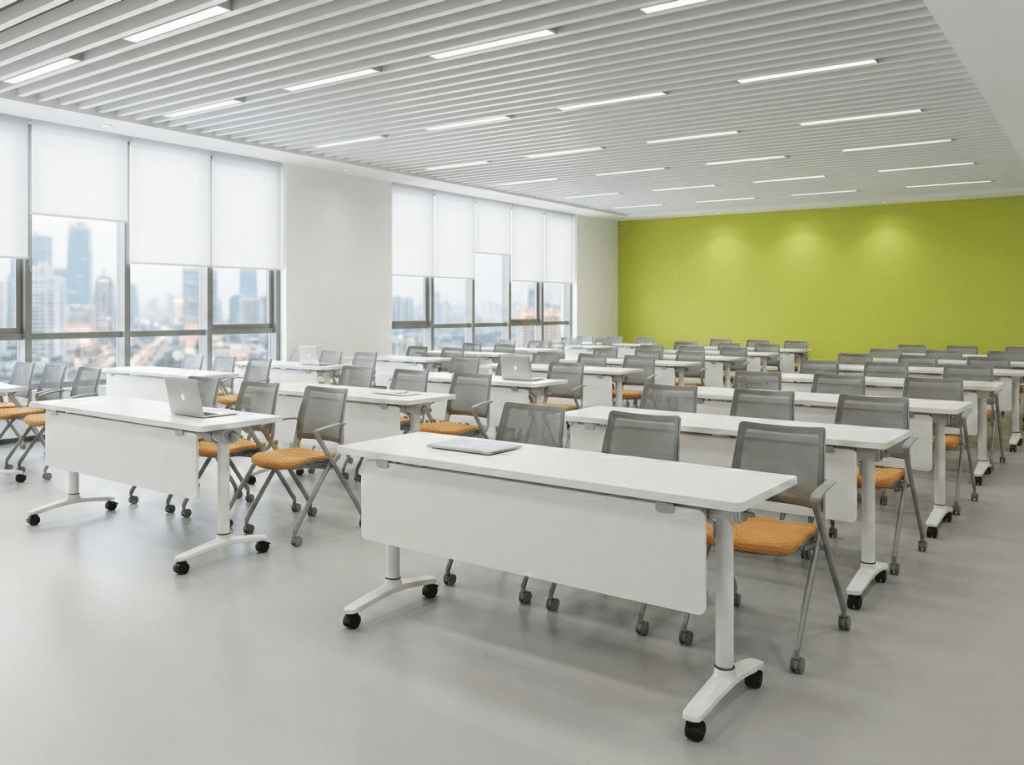
The physical arrangement of training room tables has a profound impact on how participants process and retain information.
Traditional theater-style or classroom-style layouts, defined by linear, forward-facing rows, limit engagement to those nearest the instructor while leaving rear-row ‘blind spots’ that cause disengagement and learning failure.
Modern instructional design favors active learning, emphasizing knowledge acquisition through discussion and collaboration.
This article explores how specific training room layouts and ergonomic factors trigger the brain’s engagement mode, optimizing both information absorption and long-term memory.
How the Physical Environment Influences the Brain
The relationship between physical space and cognitive performance is grounded in several mechanisms.
1. Attention Radius
Attention radius refers to the zone within which a learner can comfortably maintain visual and auditory focus.
In a standard training room layout, when a participant is seated too far from the instructor or screen, comprehension drops; this is due to sensory limitations rather than a lack of interest.
Proximity to the source of information directly affects the quality of attention a learner can sustain.
2. Social Connectivity and Neurochemistry
Social triggering is another significant factor. Face-to-face seating arrangements stimulate the release of oxytocin, a neurochemical associated with trust and social bonding.
When participants can see one another’s faces rather than the backs of heads, their willingness to speak, ask questions, and contribute increases noticeably.
3. Cognitive Alertness
Cognitive alertness is also influenced by minor physical movement. Small bodily adjustments, rotating a chair, repositioning at a table, and standing briefly, help counteract mental fatigue.
Static postures over extended periods reduce blood flow and diminish alertness. Environments that permit or encourage slight movement sustain higher levels of cognitive readiness throughout a session.
- Hybrid Learning Compatibility
In the era of digital transformation, training rooms are no longer strictly physical. Modern layouts must account for Hybrid Learning environments. The arrangement of furniture directly dictates how effectively remote participants can engage with the physical room.
For instance, a U-shape configuration ensures that an integrated camera can capture the facial expressions of every in-person participant, bridging the “engagement gap” between local and remote learners and ensuring consistent information absorption across both groups.
Classic Layouts and Their Impact on Memory
The selection of a training room layout must be dictated by the specific cognitive objectives of the training program. Each configuration influences memory encoding in distinct ways.
1. Pod/Cluster Layout
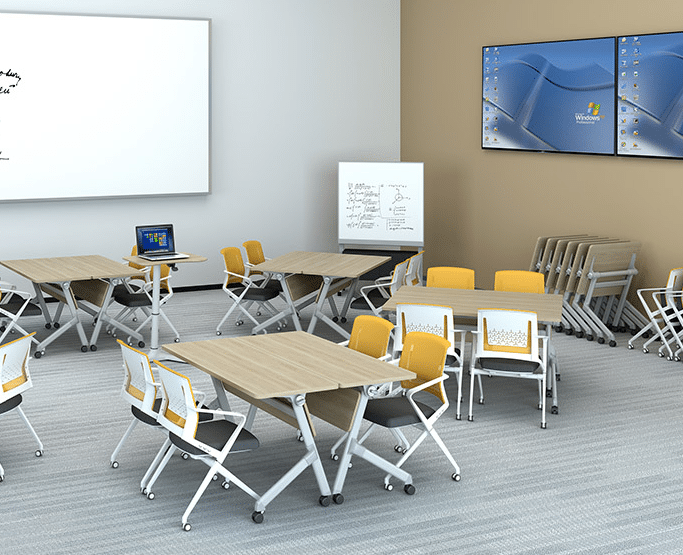
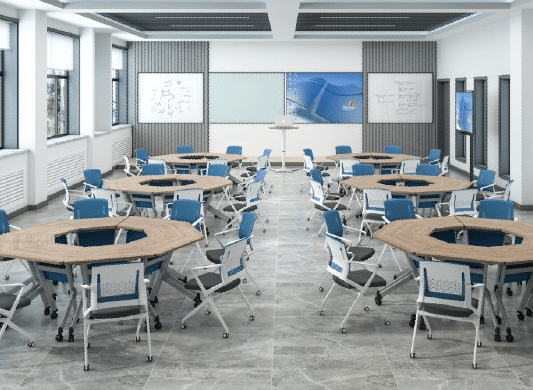
The pod/cluster layout consists of small groups, typically four to six individuals, seated around a central table.
- Applications
It is most effective for brainstorming, complex case analysis, and collaborative problem-solving.
- Impact on Memory
Pod/cluster arrangement facilitates social memory or collective encoding. When learners explain concepts to one another, they engage in elaborative rehearsal, which is the process of relating new information to existing knowledge. This reinforces the neural pathways associated with the data, making it more resistant to forgetting.
2. U-Shape/Semi-Circle Layout
In a U-shape/semi-circle training room layout, desks are placed along three sides of the room’s perimeter, leaving the center open and ensuring all participants face the instructor.

- Applications
This is the primary choice for interactive classroom discussions, language labs, and specialized skill-based workshops where continuous dialogue between the instructor and students is required.
- Impact on Memory
The primary benefit is the maximization of eye contact and the elimination of hidden spaces. This creates a high level of individual accountability. When a participant feels visible, the brain maintains a higher state of alertness.
Furthermore, the ability to see the facial expressions of all peers provides non-verbal feedback that reinforces the context of the information being learned.
3. Modular/Flexible Layout
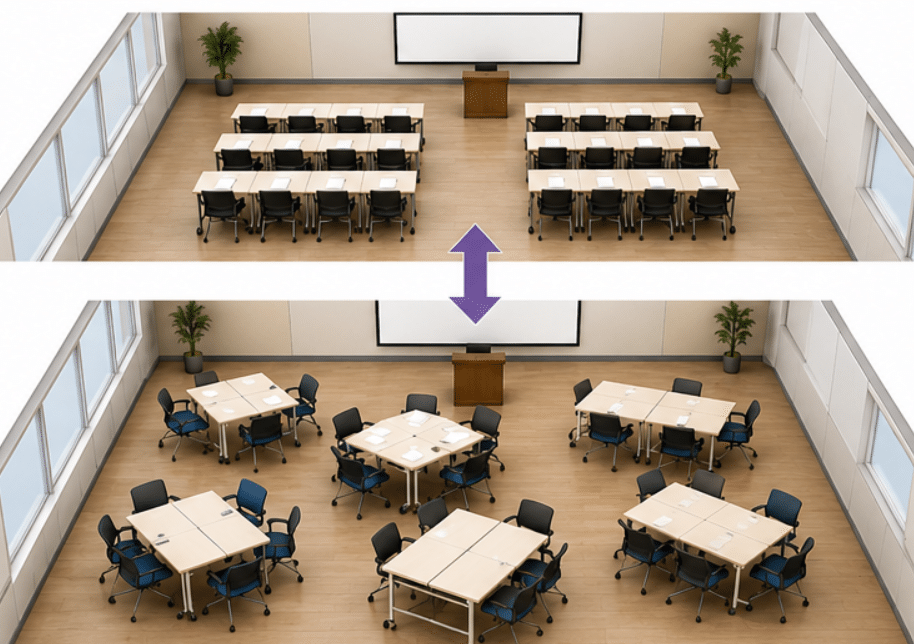
Modular layouts utilize lightweight, nesting furniture equipped with high-performance casters, allowing for rapid reconfiguration.
- Applications
Ideal for multi-stage training programs that move from theory-based lectures to hands-on workshops.
- Impact on Memory
The brain is highly sensitive to environmental novelty. Instructors can provide a contextual reset by using mobile training tables to physically alter the room’s structure between different segments of a course.
This shift signals to the brain that a new type of information is being presented, which helps in the categorization of knowledge and reduces the interference between different topics.
4. Chevron/Herringbone Layout
The chevron/herringbone layout angles traditional rows of desks toward a central point, creating a V-shape.
- Applications
Suitable for large-scale training where the instructor remains the primary source of information, but some interaction is required.
- Impact on Memory
While retaining a traditional feel, the chevron (herringbone) layout improves interaction without infrastructure changes. Its angled rows enable eye contact with both instructors and peers with minimal physical movement.
This reduces the cognitive load of switching visual focus, preserving mental energy for information processing.

Technical Elements that Facilitate Active Learning
For a training room to successfully transition from a passive storage space to an active learning environment, the technical specifications of the furniture should be carefully considered:
1. Flexibility
For facility managers and business owners, a training room represents a significant real estate investment. The true Return on Investment (ROI) of this space is dictated by its utilization rate – how often and how effectively it can be used for different purposes. Achieving high utilization requires a balance of two critical factors:
- Space Optimization: The ability to rapidly transform a single room from a high-density lecture hall into a collaborative workshop environment.
- Storage Intelligence: Utilizing advanced “flip-top” mechanisms and nesting designs to stow furniture with a minimal footprint. This can save up to 70% of floor space when the room is needed for non-seated activities, transforming a fixed expense into a high-utility asset that adapts to any corporate need.
To meet these demands, Leadcom offers two specialized solutions designed to maximize operational efficiency:
1. ODEON LS-418 Flip-top Training Table:
Designed for speed and stability, the ODEON LS-418 addresses the physical constraints of heavy furniture. Equipped with high-performance, lockable casters, it reduces the labor and time required to transition between teaching modalities.
Its folding, stackable design ensures that instructors are never discouraged from reconfiguring the room, preventing the “passive learning” trap and maintaining a dynamic environment.
2. Clarence LS-424S Flip-top Training Table:
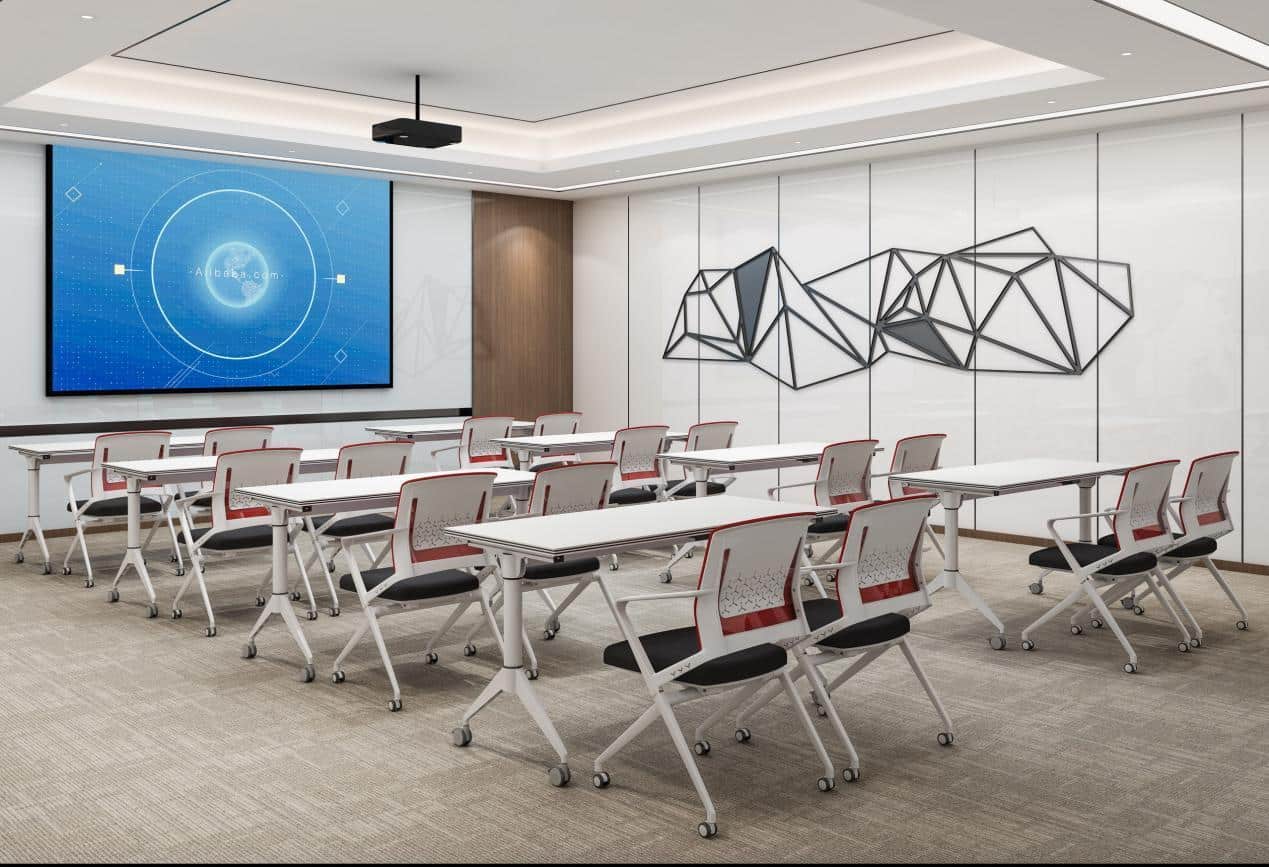
Where standard rectangular tables limit collaboration, the Clarence LS-424S flip-top series offers superior geometric adaptability. It is available in two footprints:
- The LS-424AS Model: A standard version optimized for mainstream training and office settings.
- The LS-424BS Model: A compact version designed for space-constrained areas or intricate layouts, such as trapezoidal or semi-circular clusters. This versatility allows for rapid reconfiguration into hexagonal groups for deep peer discussion or linear rows for independent testing, ensuring the furniture never dictates the curriculum.
3. Support and Comfort
Cognitive resources are finite. When participants experience discomfort due to inadequate lumbar support, the brain instinctively reallocates energy to process these negative physiological signals, creating physical distraction.
High-quality ergonomic support maintains the natural curvature of the spine, decreasing muscle fatigue and allowing learners to sustain focus without the cognitive interference of physical strain.
4. Connectivity
In the era of digital learning, accessible power and connectivity have evolved into foundational requirements.
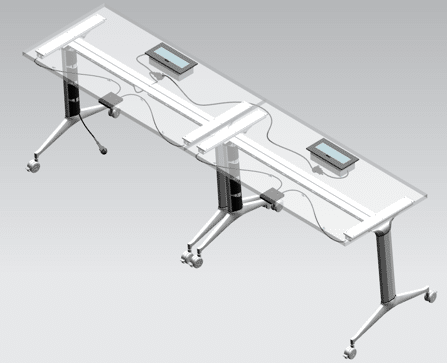
In this regard, Leadcom demonstrates exceptional customization capabilities, with training room tables crafted to accommodate integrated cable management and versatile power configurations.
By embedding charging ports and data interfaces directly into the workstation, learners can avoid the clutter of tangled cables, ensuring the “learning flow” remains unbroken throughout the training cycle.
Scenario Comparison
- Scenario A: A classroom with fixed, forward-facing long benches. In this setting, the instructor is the sole source of information, and peer interaction is physically obstructed.
- Scenario B: Replaces fixed furniture with modular, movable pieces. Whiteboard-topped tables allow learners to write down ideas. Casters enable quick reconfiguration from a lecture setup to small-group clusters.
In this environment, participants stood, wrote on table surfaces, and discussed points with neighbors.
Post-session tests indicated that flexible spatial arrangements increased classroom interaction rates by more than thirty percent compared to fixed layouts. Additionally, learners in Scenario B showed better recall of information presented in the second half of the session.
Conclusion
It is clear that the furniture within a training or educational space is not merely a background utility; it is a critical instrument of instruction. The training room layout functions as a silent curriculum that either facilitates or hinders the brain’s natural learning processes.
For educational institutions and training centers looking to improve student outcomes, the recommendation is to move away from rigid, fixed-row seating. Instead, priority should be given to modular, high-extension furniture like Leadcom products that support a variety of configurations.
Contact Leadcom’s space-planning experts today for a complimentary 2D/3D layout consultation tailored to your specific training objectives.
Reference
- Available at: https://doi.org/10.1371/journal.pone.0156530
- Available at: https://doi.org/10.1371/journal.pone.0156530