

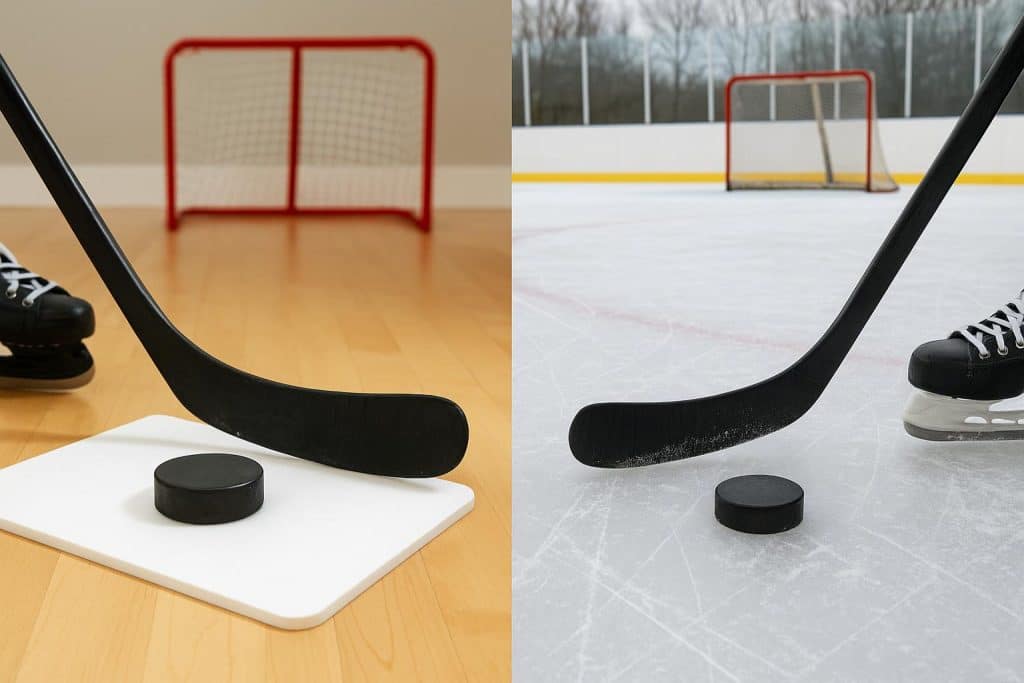
Every hockey player and parent faces the fundamental question of where to allocate practice time and resources. Ice time is expensive, often costing $200 to $400 per hour to rent, and is limited in availability, with early morning or late night slots being the only options in many areas. Home practice using dryland training requires no rental fees and offers unlimited access, but players can’t replicate actual skating while shooting or stick handling on garage floors.
The debate between ice versus home practice creates a false dichotomy. The reality is that optimal skill development requires both, with each environment offering distinct advantages that complement rather than replace each other. Understanding what skills develop best in each setting allows players to maximize improvement while managing time and budget constraints effectively.
Strategic allocation of practice between ice and home, using appropriate hockey practice equipment for off-ice training, provides comprehensive development that exceeds what either environment alone could achieve. The key is knowing which skills benefit most from ice practice versus which develop equally or better through home training.
Skills That Require Ice
Certain hockey skills simply cannot be practiced effectively off-ice effectively because they fundamentally depend on skating or ice-specific conditions.
Edge Work and Skating Mechanics
Skating technique, agility, edges, crossovers, and transitions all require actual ice. No dryland training replicates the glide, edge control, or balance challenges of skating on ice.
Even with synthetic ice or slide boards, the physics differ enough that actual ice skating remains irreplaceable for developing proper skating mechanics and power.
Players need regular ice time specifically dedicated to skating practice to develop and maintain proper technique and efficiency.
Full-Speed Game Situations
Practicing plays at game speed, reading defensive coverage while skating, and executing skills under time pressure and physical contact all require ice and preferably organized practice or scrimmages with other players.
The decision-making, timing, and execution under game-realistic conditions cannot be simulated at home. This game-situation practice is where skills learned elsewhere get integrated into actual play.
Goaltending
Goalies require ice for nearly all position-specific practice. While some dryland training helps with flexibility, reaction time, and strength, actual goaltending practice requires ice and shooters.
The angles, speeds, and movements involved in stopping pucks on ice cannot be adequately simulated off-ice.
Skills That Develop Well at Home
Many fundamental hockey skills develop equally well or even better through home practice compared to ice practice, particularly for younger or developing players.
Stick Handling
Stick handling mechanics, hand speed, puck control, and coordination develop excellently off-ice. Using shooting pads, synthetic ice tiles, or even smooth concrete allows thousands of repetitions that build muscle memory and control.
Players can practice stick handling daily at home, accumulating far more total touches than would ever be possible during limited ice time. This volume of practice dramatically accelerates stick handling development.
The lack of skating during dryland stick handling isn’t a disadvantage for pure stick handling development. Once players master control in stationary positions, adding skating on ice becomes relatively easy.
Shooting
Shooting mechanics, release speed, accuracy, and power can all be practiced effectively at home with proper equipment. Shooting tarps, nets, and appropriate floor surfaces allows extensive shooting practice.
The shooting motion itself is identical whether on ice or synthetic surfaces. Players can work on wrist shot release, snap shot technique, and slap shot mechanics without ice access.
Some argue that shooting while skating adds complexity, which is true, but developing optimal shooting mechanics first in controlled dryland environments often accelerates overall shooting development more than practicing poor mechanics while skating on ice.
Passing and Receiving
With passing aids, training partners, or even walls, passing practice happens effectively at home. The hand-eye coordination, stick positioning, and weight transfer involved in passing directly to on-ice performance.
Receiving passes, developing soft hands, and practicing one-touch passes all work well in dryland settings. The puck movement mechanics are essentially identical whether on ice or quality synthetic surfaces.
Strength and Conditioning
Off-ice training for strength, explosive power, endurance, and flexibility cannot happen effectively on ice. These physical foundation elements require dedicated dryland training using weights, plyometrics, conditioning exercises, and stretching routines.
Players who neglect off-ice conditioning in favor of spending all available time on ice often plateau physically, while peers who balance ice and strength training continue progressing.
Stickhandling Under Obstacles
Complex stick handling drills using cones, obstacles, or puck handling aids actually work better at home, where players can set up elaborate courses and practice repeatedly without time pressure.
Ice time is too valuable to spend on stationary technical drills that could be done at home, especially in team practices where ice time must be shared.
The Cost-Benefit Analysis
Ice time costs approximately $20 to $40 per player per hour when renting private ice, even more for private lessons. For that same cost, families can purchase significant quantities of quality home practice equipment that provides unlimited use for years.
A shooting tarp, shooting pad, passing aids, and stick handling equipment total a few hundred dollars but offer thousands of hours of practice time. Amortized over multiple years and potentially multiple children, the per-hour cost becomes pennies.
This isn’t to suggest avoiding ice entirely; ice remains essential. But the financial reality means that maximizing home practice allows players to maintain more total practice volume than if relying exclusively on expensive ice time.
Time Efficiency and Access
Home practice offers unmatched convenience. Ten minutes of stick handling before school, twenty minutes of shooting after homework, or spontaneous practice whenever motivation strikes, all contribute to skill development.
Ice time requires scheduling weeks in advance, driving to rinks at inconvenient hours, and committing to full-hour blocks regardless of energy or focus levels that day. This logistical overhead reduces total practice time compared to home training, requiring only walking to the garage.
Players can accumulate five to ten hours weekly of quality home practice with less disruption than scheduling two hours of ice time.
Developmental Stages and Balance
The appropriate balance between ice and home practice varies by age and skill level.
Youth Players (Under 12)
Younger players benefit tremendously from extensive home practice focused on fundamental stick handling, shooting mechanics, and basic passing. These foundational skills develop efficiently through high-repetition dryland training.
Ice time for this age group should emphasize skating development and game-situation experience rather than skills that could be practiced at home. This allocation maximizes the unique benefits of ice while allowing skill fundamentals to develop through accessible home practice.
Competitive Teen Players
Teenage competitive players need substantial ice time for game-situation practice, team systems, and integrating skills at speed. However, maintaining and refining technical skills still benefits from regular home practice.
The balance might shift toward more ice time, perhaps three to four ice sessions weekly supplemented by several home practice sessions focusing on skill maintenance and physical conditioning.
Adult Recreational Players
Adult players with limited ice access due to work and family commitments benefit enormously from establishing home practice routines that maintain skills between infrequent ice times.
Regular home stick handling and shooting practice prevents skill decay during long gaps between games or ice sessions, allowing adults to maintain competency despite limited ice access.
Creating Effective Home Practice Routines
Random casual home practice provides some benefit, but structured routines optimize development. Fifteen focused minutes of progressive stick handling drills beat thirty minutes of mindless puck handling while watching TV.
Set specific goals for each practice session, such as mastering a particular stick handling move, improving shooting accuracy to specific targets, or completing a certain number of passing repetitions.
Track progress through video recording, accuracy statistics, or personal performance notes. Measurable improvement motivates continued practice.
Integration Between Environments
The most effective approach views ice and home practice as complementary rather than competing. Skills learned at home get tested and refined on ice. Weaknesses identified during ice practice get addressed through focused home training.
For example, a player might notice during games that they struggle receiving hard passes. They can practice soft hands and pass reception extensively at home, then test improvement during subsequent ice times. This feedback loop between environments accelerates development.
The Mental Game
Home practice offers a pressure-free environment for experimentation and skill acquisition. Players can attempt difficult moves repeatedly without embarrassment, make mistakes freely, and develop confidence before attempting skills in game situations.
This psychological safety accelerates learning compared to only practicing on ice, where teammates and coaches observe, creating performance pressure that inhibits experimentation.
Equipment Investment Strategy
Rather than viewing home practice equipment as an expense, consider it an investment that dramatically increases total practice hours available. Even modest equipment purchases multiply practice opportunities exponentially.
Starting with basics like a shooting pad and stick handling ball provides immediate practice value, with equipment additions over time as budget allows.
Quality equipment from Give-N-Go Hockey, designed for serious training, withstands thousands of hours of use, making the cost-per-use negligible over the equipment’s lifetime.
The Complete Development Picture
Neither ice nor home practice alone provides complete development. Elite players universally combine substantial ice time with extensive dryland training. They understand that while ice time is irreplaceable for certain skills, home practice allows the volume and repetition necessary for mastering technical fundamentals.
The question isn’t whether ice or home practice is better, but rather how to strategically allocate practice time between environments to maximize development while respecting budget and time constraints. Players who embrace both, using each environment for its distinct strengths, develop more completely and efficiently than those who rely exclusively on either ice or home practice alone.