

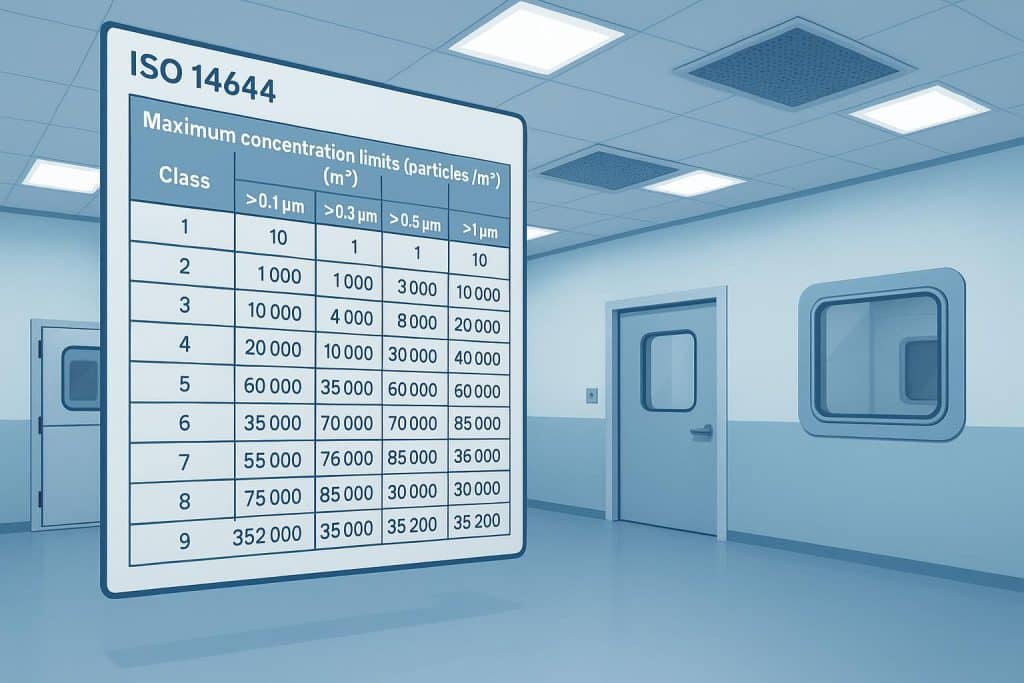
When companies plan a cleanroom, one of the first terms they usually encounter is ISO classification. Buyers may ask for an ISO 8, ISO 7, ISO 6, or ISO 5 cleanroom because these classes provide a clear particle-count target. But an iso 14644 cleanroom is not designed by classification alone. The classification tells you the cleanliness level to achieve; it does not tell you how the room should function during real production.
This distinction matters. A cleanroom can pass a particle test under controlled conditions but still be difficult to operate if airflow, pressure, layout, materials, and maintenance access were not planned properly. ISO 14644 gives the project a measurable standard, but engineering decisions determine whether the cleanroom can maintain performance in daily use.
The first question should always be about the process. What product is being handled? How sensitive is it to airborne particles? Does the process generate dust, heat, vapor, or static? How many people will work inside the room? Will the cleanroom be tested at rest, during operation, or both? Two cleanrooms with the same ISO class can require very different designs depending on these answers.
Airflow strategy is one of the most important design choices. Some rooms use centralized HVAC with terminal HEPA filtration. Others use ceiling-mounted FFUs to provide modular clean-air coverage. In electronics, precision assembly, medical devices, laboratories, and local high-cleanliness zones, FFU systems can help create flexible clean-air patterns where they are needed most.
Filter selection is also important. HEPA filters are widely used in cleanrooms, while an ulpa filter may be selected for applications requiring more demanding particle control. However, filter grade should not be viewed in isolation. A high-performance filter can still underperform if the frame leaks, the ceiling grid is poorly sealed, or the return air path creates turbulence around sensitive work areas.
This is especially relevant in higher-grade clean zones. When a room requires stricter particle control, the clean air must be delivered consistently and removed properly. If airflow creates dead zones or recirculates contamination near the work surface, the cleanroom may struggle during operational testing. Good design considers supply air, return air, equipment placement, operator movement, and process-generated particles together.
Pressure control also plays an important role. Cleanrooms often maintain pressure differences between adjacent spaces to prevent unwanted contamination movement. But pressure stability can be disrupted by frequent door opening, poor sealing, unbalanced airflow, or unsuitable transfer equipment. An ISO class target does not replace the need for a proper pressure-control strategy.
Materials and enclosure systems are equally important. Wall panels, ceilings, windows, doors, lighting, and flooring should be cleanable, durable, and compatible with the intended cleanliness level. If the cleanroom envelope sheds particles, traps dust, or becomes difficult to maintain, the air filtration system will need to work harder and performance may decline over time.
Maintenance access should also be planned early. Filters need inspection and replacement. Airflow may require balancing. Sensors, lights, seals, and doors need periodic checks. A cleanroom that is difficult to service can lose performance gradually, even if it was well tested at the beginning.
For many buyers, the best way to think about an ISO 14644 cleanroom is this: the classification defines the destination, while the design defines the route. ISO class gives a measurable target, but real performance comes from airflow, filtration, pressure, materials, layout, operation, and testing working together.
A successful cleanroom project does not simply “meet ISO class” once. It should be able to support production repeatedly, withstand routine operation, and remain practical to maintain. That is the difference between a cleanroom that passes a report and a cleanroom that performs as a reliable manufacturing environment.