

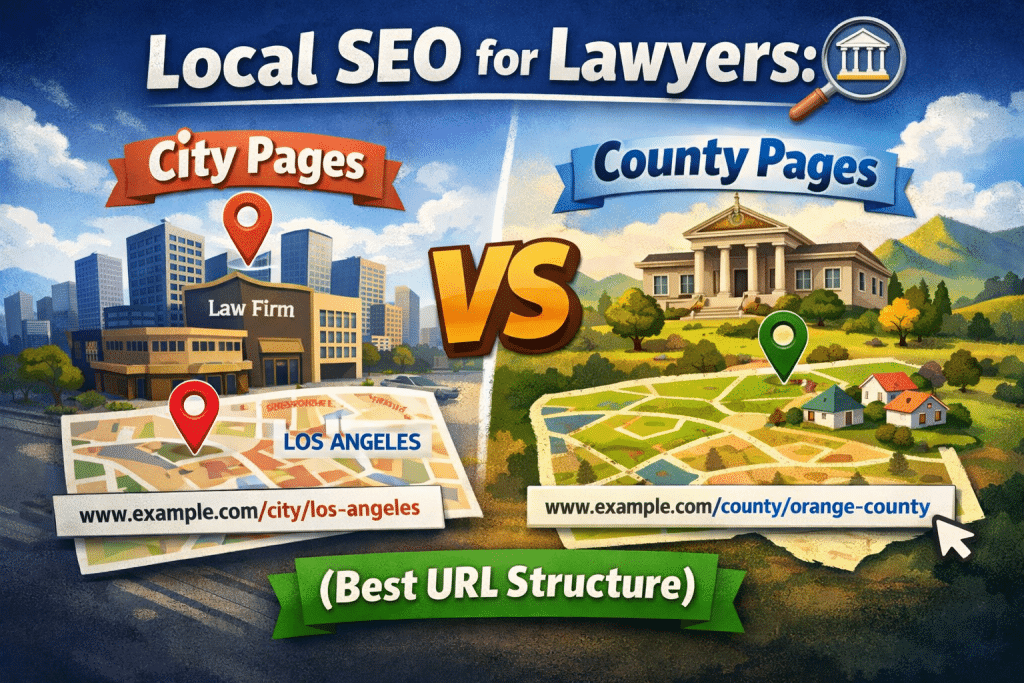
When potential clients search for legal help, they almost always include a location in their query. Whether someone needs a DUI consultation in Maryland or estate planning assistance in Glen Burnie, geographic targeting determines which law firms appear in search results.
Understanding how to structure your website’s location pages can mean the difference between dominating local search and being invisible to the clients who need you most.
This guide breaks down the strategic differences between city pages and county pages, and provides the URL structures that help law firms capture more local traffic.
Why Local SEO Matters More Than Ever for Law Firms
Local search has become the primary way clients find attorneys. The data is clear: firms that optimize for geographic searches consistently outperform those relying on broad keyword targeting alone.
Local SEO Statistics for Law Firms (2024 to 2025)
| Metric | Percentage |
| Google searches with local intent | 46% |
| Users who only click the top 3 local pack results | 75% |
| Local searches leading to a call or visit within 24 hours | 76% |
| Law firms say SEO brings the highest ROI | 65% |
| Firms with optimized Google Business Profiles getting more clicks | 70% |
| Mobile searches that are location-based | 30% |
With nearly half of all Google searches seeking local results, law firms cannot afford to ignore geographic optimization. The question is not whether to create location pages, but how to structure them effectively.
City Pages vs County Pages: Understanding the Difference
Before diving into URL structure, it is essential to understand when each type of location page makes sense for your practice.
City Pages
City pages target specific municipalities where you practice law. They work best when your potential clients search using city names, which is the most common search pattern for legal services.
Example searches city pages capture:
- “Personal injury lawyer Austin”
- “Divorce attorney Denver”
- “Criminal defense lawyer Miami”
County Pages
County pages target broader geographic regions and work well when your practice area covers multiple cities within a county, or when clients commonly search using county names.
Example searches county pages capture:
- “DUI attorney Orange County”
- “Family law lawyer Cook County”
- “Estate planning Maricopa County”
When to Use Each Page Type
| Scenario | Recommended Approach |
| Major metropolitan area | City pages for primary cities |
| Suburban practice serving multiple small towns | County page with city mentions |
| Rural area with low city search volume | County pages as primary focus |
| Multi-office firm | City page for each office location |
| Service area without a physical office | Service area pages targeting cities and counties |
The best strategy often combines both approaches, creating city pages for high-volume locations and county pages for broader regional coverage.
URL Structure Options: Which Performs Best?
URL structure directly impacts how search engines understand your geographic targeting. Research shows that pages with short, concise slugs rank slightly higher across millions of search results.
Common URL Structure Patterns
| Structure Type | Example URL | Best Use Case |
| Flat with location and service | /dui-lawyer-chicago | Single-location firms |
| Location subfolder | /chicago/dui-lawyer | Multi-location practices |
| Service subfolder | /dui-lawyer/chicago | Practice area-focused sites |
| Locations hub | /locations/chicago | Large multi-office firms |
According to SEO best practices, URLs should use 3 to 5 meaningful words and stay under 60 characters when possible. Google recommends using hyphens to separate words, not underscores, and avoiding unnecessary parameters or special characters.
Recommended URL Structures for Law Firms
Based on current SEO data and law firm marketing research, here are the optimal URL structures for different firm types.
Single Location Firm
For firms with one office, a flat structure works best:
- /practice-area-city (Example: /criminal-defense-lawyer-dallas)
- /city-practice-area (Example: /dallas-criminal-defense-lawyer)
Both formats perform similarly. Choose one and maintain consistency across your site.
Multi-Location Firm
For firms with multiple offices, a hierarchical structure provides better organization:
- /locations/city-name/practice-area
- Example: /locations/austin/personal-injury-lawyer
This structure allows you to create location hub pages that link to all city-specific service pages, improving site architecture and user navigation.
Service Area Pages (No Physical Office)
When targeting areas where you practice but do not have an office:
- /service-areas/city-name
- Example: /service-areas/plano-tx
Mark Scheuerman of Scheuerman Law notes: “Service area pages must contain unique, substantive content about the specific location. Simply swapping city names on template content will hurt your rankings due to duplicate content penalties.”
City Page Best Practices
Creating effective city pages requires more than adding a location to your existing content. Each page needs unique elements that demonstrate genuine local relevance.
Essential Elements for City Pages
| Element | Purpose | SEO Impact |
| Local court information | Demonstrates jurisdiction knowledge | High |
| City-specific statistics | Adds unique content | Medium |
| Embedded Google Map | Confirms location targeting | Medium |
| Local schema markup | Helps search engines understand geography | High |
| Area-specific testimonials | Builds local credibility | Medium |
| Nearby landmark references | Reinforces geographic relevance | Low to Medium |
Content Requirements
Each city page should contain at least 500 words of unique content. Include information such as:
- Specific courts where you practice in that city
- Local legal procedures unique to the jurisdiction
- Statistics relevant to your practice area in that location
- Directions from major landmarks or highways
- Information about parking or public transit options
County Page Best Practices
County pages serve a different strategic purpose and require a different content approach than city pages.
When County Pages Outperform City Pages
| Situation | Why County Pages Work Better |
| Practice areas with regional courts | Clients search by county where the court is located |
| Areas with many small municipalities | Individual city search volume too low |
| Immigration and federal practice | Jurisdiction often county-based |
| Real estate and probate law | County recorder and court systems |
County Page Content Strategy
Effective county pages should:
- List all cities and communities served within the county
- Reference county court systems and procedures
- Include county-specific legal statistics
- Mention multiple neighborhoods to capture long tail searches
- Link to individual city pages where search volume warrants them
Technical SEO Considerations
Proper technical implementation ensures search engines correctly interpret your location targeting.
Schema Markup for Location Pages
Implement the LocalBusiness schema on every location page. Include:
- Complete business name
- Full street address
- Phone number
- Business hours
- Geographic coordinates
- Service area definitions
Law practices with comprehensive schema markup see improved visibility in local search results and richer snippets in search engine results pages.
Internal Linking Structure
| Page Type | Should Link To |
| Homepage | Main location pages |
| Location hub | All city and county pages |
| City pages | Related practice area pages, nearby city pages |
| County pages | All city pages within the county |
| Practice area pages | Relevant location pages |
Strong internal linking helps distribute page authority and helps search engines understand the relationship between your location and service pages.
Measuring Location Page Performance
Track these metrics to evaluate whether your location pages are working:
Key Performance Indicators
| Metric | Target | Tool |
| Local pack appearances | Top 3 positions | Local Falcon or BrightLocal |
| Organic traffic by location | Month-over-month growth | Google Analytics |
| Phone calls from location pages | Increasing trend | Call tracking software |
| Form submissions by city | Conversion rate above 3% | CRM or Analytics |
| Local keyword rankings | First page positions | SEMrush or Ahrefs |
According to industry data, law firms that invest in targeted local SEO see ROI ranging from 468% to 642% over three years, depending on practice area. The investment in properly structured location pages pays dividends through sustained organic traffic growth.
Common Mistakes to Avoid
Many law firms undermine their local SEO efforts with these errors:
Duplicate Content Across Location Pages
Creating multiple city pages with identical content except for the city name triggers duplicate content penalties. Each page needs substantive, unique content.
Ignoring Mobile Optimization
With 60% of searches happening on mobile devices and 30% of mobile searches being location-based, location pages must load quickly and display properly on smartphones.
Inconsistent NAP Information
Your name, address, and phone number must be identical across your website, Google Business Profile, and all directory listings. Even minor variations like “Street” versus “St.” can confuse search algorithms.
Targeting Too Many Locations
Spreading efforts across dozens of location pages dilutes your authority. Focus on your primary service areas first, then expand strategically.
Final Thoughts
The choice between city pages and county pages depends on your practice area, geographic footprint, and how your potential clients search for legal services. Most successful law firms use a combination of both, with city pages targeting high-volume urban searches and county pages capturing broader regional queries.
Your URL structure should be clean, consistent, and include relevant geographic and practice area keywords. Whether you choose a flat structure or hierarchical subfolder approach, maintain that pattern across your entire site.
The firms that dominate local search are those that treat location pages as strategic assets, not afterthoughts. Invest in unique, valuable content for each location you target, implement proper technical SEO, and track your results to continuously improve performance.