

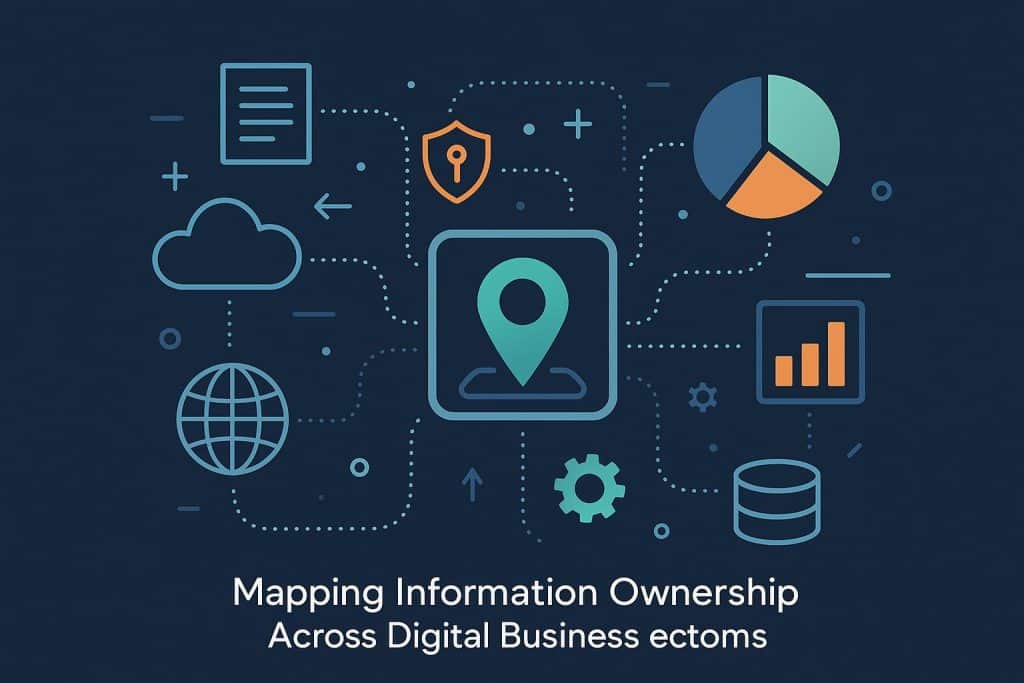
Understanding who owns information when companies collaborate across platforms and supply chains is essential for competitive advantage, regulatory compliance, and trust. Information ownership is less a legal fact and more a negotiated arrangement shaped by contracts, technology, market forces, and social expectations. Mapping ownership requires tracing the lifecycle of data from point of capture through enrichment, transformation, use, and eventual deletion or archiving. Stakeholders often assume ownership based on possession, but possession diverges from entitlement: a cloud provider may physically hold sensor readings while the device manufacturer retains the rights to analyze and monetize them.
Actors and Motivations
Participants in a business ecosystem include producers, aggregators, processors, platform operators, customers, and intermediaries. Each actor brings distinct motivations. Producers want attribution and revenue; aggregators seek scale and insights; processors care about compliance and auditability; platforms focus on network effects. Customers demand transparency and control over how their personal information is used. Mapping information ownership across these groups requires identifying who contributes what data, what transformations occur, and who benefits economically or operationally. Governance patterns shift when data moves from one context to another: telemetry that is anonymized for analytics may later become reidentified when combined with other sources, creating new ownership questions.
Legal and Contractual Tools
Contracts, service terms, and intellectual property law are primary mechanisms for allocating rights. Licensing agreements define permitted uses, while data processing addendums specify responsibilities for handling sensitive records. Emerging regulatory regimes introduce obligations that alter customary ownership claims, especially where individuals have enforceable rights over their data. Creating a clear mapping involves cataloguing contractual clauses alongside operational practices so that legal intent matches technical reality. In many ecosystems, layered contracts create ambiguity: a downstream analysis may aggregate inputs from multiple upstream vendors, each with different restrictions. Negotiating clear downstream rights, specifying audit windows, and embedding termination clauses help to resolve disputes before they begin.
Technical Approaches to Provenance
Technical metadata and provenance frameworks make ownership visible and verifiable. Embedding provenance records that capture origin, transformations, and custodial handoffs creates an auditable trail. Schema-driven metadata tied to persistent identifiers can assert lineage and responsibilities. Cryptographic techniques such as digital signatures and hash chains validate that a dataset at step N corresponds to a particular upstream snapshot. Distributed ledger technology offers one approach to immutably record provenance and consent, though it is not a panacea; performance, privacy, and governance of the ledger itself must be considered. Effective mapping combines lightweight, interoperable metadata with selective cryptography so that everyday workflows are not encumbered.
Operational Controls and Identity
Identity management is central to mapping ownership because rights attach to identities. Robust identity and access management systems enforce entitlements and log decision points. Attribute-based access controls allow permissions to follow the semantics of ownership rather than rigid roles. When identities are federated across organizations, agreement on attribute schemas, trust anchors, and revocation mechanisms is required. Operational processes such as data tagging, role certification, and periodic entitlement reviews prevent scope creep where access accumulates over time without renewal. Mapping ownership must therefore include operational checklists that align identity sources, access policies, and stewardship responsibilities.
Economic Models and Incentives
Ownership maps are not purely legal or technical artifacts; they embody economic incentives. Data monetization models influence how stakeholders claim and defend ownership. Where value accrues through aggregation, incentives favor open sharing under revenue-sharing arrangements or royalties. Other situations encourage exclusivity to protect differentiation. Designing economic incentives that align with cooperative goals reduces the need for adversarial enforcement. Marketplaces and brokered exchanges can mediate transfers of usage rights, while escrow and arbitration mechanisms provide dispute resolution. When ownership remains ambiguous, frictions increase and innovation slows; clarity unlocks collaboration and investment.
Roadmap for Organizations
Organizations undertaking a mapping effort should start with a discovery phase that inventories datasets, interfaces, and contracts. Next, build lineage maps that visualize flows and transformations. Parallel to this, adopt metadata standards and lightweight provenance records to make assertions machine-readable. Harmonize contractual terms to reduce downstream ambiguity, and pick identity patterns that scale across partners. Consider pilot projects that use cryptographic provenance or ledger records to test immutability and auditability. Finally, align incentives through revenue models, licensing terms, and shared governance forums so that stakeholders see clear returns from cooperation.
Policy and Collaboration
Policy coordination and collaborative bodies help translate technical maps into enforceable practices. Establishing sector-wide principles, shared glossaries, and dispute resolution pathways reduces friction between partners. A joint stewardship council that oversees metadata standards and consent models provides transparency and accountability, while documented operational playbooks turn high-level statements into runnable processes. Embedding data governance into contracts and tooling ensures that policy is executable rather than aspirational, and it gives auditors concrete checkpoints to assess compliance.
Building Trust at Scale
Trust is the ultimate outcome of effective information ownership mapping. When participants can trace origin, verify entitlements, and enforce limits, ecosystems expand and new business models become feasible. The mapping exercise is ongoing: as relationships change, regulations evolve, and technologies advance, ownership diagrams must be maintained. Invest in people who understand legal nuance, technical implementation, and economic consequence. With a disciplined approach that blends contracts, metadata, identity, and incentives, organizations can shape information flows into predictable, auditable channels that support collaboration and responsible innovation. Practitioners who prioritize this work create resilient ecosystems where data becomes a shared asset rather than a contested resource.