

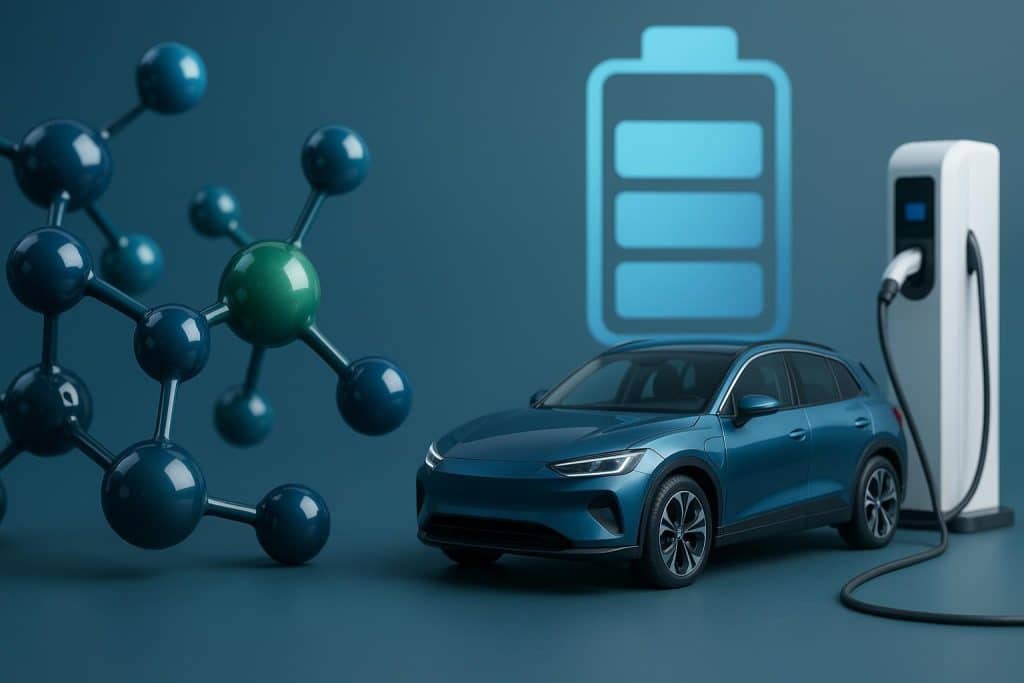
When we talk about new energy vehicles (NEVs), the focus often lands on driving range, smart driving capabilities, or charging speed. However, behind these leaps in performance lies a quiet yet profound materials revolution. From the energy-dense heart of the power battery to the lightweight skeleton of the vehicle body, novel chemical materials have quietly become the three key pillars supporting NEV performance breakthroughs, cost optimization, and green development.
Panoramic View of the Supply Chain
The materials system for NEVs spans a long and intricate supply chain:
- Downstream – Vehicle Manufacturing: Directly relies on lightweight materials for energy efficiency gains.
- Midstream – Components & Materials: The core lies in the “Three Electric” systems – the battery, electric motor, and electronic control. Here, the battery supply chain is the most complex. From the microscopic cell components (cathode, anode, separator, electrolyte) to the intelligent Battery Management System (BMS), and up to the integrated battery pack, each step hinges on material innovation.
- Upstream – Mineral Resources: 23 critical resources like chromium, aluminum, lithium, cobalt, and nickel form the physical foundation for everything.
It can be said that key materials are like the lifeblood, permeating and nourishing every link of this chain.
Power Battery Materials
The power battery is a core component of NEVs, primarily including types like lithium-ion batteries, solid-state batteries, and hydrogen fuel cells. Among these, lithium batteries dominate the market due to advantages like high energy density and long cycle life. In their cost structure, the four key materials – cathode, anode, electrolyte, and separator – each account for roughly a quarter, making them the central battleground for technical advancement.
Current mainstream lithium battery technologies present a diverse landscape:
- NMC (Nickel Manganese Cobalt Oxide) Batteries: The cathode material is lithium nickel manganese cobalt oxide. Adjusting the ratios of nickel, cobalt, and manganese balances energy density, stability, and safety. Higher nickel boosts range, higher cobalt aids structural stability, and manganese enhances safety. The anode primarily uses graphite.
- LFP (Lithium Iron Phosphate) Batteries: The cathode uses lithium iron phosphate, offering structural stability, high safety, and lower cost, also paired with a graphite anode.
- LCO (Lithium Cobalt Oxide) Batteries: The cathode is lithium cobalt oxide, offering high energy density but at higher cost and relatively weaker safety. The anode often uses soft carbon or hard carbon.
- LMO (Lithium Manganese Oxide) Batteries: The cathode is lithium manganese oxide, providing low cost, good safety, and environmental friendliness, but with lower energy density. The anode is mainly graphite.
Lightweight Materials Technology
Lightweight materials technology is a crucial breakthrough point for NEV R&D and innovation.
-
Low-Density Material Application:
- Path One: Optimize traditional materials, e.g., reducing talc content in polypropylene to lower density while maintaining performance.
- Path Two: Bold material substitution. For instance, using PP-LGF40 (long glass fiber reinforced polypropylene) to replace metal for front-end modules not only achieves significant weight reduction but also improves integration and precision, already adopted in several vehicle models.
- Thin-Walling Technology:
Achieved by increasing material flexural modulus and flowability to reduce part wall thickness. For example, reducing bumper wall thickness from 3.0 mm to 2.5 mm can cut weight by approximately 16.7%. - Microcellular Foam Materials:
Creating a microcellular structure during the injection molding process to save material and reduce weight. This technology is already applied in components like instrument panels and door trim panels, achieving weight reductions of 16% to 40% in some vehicle models. -
Plastic Replacing Steel:
Using high-strength engineering plastics to replace metals is a major direction for lightweighting. Key materials include:- Short Glass Fiber Reinforced Nylon: Used for mirror brackets, storage bin brackets, etc.
- Long Glass Fiber Reinforced Nylon: Used for instrument panel beams, seat frames, offering good impact resistance and anti-creep properties.
- Long Glass Fiber Reinforced Polypropylene: Applied in front-end modules, door modules, tailgate inner panels, etc., improving integration while reducing weight.
- PPE+PA Blends: Combine heat resistance, dimensional stability, and processing flowability, already used in components like plastic fenders, achieving 40%-50% weight reduction compared to steel.
The development of new energy vehicles is inextricably linked to the continuous advancement of materials technology. Innovation in power battery materials directly impacts vehicle range and safety, while the application of lightweight materials significantly boosts energy efficiency and the driving experience. Looking ahead, with further progress in materials science, new energy vehicles will achieve even greater breakthroughs in performance, cost, and sustainability.