

The AI video industry is changing fast. Recently, OpenAI made a major decision:
it officially shut down the Sora app and its related services.
For many creators, this marks an important turning point.
Sora was once seen as one of the most advanced AI video tools, capable of turning text into realistic video clips. But now, its closure raises a key question:
What comes next for AI video creators?
Why OpenAI Closed Sora
OpenAI’s decision was not sudden, but part of a larger strategy shift.
Reports show that the company is moving its focus toward core AI products and long-term research, such as robotics and large-scale AI systems.
There were also several challenges:
- High computing costs for video generation
- Copyright and content moderation concerns
- Increasing competition from other AI companies
- Difficulty scaling the product for long-term use
Sora gained attention quickly after launch, but maintaining it proved difficult.
What This Means for Creators
For AI video creators, this change highlights a key reality:
Relying on a single platform is risky.
Many creators built workflows around Sora. Now, they need alternatives that are:
- More flexible
- Continuously updated
- Not dependent on one model
The industry is shifting from “one powerful tool” to “multiple tools working together.”
The Rise of Multi-Model AI Video Platforms
As Sora exits, a new type of platform is becoming more important.
Instead of offering just one model, these platforms integrate multiple AI video models in one place. This gives creators more options and control.
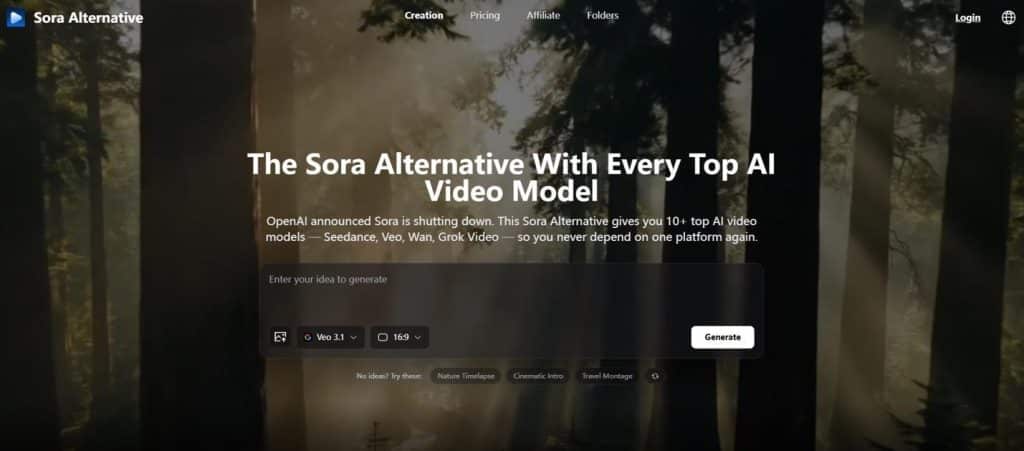
One example is
Sora Alternative
This type of platform allows users to access models such as:
- Seedance 2.0
- Veo 3.1
- Wan 2.5
- Grok Video
Each model has its own strengths, making it easier to choose the right one for different projects.

Why This New Approach Works
No AI video model is perfect.
Some models are better for cinematic visuals.
Others perform better in motion or speed.
A multi-model platform solves this by letting users:
- Test different outputs
- Compare results
- Select the best version
This creates a more flexible and efficient workflow.
A Bigger Shift in AI Video Creation
The closure of Sora reflects a broader trend in the industry.
AI video creation is moving toward:
- Platform flexibility
- Workflow efficiency
- Model diversity
Instead of asking:
“Which tool is the best?”
Creators are now asking:
“Which model is best for this specific video?”
The Future After Sora
Sora’s shutdown does not mean AI video is slowing down.
In fact, it shows the market is maturing.
Tools are becoming more specialized.
Platforms are becoming more flexible.
And creators now have more choices than ever before.
Final Thoughts
OpenAI closing Sora is a major moment, but it also opens new opportunities.
The future of AI video creation is not about one tool dominating the space.
It is about giving creators the freedom to choose, adapt, and experiment.
In short: Sora may be gone, but AI video creation is entering a more flexible and powerful era.