

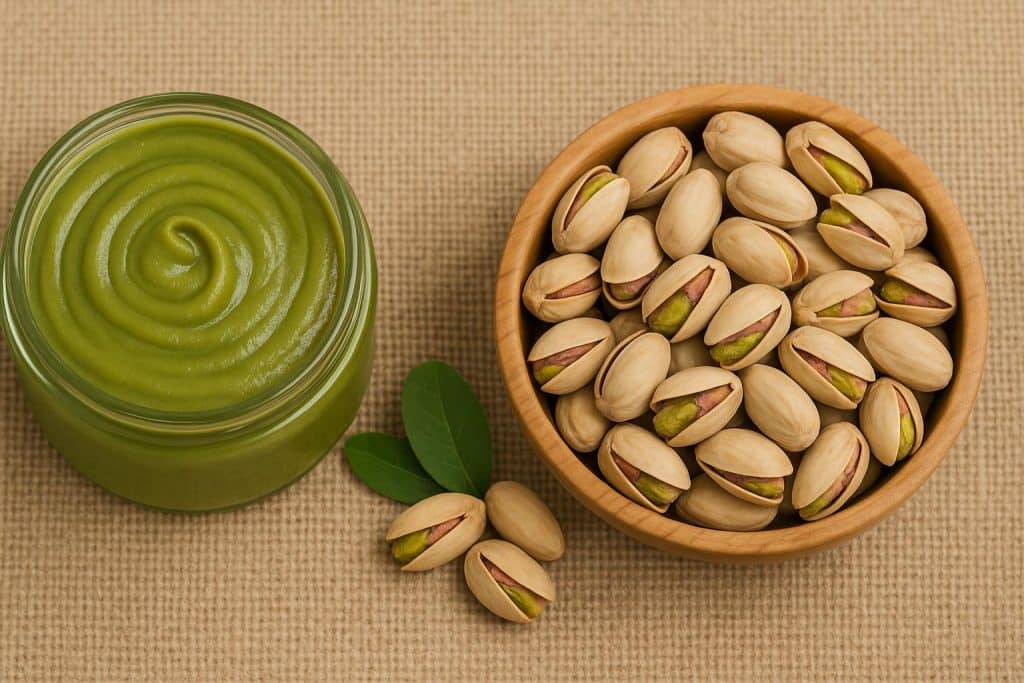
Pistachios have earned a permanent place in food manufacturing. They appear in ice cream, confectionery, bakery products, savoury sauces, and premium snack lines. What has changed in recent years is how manufacturers choose to use them — and the shift toward pistachio paste over whole nuts is accelerating across multiple categories.
The decision between paste and whole pistachios is not purely aesthetic. It touches on nutritional retention, processing efficiency, ingredient consistency, and cost per unit of flavour delivered. Each form has a legitimate role, but they serve different manufacturing needs.
How the two forms compare nutritionally
Whole pistachios and pistachio paste share the same core nutritional profile. Both are rich in monounsaturated fats, protein, fibre, potassium, and antioxidants including lutein and zeaxanthin. The nut itself does not lose its fundamental nutritional value when processed into paste.
What changes is bioavailability. Processing breaks down cell walls, which means the body absorbs nutrients from paste more readily than from whole nuts. For manufacturers developing functional food products or making nutritional claims, this distinction matters and is worth noting in product documentation.
Paste also concentrates the nutritional content by weight. A gram of pistachio paste delivers more active compounds than a gram of whole pistachio when accounting for moisture and shell weight, making it a more efficient vehicle for nutrition-forward formulations.
Industrial advantages of pistachio paste
Whole pistachios introduce variables that are difficult to manage at scale. Size inconsistency, shell fragment risk, and moisture variation all create quality control challenges on high-volume production lines. Paste eliminates most of these issues by standardising the ingredient before it enters the manufacturing process.
Mixing behaviour is one of the clearest differences. Pistachio paste disperses evenly through batters, creams, ganaches, and frozen bases. Whole or chopped pistachios do not. For products where uniform flavour distribution is critical — gelato, praline fillings, pistachio spreads — paste is the only practical choice.
Processing speed is another factor. Paste integrates in a single mixing stage. Whole pistachios often require pre-roasting, chopping, and separate addition steps. Reducing ingredient handling steps lowers labour costs and reduces the risk of contamination or damage to the nut during processing.
Where whole pistachios still lead
Whole pistachios retain a textural and visual function that paste cannot replicate. In products where the nut itself is part of the eating experience — a pistachio-topped baklava, a premium chocolate bar with visible nut pieces, or a garnished dessert — whole or halved pistachios are the correct choice.
Shelf presentation matters in retail. A product that shows a whole green pistachio communicates quality to consumers in a way that a paste-containing product cannot achieve through the nut form alone. For this reason, many manufacturers use both: paste for internal flavouring and whole nuts for surface decoration.
The two forms are not competitors in most production contexts. They solve different problems and are often used together within the same finished product.
The sourcing question for paste specifically
Not all pistachio paste performs the same way industrially. Oil content, grind consistency, roast level, and moisture all affect how paste behaves in a given application. A paste formulated for ice cream will have different specifications than one used in a bakery filling or a savoury sauce base.
Iranian pistachios — particularly Akbari and Fandoghi varieties — are widely used by paste manufacturers supplying the food industry because of their naturally high oil content and strong colour. These characteristics produce a paste that is stable across a wider range of processing temperatures and holds flavour through freezing, baking, and extended storage.
Manufacturers sourcing pistachio paste from Iranian suppliers in 2026 are increasingly prioritising processing transparency and batch documentation over price alone — something that commodity channels rarely offer at the required level of consistency.
Regulatory and labelling considerations
Both whole pistachios and pistachio paste are subject to allergen labelling requirements in most markets. Tree nut declarations are mandatory across the EU, UK, US, and Gulf markets. Paste suppliers operating at an industrial level are expected to provide full allergen documentation, batch traceability records, and certificates of analysis as standard.
Aflatoxin testing is a specific concern with pistachio products and is subject to regulatory limits that vary by destination market. Premium paste suppliers test routinely and provide results with each shipment. This documentation is not optional for manufacturers supplying retail or foodservice channels in regulated markets.
Conclusion
Pistachio paste and whole pistachios serve distinct roles in food manufacturing, and the choice between them depends on application rather than preference. Paste delivers consistency, processing efficiency, and superior flavour distribution at scale. Whole pistachios provide texture and visual appeal that paste cannot replace.
For manufacturers who rely on paste as a core ingredient, supplier quality is the variable that determines everything downstream — from nutritional claims to production line performance to finished product shelf life.