

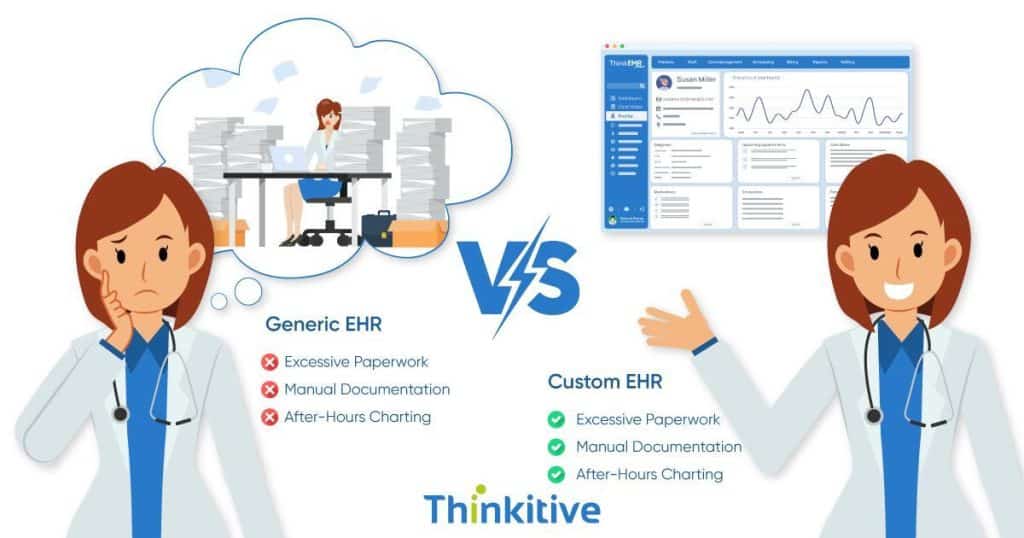
The healthcare industry is under immense pressure, and the additional tasks that have been given to them are making their lives much more difficult, hectic, and at times even frustrating. And the major reason for this additional burden is due to documentation.
To give you an idea, a landmark AMA-related study showed that for every 8 hours that a provider spends on patient consultation, they have to spend five hours on the EHR. Just imagine the clinical time these providers are spending on documentation, which could have been spent on patient care.
This is the reason why most of the providers or healthcare practices are looking for custom EHR software development. And one specific reason why they want to develop a custom EHR software for their practice is documentation.
Furthermore, the inefficiencies of generic EHR systems are more than just one concern. From manual documentation to generic templates and even isolated data. Due to this, workflow bottlenecks are created, slowly leading to burnout and reduced care quality.
But these workflow inefficiencies can still be covered up, overcome, or managed; the problem of documentation is still a growing concern amongst healthcare providers. And in their quest to reduce their burden of documentation and focus on things that actually matter, many healthcare providers are actively looking towards custom EHR software solutions.
On that note, let’s explore the intricacies of custom EHR software and how it can improve clinical documentation efficiency, reduce physician burnout, and improve healthcare workflow automation.
So, without further ado, let’s get started!
Why Standard EHR Systems Increase Documentation Burden
Before we get started, let’s first try to find out the reason behind the problem of documentation that has become a burden for healthcare providers.
Upon investigating a little about the practices that have faced this issue, one common link that can be found amongst all of them is the generic EHR system. Now, the problem with generic EHR systems is that they use a one-size-fits-all template.
Due to this, the specific needs of a practice are simply not met. Furthermore, to make the situation even worse, if you are a specialty practice, then at times these templates simplify and don’t match the needs of your practice.
On top of that, excessive alerts and non-relevant data fields cause cognitive overload. This has made pajama time a norm amongst healthcare providers. For those who don’t know, pajama time is the after-hours providers spend on charting.
In this entire scenario, you can see that providers have to adapt to the workflows and functioning of the software, where, in fact, it should be the other way around.
How Custom EHR Software Reduces Documentation Work
Custom EHR software is nothing but building an EHR software for your needs and requirements. It can be easily aligned with the unique workflows of your practice, and even match the specific needs of your providers.
Here are some ways in which custom EHR helps you in reducing documentation work for your providers:
- Specialty-Specific Workflows: As discussed earlier, you get the liberty to design the templates for your practices or care services you provide. This means you can eliminate the redundant fields, unnecessary fields, and align them with your workflow. This way, your providers can not only use the software effectively but also be able to stay specific to the care delivery.
- AI-Assisted Documentation: With advanced EHR features replacing some of the traditional features in EHR, documentation remains the top use case for these features. AI-powered features like voice recognition, natural language processing, and ambient tools make this work much easier. For instance, with these tools, you don’t have to type and take notes separately. Your smart EHR system will be able to do that for you with accuracy and in real-time.
- Workflow Automation: On top of that, most of the documentation pressure is due to manual data entry. And let’s be honest, most of the time you just fill in one type of data again and again. This takes most of the time, and the way custom EHR solves this for you is with workflow automation. With intake forms, task routing, and follow-ups handled automatically, the data can be synchronized with all the relevant data fields in real-time.
- Integrated Data Flow: Another extended use case of workflow automation can be seen in integrated data flow. You see, with your system being in connection with other disparate healthcare systems like labs, imaging, pharmacies, etc., you completely eliminate manual re-entry, saving you time that you never thought could be saved.
Clinical & Operational Benefits for Providers
You must have learnt about the features and functionalities of a custom EHR software that can help you in reducing physician burnout. But what exactly are the clinical and operational benefits for providers?
Well, let’s exactly see that here below:
- Less After-Hours Charting: One of the major benefits that providers get with a custom EHR is that it reduces after-hours charting or the pajama times that providers spend. This is done due to automation, workflows, data synchronization, etc. This way, you lower the risk of burnout and add more to provider satisfaction.
- More Patient-Facing Time: Due to documentation, many healthcare providers complain about less patient-facing time during consultation. However, with automation, synchronization, and workflow automation, providers can have a patient-facing experience during visits and give patients a delightful experience.
- Consistent Clinical Documentation: With synchronised workflow and dataflow, you can ensure cleaner and more consistent clinical documentation. Meaning, you don’t have to worry about any duplicate or double entry, as data entered will find its way to its required field.
- Faster Billing: Your custom EHR software can act as a centralized repository for your clinical and administrative data. Due to this, your staff gets all the data in time, which will lead to faster billing, accurate claim processing, and by eliminating the factor of errors, you can ensure very few issues related to the claims. This way, you can significantly improve your practice’s financial health and reduce the burden from your billers.
Security, Usability & Trust
The benefits of a custom EHR software are many, and a few practices have effectively implemented it into their practice to reduce the burden from their clinical and administrative documentation. However, some of the core aspects of a custom EHR software that you must consider are security, usability, and trust.
In terms of security, make your EHR software a HIPAA-compliant EHR software. For this, you will need to implement robust access control and make your software audit-ready. Furthermore, it should be built into the system and not as an add-on feature.
And since your software system will be used by different users, you need to implement role-based permissions so that only authorized personnel can access the data that they need. However, one thing to keep in mind during this is that this process should not slow down the daily workflows and ensure consistent performance.
Last but not least, build the interface of your EHR system that is clean, intuitive, and focuses on reducing clicks. This is one of the best ways to elevate the satisfaction levels of your users while using the software.
Conclusion: Give Time Back to Clinicians
Documentation is something that supports the care delivery process and does not make it longer, and takes away focus from it. Furthermore, providers are already under a lot of pressure, and adding the pressure of documentation is making them question their life choices, taking their morale down.
But if you have made it till here, then I hope I have given you a solution that can help you overcome this problem. Give your clinicians the time they rightfully deserve with custom EHR software and let them focus on patient care rather than just computer screens.
On that note, let this blog be the convincing factor to go develop a custom EHR software. And if you want to get started, then get your first free consultation here.
FAQs
- Why does EHR documentation contribute to clinician burnout?
Traditional EHRs rely on rigid, generic workflows that force clinicians to spend excessive time clicking, typing, and navigating screens. This increases cognitive load, extends work into evenings, and shifts focus away from patient care—directly contributing to physician burnout and dissatisfaction.
- How does custom EHR software reduce documentation time?
Custom EHR software aligns documentation with real clinical workflows. It removes unnecessary fields, automates repetitive tasks, and supports specialty-specific templates. By streamlining data entry and reducing clicks, clinicians can document faster and more accurately during patient encounters.
- Can AI tools help reduce after-hours charting?
Yes. AI-powered tools like ambient clinical documentation, smart summarization, and automated coding capture notes in real time. This significantly reduces “pajama time” by completing documentation during visits instead of after clinic hours.
- Is custom EHR software suitable for specialty practices?
Absolutely. Custom EHRs are designed around specialty-specific workflows, terminology, and compliance needs. Whether for cardiology, orthopedics, or behavioral health, tailored documentation improves clinical efficiency while supporting healthcare workflow automation and better patient outcomes.