

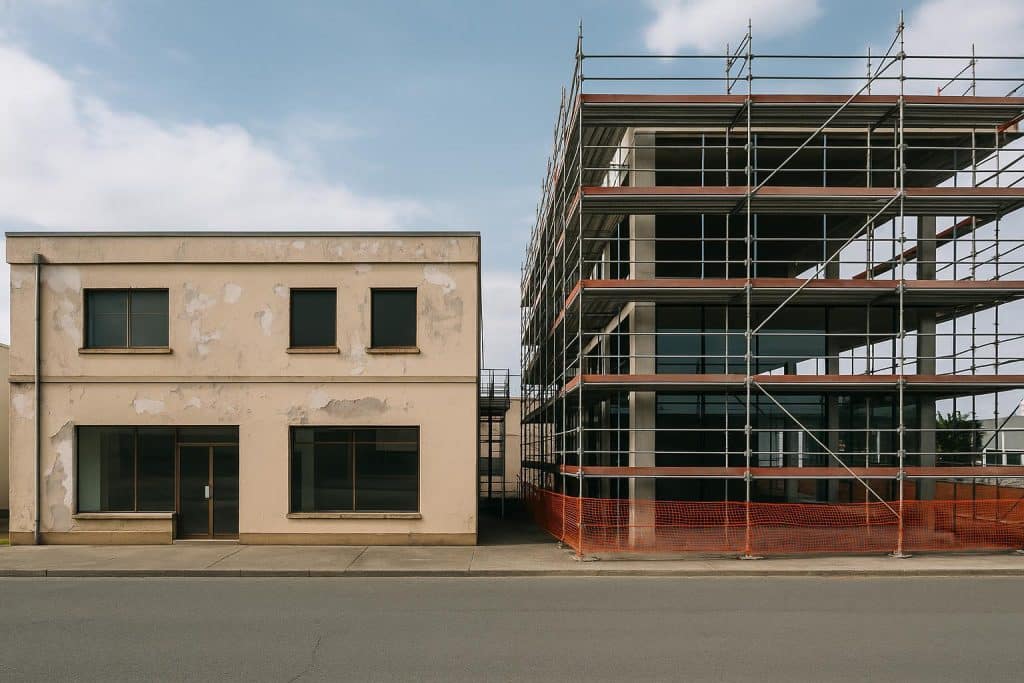
Commercial real estate success depends on investors who make decisions with clarity. Investors face their most important decision when they must choose between renovating existing properties and starting new construction projects. The selection between property renovation and complete reconstruction determines how well investments will perform, how stable operations will remain, and what position the market will assign to the property.
The decision process requires more than physical construction work. The decision protects investment value while building an asset that will succeed over the following decade.
The article outlines key factors that determine whether real estate investments will generate profits or result in financial ruin. The article provides an authentic evaluation of key elements, their relative importance, and proven methods to achieve decision certainty rather than relying on guesswork.
Understanding the Difference: Renovation vs Rebuild
Developers need to use existing buildings as their base for starting renovation work. The renovation process involves three main steps: interior improvements, system maintenance, and exterior restoration work to preserve the building structure. It sounds simple. The renovation process reveals hidden problems that lead to higher construction costs and longer project durations.
The rebuilding process requires owners to dedicate themselves fully. The rebuilding process starts with demolishing existing structures, then constructing new structures, and replacing all building systems. The first investment for this construction approach is the most expensive among all available options. Through rebuilding, owners gain complete freedom to create their space design while achieving peak operational performance and extending the building’s lifespan.
Property owners face confusion because they misunderstand that renovation costs less than rebuilding and that rebuilding projects always take longer than expected. Neither assumption is reliably accurate. The evaluation of each property requires using actual data together with realistic projection techniques.
Structural Integrity and Building Condition
Every decision relies on the fundamental elements that make up a building structure. A building with major structural problems or an an outdated design will cost money without providing stability. The combination of small cracks, uneven flooring, and outdated foundation structures points to major issues that will prolong renovation work indefinitely.
The cost of fixing a failing structure eventually exceeds the cost of starting fresh construction. A building reaches its critical point when it shows signs of aging, needs various repairs, suffers from water damage, and undergoes unauthorized changes. A professional structural assessment is the safest way to determine which building components remain usable and which need complete replacement. The process of rebuilding becomes more reasonable than repair when structural integrity fails, even though it seems like an extreme measure.
Cost Analysis: Short-Term Spend and Long-Term ROI
Investors base their decisions on the upfront costs required by different investment alternatives. At first glance, renovation expenses seem manageable. In reality, the situation becomes far more complicated once work begins. The discovery of outdated wiring, hazardous materials, and hidden plumbing issues often forces budget revisions. These surprises can quickly erode the initial cost advantage and push renovation expenses close to the levels typically expected in construction for commercial buildings, where planning and standards are more predictable.
The construction process for a new property includes fixed expenses such as demolition, site preparation, and complete construction services. Although the initial price tag for a new build is higher than other investment options, building from scratch offers long-term advantages. New structures require minimal maintenance, consume less energy, and can be updated with ease as future needs evolve.
The key decision point is choosing the investment path that delivers more substantial returns over the entire ownership period. Cutting costs in the early phase may result in higher operational expenses and reduced interest from the rental market later on. The long-term return on investment becomes the primary protective factor supporting and stabilizing investor financial performance.
Local Regulations and Zoning Constraints
Investors who want to choose their investment path need to understand regulations before making their decision. The point of no return has already been reached at this stage. The extent of building modifications permitted by local codes during renovation work determines the scope of the renovation. The cost of renovation becomes equivalent to building from scratch when projects reach certain thresholds that demand full compliance with building codes.
Zoning regulations determine maximum building heights, specify which activities can operate, and set boundaries for property expansion. The evaluation process for projects depends on the environmental standards that need to be evaluated.
The time required to obtain permits determines the overall time needed for the process. The number of approval steps for renovations remains minimal, but complex projects that require extensive code compliance result in construction durations comparable to those of new building projects. Investors who detect these project constraints early can avoid unexpected, expensive costs.
Market Positioning and Tenant Expectations
Commercial properties need to draw tenants through contemporary features, sustainable systems, and attractive architectural designs. Basic cosmetic enhancements to a building will not make it look modern to potential tenants. Projects fail to meet market standards when investors stop at renovation work.
Developers who choose to rebuild their properties can design contemporary spaces that combine eco-friendly features with flexible areas that attract high-end tenants. The process of buying a property allows developers to transform every aspect of the property. The new construction offers better branding opportunities because it meets current market expectations.
The choice between renovating a property and building it from scratch depends on knowing what tenants want now and what they will need during the next five years.
Timeline and Operational Disruption
The operations of commercial real estate require financial compensation based on the time workers spend on their tasks. The construction process appears shorter because the building structure remains intact during renovation work. The renovation process takes longer because workers must handle existing tenants and unexpected issues that arise. The project duration will exceed initial expectations, stretching into multiple months.
The rebuilding process generates disruptions but operates through established timelines. The process requires tenants to move out while businesses experience revenue disruptions. The reconstruction process operates through a scheduled framework that enables accurate duration predictions. The investment strategy benefits from precise timing, which helps identify when to expect opportunity costs.
The investment strategy forces owners to choose between immediate property occupancy and long-term revenue streams. Selecting this approach enables owners to achieve quick property occupancy. Owners who want to restart their property for improved future returns will choose this option.
The Decision Framework
Owners need to evaluate building condition, regulatory needs, market expectations, construction expenses, and operational impacts to make their decision. The decision to renovate becomes risky when most indicators show that the limitation provides better results. The decision to rebuild becomes a strategic advantage when most indicators point to positive potential.
Owners should consult structural engineers, architects, and financial advisors during their initial process to ask fundamental questions. The present building system enables our organization to achieve its planned business targets. The renovated building will either establish a market-leading property or delay the need for essential repairs. The market demonstrates its readiness to invest in the elevated value that the renovated building will deliver. The vital questions will reveal the correct path through their direct responses.
The owner should explore property sales when neither the renovation nor rebuilding options yield acceptable financial performance.
Conclusion
The decision between renovation and reconstruction of commercial real estate properties results in enduring changes that affect the property’s future development. The right choice leads to higher property worth and establishes conditions for enduring market dominance. The wrong choice will use up all available resources while preventing any business growth opportunities.
Investors who perform thorough property evaluations while keeping their decisions unbiased will protect their investments. The creation of enduring assets requires investors to make prudent choices. This is one of them.