

We need to talk about the “Blue Dot” problem.
You know the one. You are standing in a massive convention center, a sprawling airport terminal, or a labyrinthine shopping mall. You open your phone’s map app to find the nearest coffee shop. The blue dot which is supposed to represent you starts having a panic attack. It jumps across the hallway, spins in circles, drifts through a solid concrete wall, and eventually decides you are standing in the middle of a decorative fountain 50 feet away.
It is annoying when you are looking for a latte. It is catastrophic when you are looking for a crash cart in a crowded hospital, a specific pallet of hazardous chemicals in a busy warehouse, or a lone worker in a 500,000-square-foot steel plant.
For the last decade, the location industry has been trying to solve this problem with a method that is, frankly, a bit of a guess. It relied on “Signal Strength” (RSSI). It was basically a high-tech game of “Hot or Cold.” If the signal was loud, the system assumed you were close. If it was quiet, it assumed you were far away.
But in a building full of metal racks, concrete pillars, water pipes, and moving human bodies, “loud” doesn’t always mean “close.” A signal can bounce (multipath) or be absorbed (attenuation), tricking the system into thinking an asset is in the wrong room entirely.
Enter Angle of Arrival (AoA).
This isn’t just a software patch or a minor upgrade; it is a fundamental rethink of the physics of tracking. Instead of asking “How loud is the signal?”, AoA asks “Which precise direction did the signal come from?”
Here is how this technology is bringing sniper-like precision to the chaotic world of indoor operations.
The Physics of “Hearing” Direction
To understand how AoA works, you don’t need a PhD in RF engineering. You just need to think about your own ears.
Close your eyes. Have someone stand in the corner of the room and snap their fingers. You instantly know where they are. You don’t know this just because the snap was “loud”; you know it because your brain is a supercomputer that calculates the tiny delay between the sound hitting your left ear and your right ear.
If the sound hits your right-ear a fraction of a millisecond before your left ear, your brain triangulates the angle. Even if the room is noisy, or if the person is whispering, the angle remains the truth.
AoA technology applies this exact same biological principle to radio waves.
In an AoA setup, the “Tag” (the device attached to your asset or ID badge) sends out a specific Bluetooth signal. This isn’t just any signal; in the Bluetooth 5.1 standard, it includes a special packet called the “Constant Tone Extension” (CTE). Think of the CTE as a pure, unwavering musical note designed specifically for measurement.
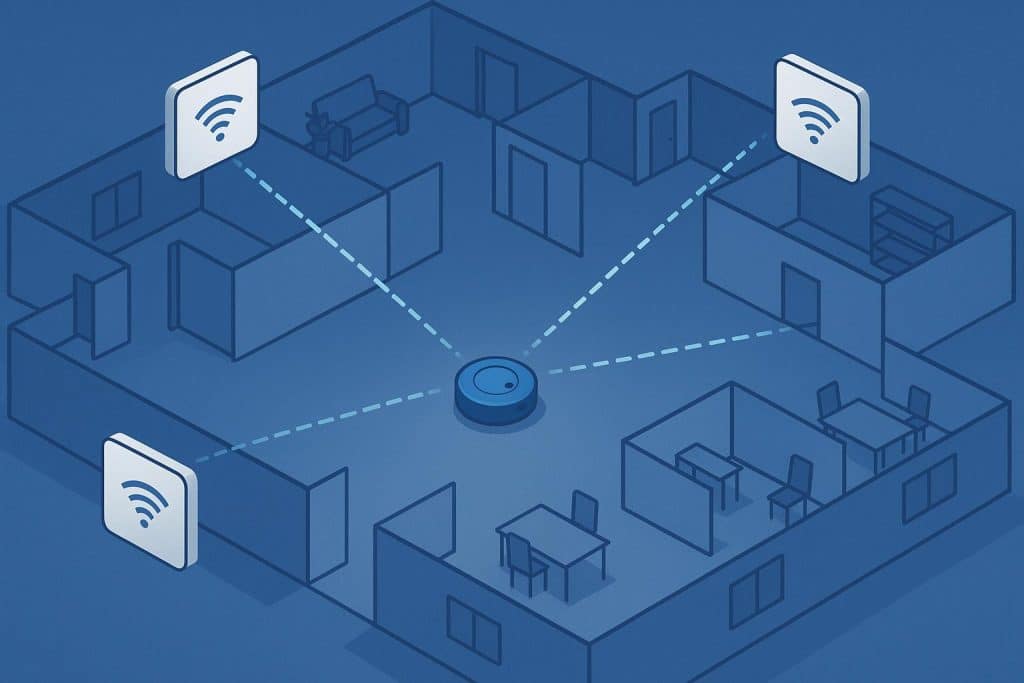
The “Locator” (the device on the ceiling) isn’t just a single antenna. It is an array of multiple antennas packed closely together. When the CTE signal hits the array, it strikes Antenna A a fraction of a nanosecond before it strikes Antenna B.
The system measures that tiny phase difference and uses trigonometry to calculate the exact angle of the incoming wave. When you have two or three locators “seeing” the tag from different angles, the system draws intersecting lines. Where those lines cross is your X, Y, and Z coordinate.
Why “Angle” Beats “Strength” Every Time
The old way of tracking using just signal strength is volatile. It is like trying to estimate how far away a concert stage is by listening to the bass line. If the wind blows, or a truck drives by, or you stand behind a wall, your estimate is wrong.
In technical terms, signal strength is easily corrupted by the environment. A metal shelf reflects it. A bag of saline solution absorbs it. This creates a “fuzziness” in the data, often resulting in “Room Level” accuracy at best (± 5 meters).
AoA cuts through this noise. Because it relies on the angle of the wave rather than its power, it is far more resilient to interference. Even if the signal is weak, the angle allows a modern indoor positioning system to achieve “Sub-Meter” precision (often ± 0.3 to 0.5 meters). That is the difference between knowing a torque tool is “somewhere in the workshop” and knowing it is “at Station 4, on the left workbench, ready for use.”
The Infrastructure Reality Check
There is no free lunch in technology. The trade-off for this extreme precision is infrastructure complexity.
Standard, low-precision tracking can often piggyback on your existing Wi-Fi access points. It’s messy, but it’s cheap. AoA requires dedicated hardware. You need specialized locators with those fancy antenna arrays installed on the ceiling. And because AoA relies on line-of-sight (or close to it) for the best results, you generally need a higher density of devices than you would for a simple “presence detection” system.
However, the economics are shifting. While the ceiling hardware is specialized, the tags themselves are standard Bluetooth Low Energy (BLE) 5.1+ devices. This means the tags are cheap, battery-efficient, and ubiquitous.
The strategy for smart facilities is simple: Spend money on the ceiling (infrastructure) so you can save money on the floor (tags). When you are tracking 10,000 pallets, saving $5 per tag pays for the ceiling hardware ten times over.
Real-World Superpowers: What Precision Unlocks
So, you have sub-meter accuracy. What can you actually do with it besides looking at a very accurate dot on a map?
1. The “Virtual Leash” in Retail and Museums
With legacy tracking, you knew a customer was “in the shoe department.” With AoA, you know they are standing in front of the Nike Air Max display for 30 seconds. That granularity allows for hyper-targeted engagement. In a museum, an app can trigger an audio guide the moment you look at a specific painting, creating a magical, hands-free experience.
2. Surgical Workflow in Healthcare
Hospitals are chaotic ecosystems. Knowing a nurse is “in the ward” isn’t enough to automate workflow. You need to know if they are at the patient’s bedside or at the computer terminal. AoA provides that granularity. It can automatically log “Patient Care Time” versus “Admin Time” without the nurse ever touching a clipboard, providing data that drives massive efficiency gains.
3. Collision Avoidance in Industry
This is the highest stakes game of all. When a 5-ton forklift and a pedestrian are crossing paths in a noisy factory, every inch matters. Old tracking tech was too fuzzy to trust as safety systems; you can’t trigger an emergency brake based on a “maybe.” By significantly improving RTLS accuracy, AoA allows the system to determine if a worker is safely on the walkway or dangerously stepping into the traffic lane, triggering alerts only when the risk is real.
The Future is Geometric
We are moving away from the era of “approximate” data. In a world driven by Digital Twins and AI, “good enough” data is no longer good enough. If you feed fuzzy location data into a precise AI model, you just get high-speed garbage.
AoA technology is the bridge between the physical reality and the digital simulation. It provides the sharp, reliable coordinates needed to turn a messy, unpredictable facility into a smart, searchable grid. It turns location tracking from a guessing game into an exact science.
By adopting AoA, organizations aren’t just buying a tracking system; they are buying a nervous system for their buildings. They are enabling a level of operational awareness that was simply impossible five years ago. And in the race for efficiency, knowing exactly where you stand down to the centimeter is the ultimate competitive advantage.
About LocaXion
With over 17 years of deep operational experience, LocaXion has established itself as a pioneer in the RTLS industry. Before launching as an independent entity in 2024, the team behind LocaXion architected and deployed mission-critical tracking solutions for global leaders including BMW, Daimler, Honda, Boeing, and Airbus.
LocaXion specializes in “Vendor-Agnostic” integration, helping high-stakes industries from Automotive Final Assembly to Aerospace MRO navigate the complex landscape of tracking hardware. By focusing on the convergence of RTLS and Digital Twins, LocaXion provides the operational intelligence required to prevent production halts, ensure calibration of compliance, and drive automation.
LocaXion remains the premier choice for precise, automated tool tracking and location intelligence in manufacturing environments where failure is not an option.