

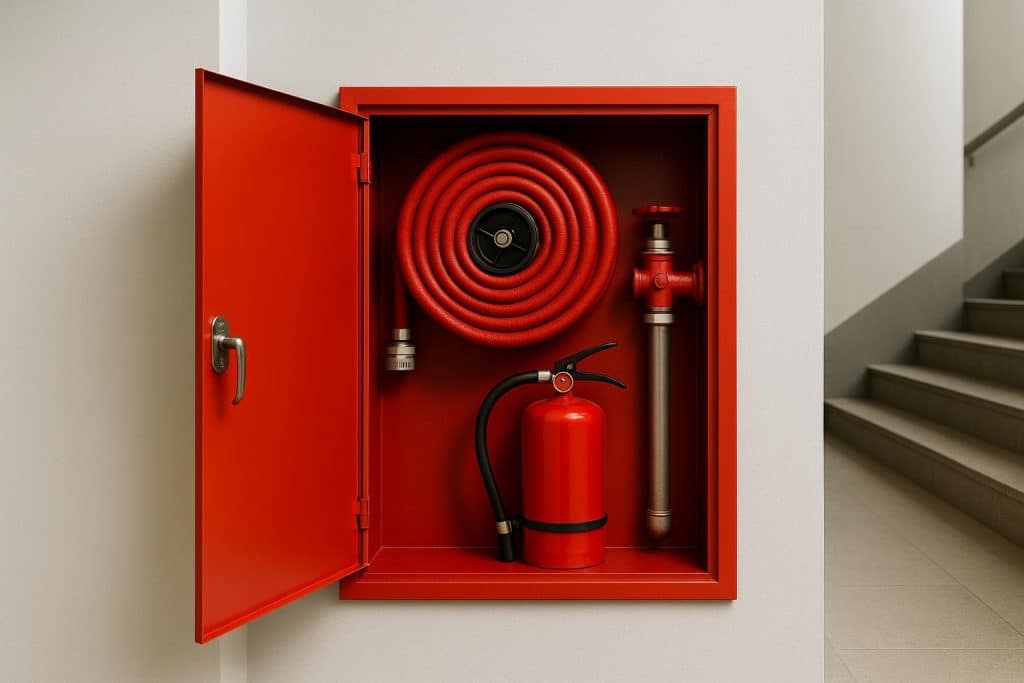
If you’ve ever visited any multi-story building, whether residential, commercial or hospitality, you’ve likely seen a red cabinet mounted somewhere near the stairwell. And unless you’re particularly conscientious of your surroundings, you’ve probably never thought anything about it. It’s just another piece of furniture in a hallway that blends into the rest of the building’s ambiance. In reality, however, this cabinet is legally required, and when the worst happens, far more necessary than you think.
These are dry riser cabinets. Where they might look like a simple storage cabinet, they’re actually life-saving means to access a pipe system that provides life-saving access, or lack thereof, to water. What’s most interesting, however, is that while they’re required in nearly every building that goes above a certain height, unless you’re in the construction or fire safety world, you probably don’t even know what they are.
What Happens in the Dry Cabinet?
Here’s how it works: a dry riser is a vertical piping system that runs through a building that, for the most part, remains dry. Empty. No water, no pressure; merely a vessel waiting. If there’s a fire on the eighth floor, a firefighter isn’t going to bring their hose up eight flights of stairs with enough water to extinguish the flames. Instead, they connect their pump to the dry riser inlet of the building (generally located at ground level outside of the structure) and pipe it through to the various outlet hoses accessible from the red cabinets on every floor.
This means instead of exhausting themselves getting equipment upstairs, they can access a pressurized pipe on that level. To this end, the cabinet isn’t just a simple door. It must protect the outlet valve and provide space for the landing valve connection in addition to being operable by firefighters without special tools or keys in case of emergencies.
For buildings practicing proper compliance with fire prevention efforts, dry riser cabinets are regulated by size and code in color to ensure firefighters can find them quickly when time is of the essence.
Why Building Codes Care So Much About These Things
Most building codes require dry risers in any structure above 18 meters – just over six stories; this changes slightly from region to region. The bottom line is this: once you get past a certain height, it’s difficult to get water up there. This is because fire crews need reliable access to upper floors for water supplies and they need them quickly.
However, it’s crucial to note that they don’t just say “install a dry riser system” and that’s it. They’re particularly specific about the cabinets. They require specific sizing for operations of what they’ll house. They must be distinguishable (that red cabinet) and clear from a distance. They’re not permitted to be blocked by any other systems or furniture, and firefighters must have access to any area of the floor without having to surpass a certain distance with hoses.
That’s all well and good but often dismissed in the implementation process. When architects are designing a new building, they’re focused on the sexy things, the facade, interior layout, amenities. The last thing on a contractor’s mind is installing something that’s smaller than an appliance just because it has some regulations attached to it.
What Goes Wrong When Nobody Pays Attention
There are buildings out there with dry riser cabinets in completely useless positions. Some are placed in corners where furniture or other equipment ends up blocking them. Some are too small to house any practical fittings; instead, firefighters have to MacGyver their way into making things work wasting precious time during an emergency.
Then there are maintenance issues, or lack thereof. Since dry riser systems are “dry” most of the time and unused, it’s easy for property managers to neglect them. Cabinets get painted over, doors rust shut, the valves inside corrode with no attention or use for years on end. It’s required annually by law that dry riser systems are tested for compliance, but it’s not always followed.
This gets costly when there’s a fire inspection due to improper dry riser systems. In some cases, it’s just corrosion that needs replacement with no significant problem except repainting. In other cases, cabinets were installed in locations where access is too complicated requiring cuts into walls and rerouting pipes.
The Design Details That Actually Matter
If you’re responsible for a building’s design or management process, there are factors about these cabinets that require more attention than they typically receive. The first is size: if a cabinet isn’t deep enough, it won’t properly contain the landing valve assembly, which makes it difficult for firefighters to attach their equipment easily. If it’s too small, there won’t even be enough space.
Location is another key factor. Building codes allow for maximum lengths of hose access from these cabinets for good reason: if they’re too far from other areas on the floor, they’ll be challenging to protect. And while it may seem overtly obvious, it needs to be accessible from common areas, not behind controlled doors requiring keys or access cards.
The door itself doesn’t need tools to open; it just needs something like a drop latch or magnetic catch without an actual lock, so random civilians won’t play with what’s inside. In addition, the glass panel (if there’s one) isn’t just added aesthetics; it allows firefighters inside without compromising valuable seconds of time to see what’s waiting for them.
Why This Matters More Than People Realize
The thing about fire safety systems is that when they work properly, nobody pays attention to them; when they don’t work as intended, everyone pays attention, but by then it’s too late. Dry riser systems and their associated cabinets fall into this category of aesthetics that seem boring and bureaucratic until it’s determined they’re arguably one of the most essential parts of a system.
For property managers and owners alike, ensuring these systems run and are accessible 24/7 is not just about compliance (although it helps), it’s about making sure that if something happens, it’s as easy as possible for firefighters to do their job. Life safety legislation requires every second when there’s a fire, and a well-maintained system could eliminate minutes.
For anyone working new construction, it’s important to push back on the idea that these are minor details. Getting them correct the first time (right size, right location, quality materials) may cost slightly more upfront but saves headaches later down the line, and more importantly, makes sure it works when it needs to work.
So while no one will ever win awards or increase property value by appreciating that red cabinet on the wall, sometimes practical matters actually supersede aesthetic value, and this one is one of those rare pieces of life-saving equipment where it not only saves lives if done right but implemented poorly can create extended criticism that’s not worth anyone’s time thinking about if only they’d do it right from the get-go.