

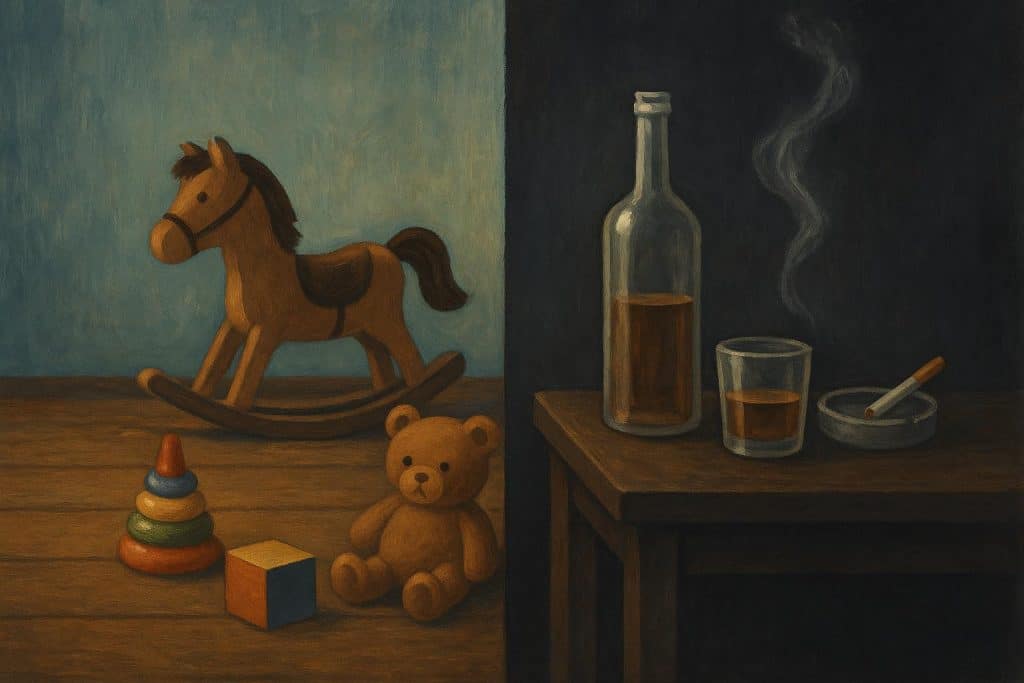
When childhood turns into crisis management
A lot of people think childhood is supposed to feel loose and light. You ride your bike, lose track of time, complain about homework, argue over snacks, fall asleep on the couch, and trust that the adults around you are handling the hard stuff. That is the basic deal. Kids get to be kids because someone else holds the weight.
But that deal falls apart when a parent is always under the influence.
Then childhood becomes something else entirely. It becomes a job without a title. A shift that never ends. A low-grade emergency that lives in the body, day after day, until it starts to feel normal. And that may be the cruelest part. Not just the chaos itself, but how quickly a child learns to treat chaos like weather. You stop asking why the storm keeps coming. You just learn where to stand.
That kind of home changes the whole emotional layout of a child’s life. You do not wake up thinking about cartoons or field trips or what game to play after school. You wake up scanning the mood in the room. Is mom slurring again? Is dad angry today? Is there money for food? Is the younger one okay? Is tonight going to be loud?
Those are adult questions. But children in these homes ask them anyway.
The quiet loss people do not always see
This is not always dramatic from the outside. Sometimes there are no broken windows. No police cars. No obvious scene. Sometimes the loss is quieter than that, which makes it easier for other people to miss.
A child may still go to school. They may still smile in photos. They may still get decent grades. But underneath that surface, a lot has already disappeared. Spontaneity disappears. Trust disappears. Rest disappears. The feeling that home is safe disappears.
And once those things go missing early, they are hard to get back.
It does not feel “bad” all the time, and that matters too
Here is the thing. These homes are not always miserable every minute. Sometimes the parent is funny, warm, affectionate, and full of promises. Sometimes they say sorry. Sometimes they mean it, at least in that moment. That is part of why children stay emotionally hooked. They keep waiting for the good version to come back for real.
So yes, the parent causes fear. But they also become the source of hope. That contradiction can twist a child inside out. Love gets mixed up with disappointment. Care gets mixed up with unpredictability. You end up missing the very person who keeps hurting you. That is confusing when you are grown. When you are seven, it is devastating.
Growing up too fast, and not in the admirable way
People often talk about children in unstable homes as “mature for their age.” It sounds almost flattering. Responsible. Strong. Impressive. But let’s be honest about what that usually means.
It means the child had no choice.
They learned how to read danger before they learned long division. They learned how to soothe a drunk adult before they learned how to name their own feelings. They learned how to make excuses, cover tracks, and keep the house running because nobody else was doing it.
That is not maturity in the healthy sense. It is survival dressed up as competence.
Parentification steals more than time
There is a term for this in family systems work: parentification. It happens when a child starts acting like the caregiver, emotionally or practically, because the actual parent is unavailable. Maybe they make dinner for younger siblings. Maybe they get everyone ready for school. Maybe they clean up after a binge. Maybe they become the emotional sponge, listening to problems no child should have to carry.
And yes, some of these kids become very capable adults. They can organize anything. Handle pressure. Read a room in seconds. Keep a whole operation moving like a project manager with no salary and no break room. But those strengths usually come with a cost.
They often feel guilty when they rest. They struggle to ask for help. They confuse overfunctioning with love. They become the one who always holds it together because falling apart feels dangerous, even years later.
The younger siblings become part of the story
A lot of children in these homes stop being just a child and become a shield. They watch younger siblings closely. They distract them when things get ugly. They tuck them into bed. They lie for them. They lie to protect them. They become little bodyguards in pajamas.
That kind of responsibility changes a person. It can create fierce loyalty, yes, but it also leaves behind grief. Because while they were trying to protect someone else’s childhood, their own was slipping away.
Home stops feeling like home
There is a reason people talk about home as a base. It is supposed to be the place where your nervous system settles. The place where you exhale. When a parent is always under the influence, home stops doing that job.
Instead, home becomes unpredictable. It becomes noisy, or eerily quiet. It smells wrong. It feels tense. It carries the heavy feeling of waiting for something bad to happen. Even ordinary moments start to feel loaded. A key in the door. A phone call late at night. A bottle clinking in the kitchen. Footsteps in the hall.
The body remembers all of it.
Fear does not always look dramatic
A child in this kind of home may not say, “I am afraid.” They might say they have a stomachache. They might stop inviting friends over. They might become hyper, withdrawn, perfectionistic, or unusually helpful. Adults sometimes read these signs the wrong way. They call the child sensitive, difficult, distracted, shy.
But often the child is not any of those things at the core. The child is adapting.
They are building a daily risk assessment system because the environment requires one. That kind of hypervigilance can show up long after childhood ends. You may grow into an adult who still startles easily, still overexplains, still expects peace to vanish at any second.
Shame moves in and makes itself comfortable
Children usually assume family problems are somehow their fault. That is how their minds try to make sense of what feels unbearable. If dad drinks because I was annoying. If mom is passed out because I asked for too much. If I were quieter, smarter, cleaner, better, maybe the house would calm down.
None of that is true, of course. But shame does not care about truth. Shame cares about survival. It whispers that blame is safer than helplessness.
And that whisper can stay for years.
School, friendships, and the outside world
The outside world often sees only fragments. A teacher notices late homework. A friend notices canceled plans. A coach sees a kid who is talented but always tense. What they do not always see is the backstory.
A child living with an impaired parent may struggle to concentrate because their brain is still at home. They may avoid sleepovers because they are worried what will happen while they are gone. They may stop bringing friends over because they cannot predict what version of their parent will answer the door.
That isolation grows quietly. Childhood becomes smaller. Less playful. Less social. Less free.
The child becomes an expert in secrecy
Families shaped by addiction often run on secrecy, denial, and image control. “Do not tell anyone.” “It is not that bad.” “Your parents are just tired.” “Keep family business in the family.”
So the child learns to edit their life in real time. They become a careful narrator. They know how to sound normal even when nothing feels normal. They know which details to leave out. They know how to laugh at things that are not funny.
That skill may help them get through the day, but it can also make honesty feel risky later on. Even in healthy relationships, they may still hide pain automatically.
For families trying to step out of that cycle, access to real support matters. Treatment and recovery resources can help create a path that feels less impossible, including programs such as Pennsylvania Rehab Programs for people who need structured care and a real chance to stabilize.
The grief is real, even when the parent is still there
One of the hardest things for children of addicted parents is that the loss is often ongoing. The parent is physically present, at least sometimes, but emotionally unreliable or unreachable. So the child grieves someone who is still alive, still in the room, still making promises.
That kind of grief is messy. There is no clean ending. No simple script. Just repeated disappointment, repeated hope, repeated letdown. It is like standing at a train station where the train keeps getting announced, delayed, announced again, and never fully arrives.
You wait anyway. Because children do.
Love does not cancel harm
A child can love their parent deeply and still be harmed by them. Both things can be true. That is important to say plainly, because a lot of survivors feel guilty for naming the damage. They think admitting the pain is a betrayal.
It is not.
Telling the truth about what happened is not cruelty. It is clarity. And clarity is often the first solid ground a person gets after years of emotional fog.
Later in life, some families begin to rebuild through accountability, treatment, and long-term support. When substance use has taken over a parent’s role in the home, services like substance abuse treatment in New Jersey can become part of that rebuilding process, not as a magic fix, but as a serious step toward repair.
What survives, and what healing asks for
The childhood that disappears in these homes does not come back in a neat package. You cannot hand someone their lost years. You cannot replace the birthdays spent in fear, the school nights interrupted by chaos, or the soft, ordinary safety they should have had all along.
But survival leaves traces other than pain.
Many of these children grow into adults with unusual depth. They notice things other people miss. They care hard. They protect fiercely. They know how precious calm really is. They do not take steadiness for granted because they had to live so long without it.
Still, healing asks for more than admiration of resilience. It asks for honesty about the cost.
It asks adults who lived this childhood to stop calling their wounds personality traits. To stop calling constant vigilance “being responsible.” To stop calling emotional numbness “being fine.” Sometimes what looked like strength was exhaustion. Sometimes what looked like maturity was grief. Sometimes what looked like independence was abandonment in disguise.
And once you can name that, something shifts.
Not all at once. Not in a tidy movie ending. But enough.
Enough to let yourself rest without earning it. Enough to believe that peace can be real. Enough to understand that the child who spent years surviving deserved more than survival. They deserved care, softness, protection, and room to be young.
They deserved a childhood.
And the fact that they did not get one is not a small thing. It is not a side note. It is the story.