

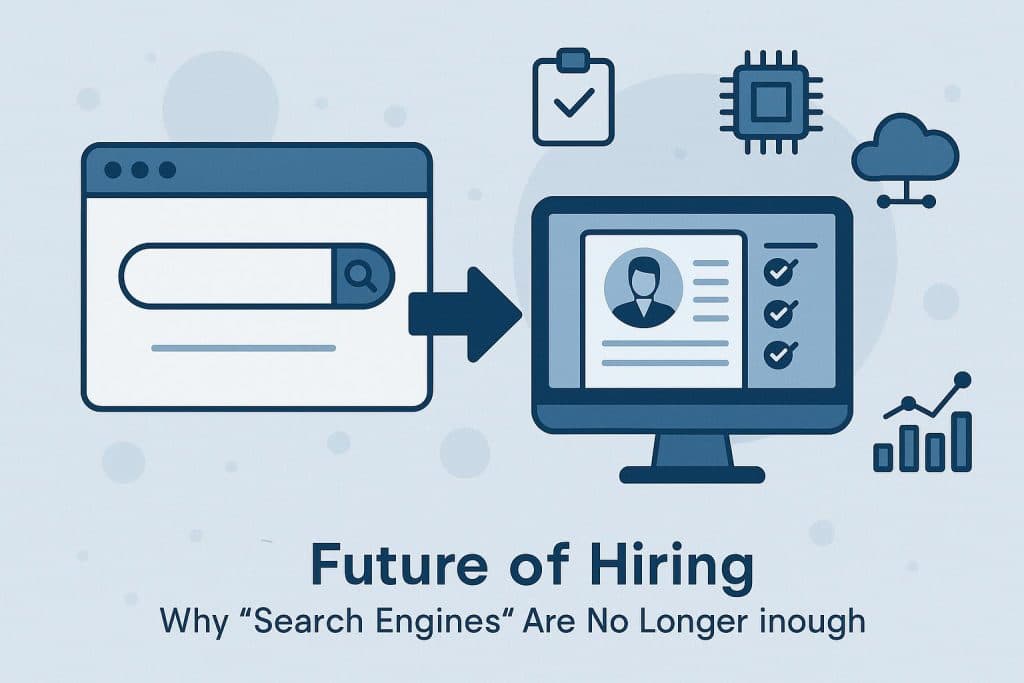
For decades, job seekers and employers alike have relied on keyword-based search tools to match talent with opportunities. Whether typing “Marketing Manager in London” into a job board or filtering by title and location, the process has stayed largely the same — until now.
But as the labor market grows more competitive and complex, this passive “search and sift” model is showing its limitations. Simply entering terms into a search bar isn’t enough to uncover the best opportunities or the right candidates anymore.
Why the Old Model Is Breaking Down
Traditional job search platforms operate on a “pull” system — meaning users must actively seek out listings themselves. While this worked in an earlier era of the internet, it creates three major problems today:
🔹 Keyword Limitations
Matching only on exact words means perfectly fitting roles can slip through the cracks simply because different terminology was used.
🔹 Timing Delays
By the time someone searches, the best roles may already have attracted dozens of applicants.
🔹 Information Overload
Search engines thrive on traffic, not relevance. This can lead to cluttered results full of sponsored or irrelevant posts that burden users rather than help them.
As a result, many candidates spend hours scrolling and filtering — often without finding meaningful leads. Recruiters face the opposite problem: too many low-quality applications that don’t match role requirements.
Smarter Matching with AI Agents
The future of hiring is shifting toward proactive, intelligent systems powered by artificial intelligence. Instead of passively waiting for users to search, AI agents actively scan the job market, match skills with opportunities, and deliver tailored recommendations.
Here’s how this approach changes the game:
1. Continuous Opportunity Discovery
Rather than checking listings periodically, an AI agent constantly monitors openings and surfaces relevant roles the moment they appear — even while you sleep.
2. Beyond Simple Keywords
By understanding skills, experience, career trajectory, and goals, AI can connect candidates to opportunities that wouldn’t be found through a keyword search alone.
3. Quality Filtering
Instead of overwhelming users with every possible position, intelligent systems can weed out low-quality or irrelevant posts, presenting only genuinely suitable matches.
A Win-Win for Candidates and Employers
These next-generation tools aren’t just helpful for job seekers — they also streamline recruiting:
- Candidates get a curated feed of roles that truly align with their profile.
- Employers receive more qualified, better-fitting applications.
AI-mediated hiring isn’t about removing humans from the process. It’s about removing inefficiencies so people can spend more time on strategic, human-centric work like interviews, relationship building, and cultural fit assessment.
What This Means Going Forward
In the coming years, candidates and organizations alike will need to adapt:
- Present richer, structured profiles to improve match accuracy.
- Engage with ongoing feedback loops to fill skill gaps highlighted by AI systems.
- Focus on uniquely human strengths — such as communication, critical thinking, and cultural contribution — which automated systems cannot replicate.
Conclusion
The age of endless scrolling through job listings is fading. What’s emerging is a proactive, intelligent approach to matching people and roles — one that bridges the gaps left by traditional search and opens doors to better opportunities for both sides of the hiring equation.