

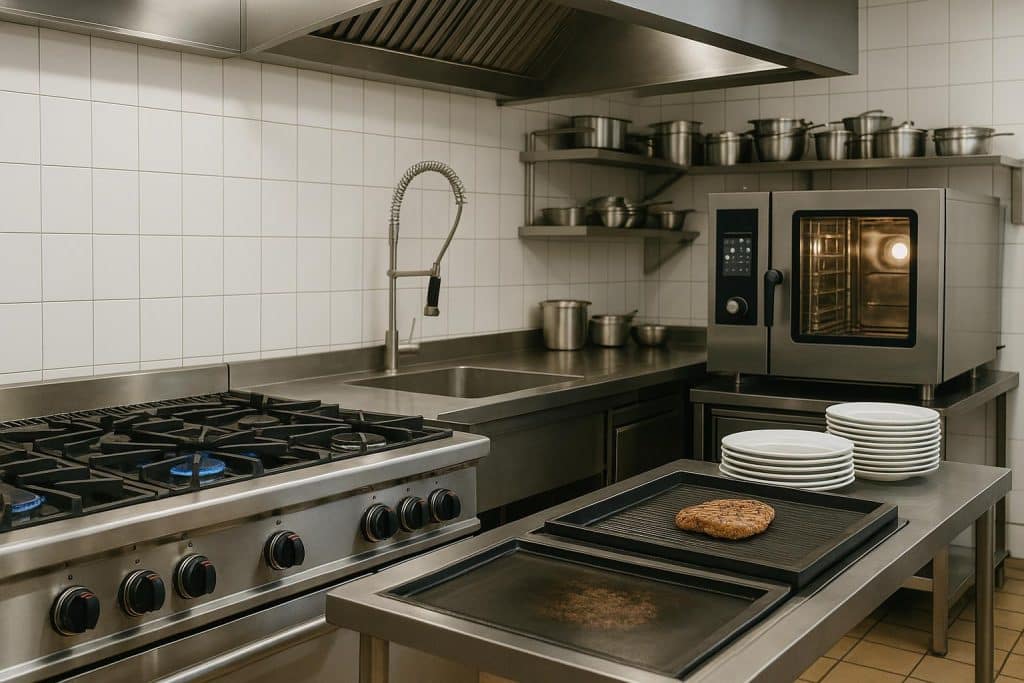
Ever walked into a restaurant kitchen during peak hours? It’s absolute chaos. Orders flying, flames roaring, and somehow everything needs to come together perfectly while customers tap their fingers impatiently. The difference between profit and loss often comes down to one thing: whether your equipment can actually keep up.
Here’s the thing about professional kitchen equipment. Most restaurant owners see it as a massive expense, which it is upfront. But that’s looking at it backwards. The real question isn’t how much it costs – it’s how much money it makes you.
Speed Actually Equals Money (Who Knew?)
Let’s say you’ve got a standard home-grade convection oven trying to handle dinner rush. You’re looking at maybe 20 covers an hour if you’re lucky. Now swap that out for commercial-grade equipment, and suddenly you’re pushing 40 covers in the same timeframe.
That’s not just twice the revenue. That’s twice the revenue with roughly the same labor costs, same rent, same overhead. The math gets pretty compelling when you think about it like that.
But speed isn’t just about cooking faster. Professional equipment heats up quicker, maintains temperature better, and recovers faster between batches. All those little efficiency gains add up to something significant by the end of the month.
The Hidden Costs of Cheap Equipment
Actually, let me tell you what really drives restaurant owners crazy. It’s not the big equipment failures – those you can plan for. It’s the constant small breakdowns that nickel and dime you to death.
Your mixer starts making weird noises mid-service. Your grill heats unevenly so half the steaks come back. The refrigeration unit can’t quite keep things cold enough during summer months. Each problem seems minor, but they’re costing you customers, wasting ingredients, and driving your staff nuts.
Quality commercial kitchen equipment from specialists like MVO commercial kitchen equipment tends to run consistently for years with proper maintenance. The reliability alone often pays for the upgrade.
Energy Efficiency Is Boring But Profitable
Look, nobody gets excited about energy ratings. But here’s where it gets interesting from a profit standpoint.
Professional equipment is designed to run constantly and efficiently. That ancient fryer you’re nursing along? It’s probably using 40% more power than a modern commercial unit. Over a year, that adds up to real money.
Plus, newer equipment often comes with smart controls that automatically adjust power usage based on demand. Your equipment literally learns when you need it most and scales back during quiet periods.
The Customer Experience Connection
This part’s a bit tricky, but customer satisfaction and equipment quality are more connected than most people realize.
When your equipment works properly, food comes out consistently. Orders don’t get delayed. The dining room runs smoothly. Happy customers return, leave good reviews, and tell their friends.
When equipment fails or underperforms, everything else falls apart. Even the best chef can’t make magic happen with unreliable tools.
Making the Numbers Work
To be honest, calculating ROI on kitchen equipment isn’t always straightforward. You’re measuring increased capacity, reduced waste, lower maintenance costs, energy savings, and improved customer retention all at once.
But here’s a rough framework that works: if upgrading your equipment lets you serve 25% more customers with the same staff, and your food costs stay proportionally the same, most of that extra revenue drops straight to your bottom line.
The payback period for quality commercial equipment usually runs 18-36 months, depending on your volume. After that, it’s pretty much pure profit improvement.
The thing is, restaurants that invest in proper equipment tend to stay in business longer. They can handle growth spurts, maintain consistency, and adapt to changing demands. That’s worth more than any spreadsheet can capture.