

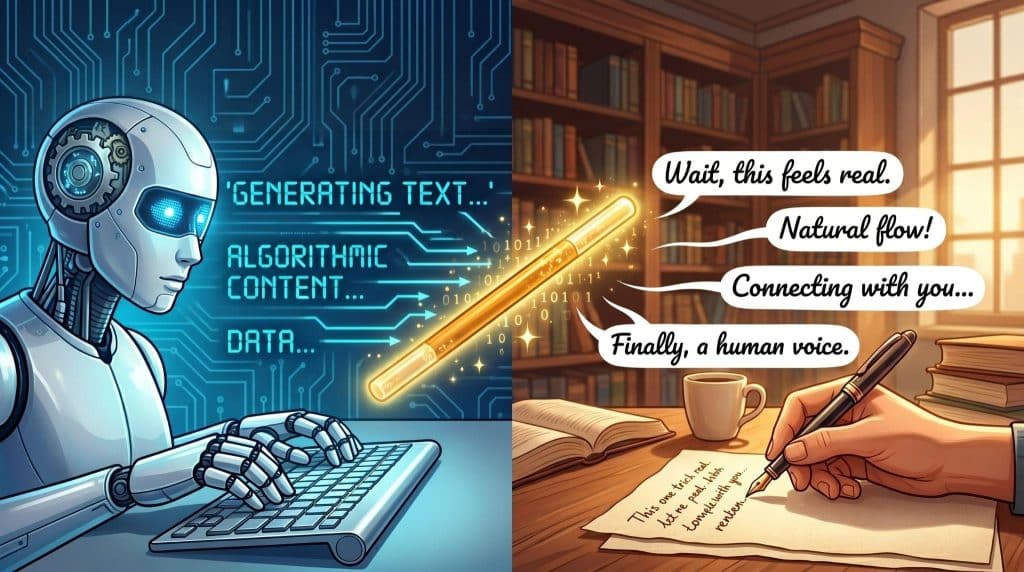
If you’re aiming to make AI text sound like a real human wrote it, it’s going to take a lot more than just a few word tweaks. A lot of people struggle because AI content is too perfect, too balanced, and frankly, a little dull. Here is the one big secret you need to know if you want to bypass detection and connect with actual humans.
The One Trick: Burstiness and Personal Anecdote
The “one trick” that will change your content completely is easy to explain: vary the pattern.
AI operates on math and probability and predicts what the most likely word is to come next in a sentence. That’s why it almost always churns out sentences of the same length and at the same tempo. That’s called low “burstiness.” Humans don’t write like that. We write a long descriptive sentence and then a short one. Or we might even just use sentence fragments.
To make your AI content sound human instantly, you need to force a burst. Use a 3-word sentence followed immediately by a 20-word sentence. That abrupt change is going to signal to the human reader, and to AI detectors, that there’s a real person behind the keyboard.
Why Standard AI Content Fails
When you ask AI to write for you, it tries to be as helpful and objective as possible. This creates several pitfalls:
- Consistent sentence structure: Each paragraph begins with the same type of sentence starter (like “Furthermore,” “Additionally,” etc.).
- No opinion: AI is designed to be objective, which often doesn’t make for interesting writing because most human writing has a clear opinion.
- Too-perfect grammar: While grammar is important, it can sound robotic. Humans use informal or idiomatic expressions that AI tends to avoid.
Using the burstiness trick will immediately break the monotonous cycle and make the writing feel less like an algorithm and more like a human.
How to Make AI Content Sound Human for Free
The best way to transform robotic text into something human-sounding for free is by using specialized software that was made for precisely this purpose.
Head over to AI Humanizer, where you can access software designed to rewrite AI-generated content into human language.
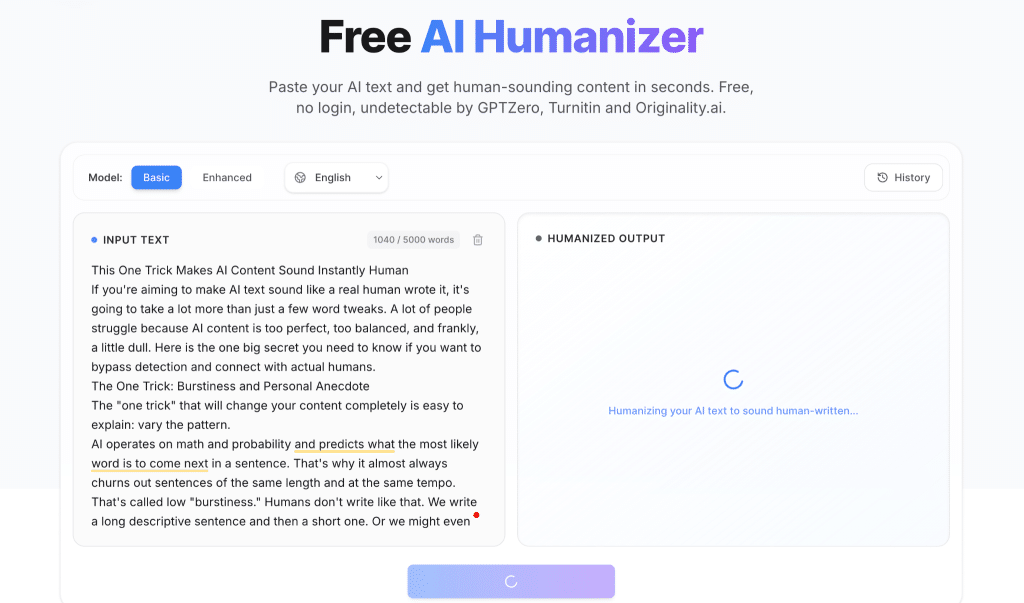
This helps you focus on your ideas while the software handles the complicated work of altering sentence tempo and vocabulary. This is incredibly useful for blog posts, emails, or essays that would otherwise sound robotic.
Steps to Manually Humanize Your Text
Even though there is software, here are the manual steps that help in humanizing your content:
- Read it out aloud: If you’re unable to finish a sentence without taking a breath, the sentence is too long. If it sounds robotic, add some variety.
- Remove the “AI language”: Take out words like “delve,” “tapestry,” “leverage,” and “comprehensive.” Replace them with “look into,” “mix,” “use,” and “complete.”
- Add personal anecdotes: AI does not have personal memories. Adding a single sentence about an event in your life will be impossible for any machine to replicate.
“Easy English” Is Your Friend
Most people believe that sophisticated language is the key to intelligence. However, the most intelligent people are often those who can explain difficult ideas in the simplest possible way. AI content often relies heavily on jargon and complex words to increase word count.
When editing your AI content, you should aim for the language of a middle schooler. This doesn’t mean your ideas need to be simplistic, it’s about how you phrase them. Clarity is a hallmark of human writing. It shows respect for the reader’s time and understanding.
Other Top Tools
AIHumanizer.io is a solid option for those seeking a simple and free experience, but there are also a handful of other alternatives:
- SuperHumanizer.ai: This tool is excellent at transforming highly technical language into everyday language that flows like a normal conversation. It focuses on capturing the overall “vibe” of your writing.
- MyHumanizer.io: If you need to edit a lengthy article quickly, this is a great choice. It is effective in removing robotic cues while retaining the original meaning.
- HumanizerPro.ai: This is a strong option for professional writers who require high accuracy. It also ensures the content remains sensible after editing.
Avoiding the Pitfalls of AI
There is one major trap you need to avoid when humanizing content: the middle-of-the-road trap. AI loves to stay in the middle and never takes risks. Being human involves taking risks with your words.
- Stop over-explaining: AI often defines every term it uses, but humans assume some level of reader knowledge. If you’re writing about SEO, you don’t need to explain what a search engine is in every article. Trimming this excess is key.
- Use active voice: AI often defaults to passive voice (“the ball was thrown by the boy”) instead of active voice (“the boy threw the ball”). Active voice sounds more natural and direct.
- Vary paragraph length: Paragraph length is just as important as sentence length. Mix longer paragraphs with single-sentence ones. This adds visual variety and breaks the monolithic feel of AI-generated text.
The Power of Emotion
A human and a machine cannot experience emotion in the same way; they can only process events. You can add emotional depth to your writing, even in professional contexts.
Use descriptive language that appeals to the senses. Instead of saying “the office was busy,” describe the atmosphere: “the office was loud with the clicking of keyboards and the ringing of phones.” These “sensory details” are difficult for AI to replicate and help signal human writing.
Conclusion: Technology and Humanity in Harmony
Using AI for writing is practical and saves time, but you can’t simply copy and paste what it produces. You are the editor, and the creator of the text’s soul.
Using the “one trick” to change sentence tempo, along with tools like AI Humanizer io, is essential for creating readable content. Whether you choose SuperHumanizer.ai, MyHumanizer.io, or HumanizerPro.ai, they all share a similar goal: producing human, readable text.
Keep your writing simple. Keep your sentences varied. And remember to write for the person on the other side of the screen, not for a search engine or an AI bot. When you write for humans, you naturally create better content than any AI ever could.