

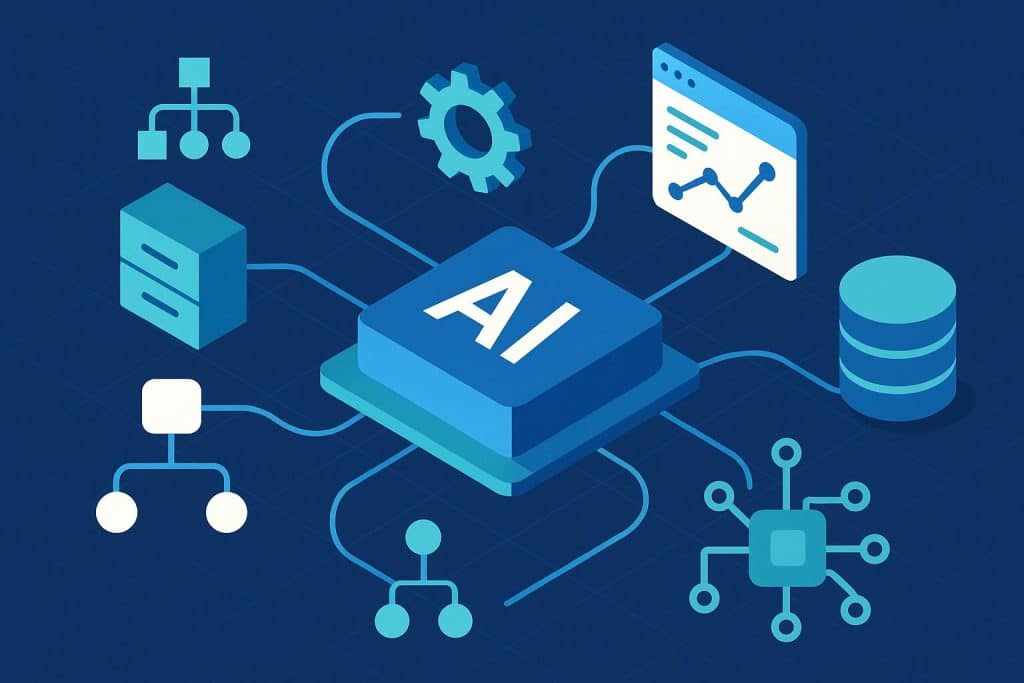
Artificial Intelligence (AI) is shaping the future of technology and business by enabling machines to perform tasks that typically require human intelligence. AI orchestration refers to the strategic integration and management of multiple AI services and tools to work in harmony towards achieving complex objectives. As businesses and organizations seek to adopt this cutting-edge technology, understanding the fundamentals of AI orchestration becomes crucial.
Understanding AI Orchestration
AI orchestration commences with a thorough understanding of various AI models and how they can be synergized. It involves managing the workflow of AI tasks, ensuring they operate efficiently together. By coordinating AI models and algorithms, organizations can solve more complex problems than they could with isolated AI solutions. This concept extends the capabilities of AI, promoting scalability and adaptability within systems.
One key aspect of AI orchestration is the seamless integration of components. Each AI element must communicate effectively, sharing insights and data in real-time. This interconnectedness enables businesses to create more sophisticated AI-driven experiences. Orchestration also provides a platform for continuous learning and improvement, which is vital in a world where AI capabilities are rapidly advancing.
Another significant facet of AI orchestration is automation. By automating repetitive tasks, organizations can free human resources to focus on more strategic initiatives. Moreover, AI orchestration facilitates the dynamic allocation of computational resources, optimizing the use of hardware and cloud-based services.
For those looking for a comprehensive AI orchestration guide, there’s a treasure trove of resources available that provide a deep dive into this subject. From expert articles to full-fledged tutorials on how to use AI orchestration platforms like BA Insight, these materials can help beginners skill up and professionals refine their orchestration strategies.
Exploring the Components of AI Orchestration Systems
At the heart of AI orchestration are several key components that ensure its smooth operation. These include data pipelines, AI models, orchestration engines, and user interfaces. The data pipelines deal with the flow and processing of data, an essential fuel for AI systems. AI models are the algorithms responsible for making predictions or decisions based on data inputs. These models can range from simple linear regressions to complex deep learning networks.
The orchestration engine is akin to a conductor, managing and directing the execution of AI tasks. It ensures the right tasks are carried out at the right time and manages dependencies between tasks. This engine is critical for maintaining the operational integrity of the entire orchestrated system. Additionally, user interfaces allow human operators to interact with the AI system, providing the means to monitor performance, input commands, or adjust parameters.
Moreover, security features are embedded within these systems to protect data integrity and prevent unauthorized access. Encryption, access controls, and regular audits are standard practices within AI orchestration systems, ensuring that sensitive information and intellectual property remain secure.
The Role of Data in AI Orchestration
Data serves as the lifeblood of AI orchestration, having immense implications for its success. The quality, volume, and velocity of data can greatly influence the outcomes of AI systems. Good quality data leads to more accurate predictions and decisions, whereas poor data can derail an entire AI initiative. This necessitates robust data governance to maintain the integrity and utility of data throughout its lifecycle.
Moreover, AI orchestration often involves data from diverse sources—internal databases, the internet, IoT devices, and more. Integrating and harmonizing this data is a non-trivial challenge that requires sophisticated ETL (Extract, Transform, Load) processes. Data must be cleansed, normalized, and often enriched with additional context to be valuable for AI models.
With an exponential increase in data generation, managing the throughput of data in orchestration systems becomes critical. High-performance data pipelines ensure that AI models receive data in real-time, empowering them to provide timely insights and actions. Efficient data utilization also includes tracking the lineage and auditing data access, crucial for compliance with regulations like GDPR and HIPAA.
Lastly, to foster continuous learning and improvement, AI systems must incorporate feedback loops. By analyzing outputs and outcomes, feedback data helps refine AI models, making them more accurate over time. Thus, the role of data in AI orchestration extends well beyond mere input and includes dynamic feedback mechanisms that bolster overall system intelligence.
Overall, AI orchestration represents a frontier of innovation that is redefining the capabilities of artificial intelligence. By carefully considering the challenges and leveraging the opportunities presented by this technology, organizations can harness the power of AI orchestration to achieve remarkable efficiency, insight, and competitive advantage.