

Introduction
AI has changed how individuals produce, and curate digital images. Graphic tools of AI-assisted image generation are more and more available and advanced in terms of sophistication across the social media graphic and professional design industries each year. Companies, advertisers, artistes and amongst content generators are turning to AI systems to generate images at a rapid rate without compromising the quality and creativity levels.
The development pace of machine learning and neural networks has allowed the image generation models to interpret prompts, identify artistic styles, and create visuals, incredibly detailed, with the help of one or two basic text directions. The industries that are being affected by these advances are the areas of advertising, entertainment, education, and e-commerce.
With the technology being on a constantly changing path, it becomes all the more crucial to understand the mechanism of AI image generation and its future direction. This paper examines how artificial image creation technology has been developed, its uses in practice, its limitations, ethical issues, and prospects of the use of AI-based digital art in the next few years.
The Evolution of AI Image Generation Technology
Generative AI image creation has advanced dramatically within the past 10 years. The early systems could not produce realistic images and they tended to generate either blurred or distorted images. But, advancements in deep learning, generative adversarial networks (GANs), and transformer-based models have shown revolutionary increases in accuracy and quality of images.
The new AI has the ability to create art pieces, realistic portraits, animations, and marketing graphics within several seconds. The gpt image 2 model and other tools that work on sophisticated frameworks illustrate that machine learning algorithms have the potential to comprehend an intricate prompt and transform it into a visually stimulating image.
These systems are trained on huge data sets of millions of images allowing them to identify patterns, textures, colors, and artistic styles. With the growth in computing power and advancements in the training process, AI-generated visuals are almost hard to distinguish between those produced by humans. The new technological revolution is presenting fresh opportunities to both professionals and the casual users.
How AI Models Create Visual Content
The generation of images by AI is based on complex algorithms that are trained on large (images) datasets. Relationships between visual and textual description are learnt by the model during training. The system picks up over time on interaction of objects, lighting, perspective, and artistic styles.
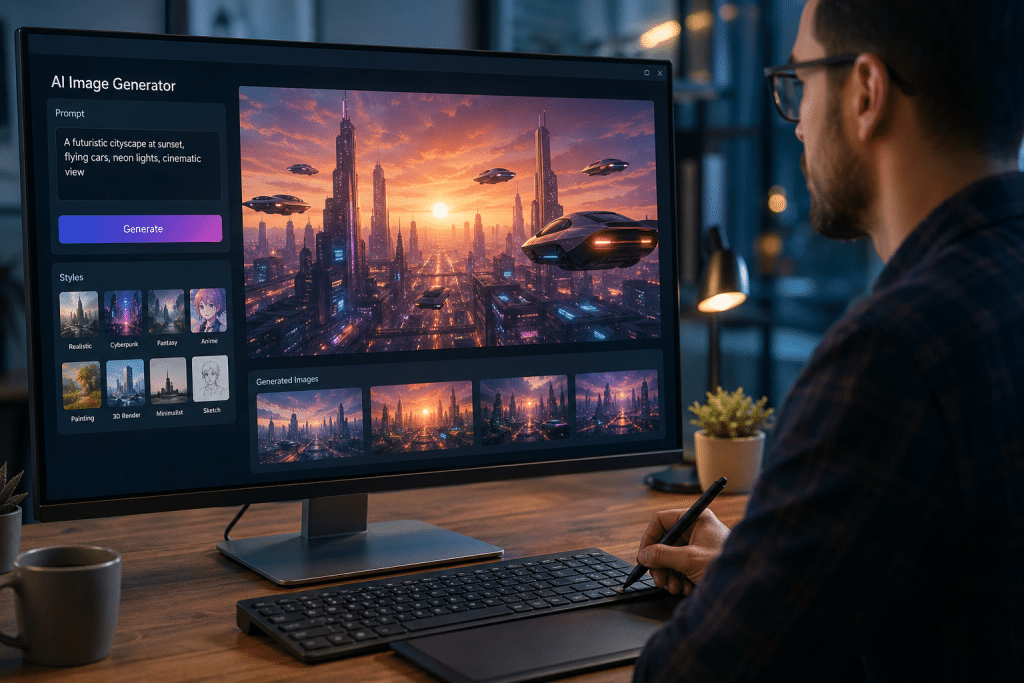
A user inserts a prompt, the AI analyses it and finds visual patterns that are similar to the request. This model later builds up a pixel image pixel by pixel. There are also advanced systems which can be used to refine the outputs so as to produce more accurate and personalized visuals according to the reactions given by the user.
One of the most popular currently used models is diffusion models. These systems begin with random noise and gradually lead to a meaningful image. This technique enables the AI to create intricate composition, realistic shadows, and textures. AI systems are also gaining the ability to comprehend context at a very rapid pace.
The contemporary models are able to read emotions, environments and abstract artistic concepts which means that the user can design a very personalized image without the need to possess specialized graphic design techniques.
Applications of AI Image Generation Across Industries
AI-generated imagery is now not considered only as an experimental technology. It has since become common and is used in various industries both practically and commercially.
Marketing and Advertising
AI-based tools are used to design social media images, advertisement banners, advertisement posters, and product visualization by the brands. With AI, it saves the design time and assists businesses in creating tailored content to various customers.
Entertainment and Gaming
AI-generated concept art is used by movie producers and videogame creators to accelerate the creative process. The designs of characters, fantasy backgrounds, scenes of the film can be already created in a significantly shorter period than it used to be done before.
Education and Training
AI images are used in educational institutions to design interactive learning content, illustrations, and simulating images. Specialized visually customized explanations can be used to explain complex ideas in the sciences.
E-Commerce
AI-generated product pictures and lifestyle images are employed by online retailers to enhance customer interaction. The high-quality displays of product can be made easily by businesses without costly photoshoots.
Architecture and Interior Design
The architects and designers employ AI to build a model of the building, furniture, and room planning before construction. This assists clients in comprehending design concepts better.
The increasing diversity of uses implies that AI image generation is transforming the ways people work in the profession and enhancing the efficiency of creativity.
Benefits of AI-Powered Visual Creation
Speed is one of the most significant benefits of AI image generation. In tasks that used to take a few hours or days to complete, now it can take only a couple of minutes. This is particularly effective to businesses that handle a lot of electronic materials. Accessibility is another key advantage.
Today, ordinary people can design graphic graphics with just the help of simple textual prompts without professional design experience. This democratization of creativity enables more individuals to engage in creation of digital content. AI tools facilitate experimentation, too.
Designers could easily experiment with various ideas, styles or compositions without having to recreate each time. This will enhance innovativeness and imaginative exploration. Another crucial aspect is cost minimization.
Start-ups and small business organizations do not need to employ a lot of personnel or spend a lot of money on software development to produce a professional image. Moreover, AI networks can be used to help in routine activities like eliminating the background of the image, enhancing it, and editing the images in terms of style, leaving the human designers to adhere to more creative choices.
Ethical Challenges and Concerns
Although AI image generation has numerous benefits, there are also several ethical and legal issues connected to it. A significant problem is the matter of copyright and ownership. Because the models of AI are trained on big data gathered online, there are concerns about the use of copyrighted art and photographs. False or made up content is another issue.
AI-generated images can be exploited to create realistic but artificial images that can be false information or harm to the trustworthiness of people. Another challenge is biasness in AI systems. When training datasets have biased or unbalanced representations, the resulting outputs can be biased.
The developers should exercise due diligence to establish equality and variety in AI generated content. Issues of the effect on creative careers are also of concern. Other artists and designers are afraid that automation will lead to abolition of the traditional creative work.
Nevertheless, most specialists think that AI will serve as a collaborative resource, replacing human creativity. Setting ethical standards, clear policies, and accountable use norms will be paramount in the use of AI image generation technology which is now increasingly growing.
The Future of AI Creativity and Innovation
The future of image generation by AI has a bright future. Additional realistic models with increased processing and customizing capabilities could be anticipated as models become more sophisticated. More types of media can be incorporated into future systems, enabling a user to create images, videos, animations, and the ability to interact with details all based on one prompt.
Humans and AI may collaborate in real-time and make it a routine part of creative processes. Personalization would also enhance a lot. AI capable of gathering personal tastes in art can adjust the results based on the personal preferences of a user. Companies would be able to produce extremely niche-oriented marketing images based on a particular audience/section.
It can also be integrated with virtual reality and augmented reality technologies, which can further enhance the scope of creativity. The holding of the immersive game experiences, educational training in digital simulation, and interactive education platforms could be powered by AI-generated environments.
Due to the rise of technology, a high level of ethical conduct and safeguarding intellectual property rights will continue being a priority. The success with which society will be able to take advantage of such potent creative tools will depend on responsible innovation.
Conclusion
AI image generation is transforming the digital creative world quickly. They are enhancing efficiency, accessibility and innovation in industries, especially in marketing and entertainment, as well as in education and e-commerce.
State-of-the-art systems like the gpt image 2 model show the power of advanced machine learning to increase a simple text prompt into a complex image. Even though there are still issues of ethics, copyright, and misinformation, there is a potential of significant benefits of AI-driven creativity.
With the current work of researchers on improving these technologies, AI image generation will become an even more significant component of modern communication and digital design. Learning about its potential and the constraints will assist people and companies in improved use of such tools in the future.