

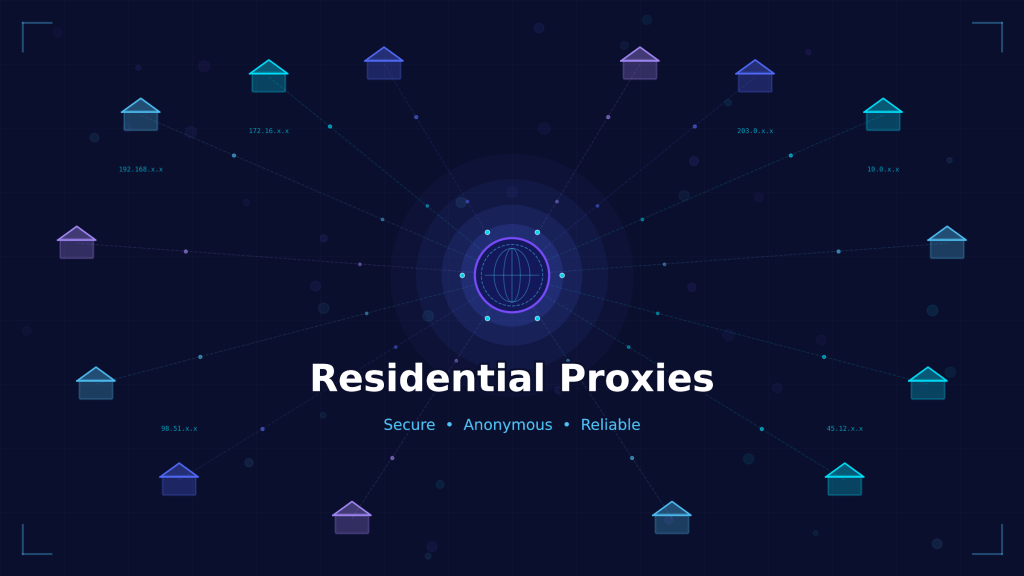
Residential proxies are IP addresses assigned by Internet Service Providers (ISPs) to real homeowners and mobile devices. When you route your internet traffic through a residential proxy, websites see a legitimate household IP address instead of your own, making your requests appear as regular user activity.
Definition: A residential proxy is an intermediary server that uses an IP address tied to a physical, residential location provided by an ISP, allowing users to browse the web as a genuine local user from a specific city, state, or country.
Unlike datacenter proxies, which originate from cloud servers and are easier to detect, residential proxies carry the trust level of real consumer connections. This makes them the go-to choice for tasks where authenticity and low block rates matter, from market research to ad verification and price monitoring.
Businesses across e-commerce, cybersecurity, travel, and digital marketing rely on residential proxies daily. Their growing adoption stems from a simple reality: websites have become smarter at detecting automated traffic, and using IPs tied to real devices is one of the most reliable ways to maintain access without triggering anti-bot systems.
How do residential proxies work?
Every residential proxy connection follows a straightforward path. Your request travels from your device to the proxy server, which then assigns it a residential IP from its pool before forwarding it to the target website. The website responds to the residential IP, and the proxy relays that response back to you.
The proxy provider maintains a large pool of residential IPs sourced through partnerships with app developers and ISP agreements. Users who opt in to share their idle bandwidth contribute their IP addresses to the pool, and proxy customers can then rotate through these IPs on demand.
Most providers offer two rotation modes. Rotating proxies assign a new IP for every request or at set intervals, which is ideal for scraping large volumes of data. Sticky sessions keep the same IP for a defined period (typically 1 to 30 minutes), which works better for account management or checkout flows that require session continuity.
Residential proxies vs. datacenter proxies vs. ISP proxies
Choosing the right proxy type depends on your specific use case, budget, and tolerance for detection risk. Each type has strengths and trade-offs that make it better suited for certain tasks.
| Feature | Residential proxies | Datacenter proxies | ISP proxies |
| IP source | Real household devices | Cloud servers / data centers | Datacenter-hosted, ISP-registered IPs |
| Detection risk | Low | High | Very low |
| Speed | Moderate | Very fast | Fast |
| Cost | Higher (per GB) | Lower (per GB or IP) | Mid-to-high |
| Best for | Scraping, geo-targeting, ad verification | Bulk tasks with low-security targets | Sneaker bots, account management, long sessions |
| IP pool size | Millions | Thousands to hundreds of thousands | Smaller, curated pools |
Residential proxies win on legitimacy. Datacenter proxies win on speed and cost. ISP proxies sit in between, offering datacenter-level speed with residential-level trust. Your decision should come down to what the target website expects and how aggressively it blocks non-residential traffic.
Common use cases for residential proxies
Residential proxies serve a wide range of business and personal applications. Their ability to mimic genuine user behavior makes them practical across industries that depend on accurate, unrestricted web access.
Web scraping and data collection
Gathering pricing data, product listings, or SERP results at scale requires IP addresses that won’t get flagged after a handful of requests. Residential proxies distribute your scraping activity across thousands of real IPs, reducing the chance of bans and CAPTCHAs. E-commerce companies, SEO agencies, and market research firms use them to pull competitive intelligence without interruption.
Ad verification and brand protection
Advertisers need to confirm that their ads appear on the right websites, in the right locations, and without fraud. Residential proxies let verification teams view ads exactly as a local consumer would, exposing geo-targeted fraud, hidden redirects, and compliance violations that datacenter IPs might miss entirely.
Geo-restricted content access
Testing localized content, pricing, or search results across different regions requires IPs from those regions. Residential proxies with city-level or country-level targeting let teams see their website, app, or ad campaign the way a local user would, without physically traveling there.
Social media management
Running multiple social media accounts from the same IP address is a fast path to suspensions. Residential proxies assign each account a different, legitimate IP, reducing the risk of platform bans. Marketing agencies managing client profiles across Instagram, TikTok, or Facebook use this approach to keep accounts safe.
Price comparison and travel fare aggregation
Airlines, hotels, and e-commerce platforms often display different prices based on visitor location, device, or browsing history. Residential proxies allow comparison platforms and individual buyers to view prices from multiple geographic perspectives, capturing the full range of available deals.
What to look for in a residential proxy provider
Not all proxy networks deliver the same level of quality. Before committing to a provider, evaluate them across several practical criteria that directly affect your results.
| Criteria | Why it matters |
| Pool size | Larger pools mean less IP reuse and lower block rates |
| Geo-targeting options | Country, state, and city-level targeting determines how precisely you can simulate local traffic |
| Rotation flexibility | Control over rotation intervals (per request, timed, sticky) affects session management |
| Bandwidth pricing | Pay-per-GB vs. pay-per-IP models vary significantly in cost depending on your workload |
| Ethical sourcing | IPs should come from consenting users, avoiding legal and reputational risks |
| Uptime and success rate | Consistent availability and high request success rates reduce wasted time and retries |
| Dashboard and API | A clean interface and well-documented API speed up integration and monitoring |
Look for providers that are transparent about how they source their IPs. Ethical proxy networks obtain residential IPs from users who have explicitly opted in, often through free apps that compensate users with ad-free experiences or small payments in exchange for idle bandwidth.