

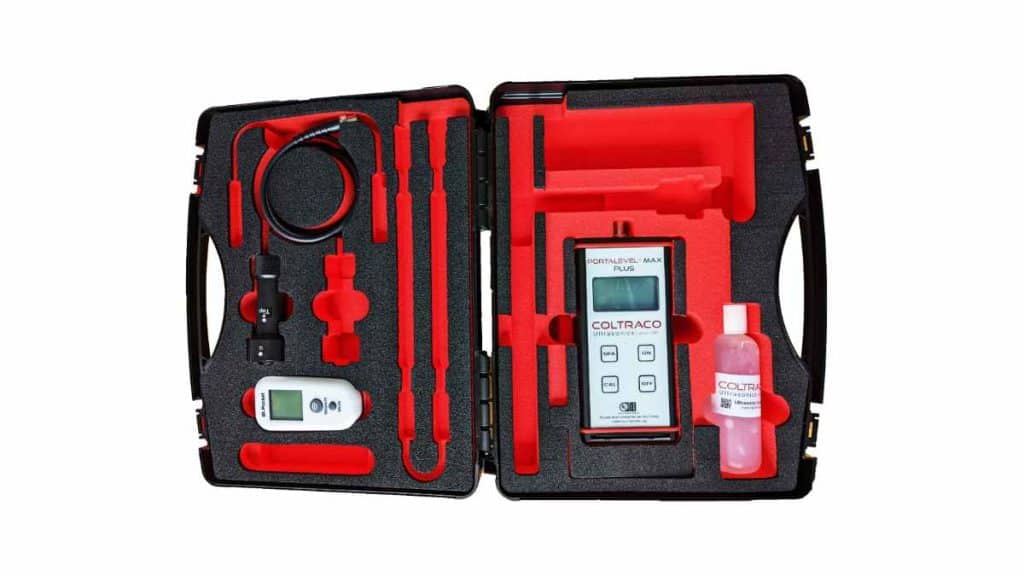
An ultrasonic liquid level indicator is a non-contact device used to measure the level of liquids in tanks or containers. It utilizes high-frequency sound waves, typically above the range of human hearing (above 20 kHz), to determine the distance from the sensor to the liquid surface. The device emits ultrasonic pulses that bounce off the liquid surface and return to the sensor. By measuring the time, it takes for the sound waves to travel back, the indicator calculates the liquid’s level accurately. It is commonly employed in various industries, including manufacturing, chemical, and oil & gas, for efficient and reliable liquid level monitoring.
Ultrasonic liquid level indicators offer several advantages, such as accuracy, reliability, and ease of installation, making them popular in a wide range of industries. Let us explore the principles behind ultrasonic liquid level indicator in detail.
1. Ultrasonic Sound Waves –
Ultrasonic waves are sound waves with frequencies higher than the audible range of the human ear (typically above 20 kHz). These waves can travel through air or other mediums and are reflected when they encounter a boundary between two materials with different densities, such as air and liquid.
2. Transmitter and Receiver –
An ultrasonic liquid level indicator consists of two main components: a transmitter and a receiver. The transmitter emits short pulses of ultrasonic waves, which propagate towards the liquid surface. The receiver detects the reflected waves that bounce back from the liquid surface.
3. Time of Flight Measurement –
The fundamental principle of ultrasonic liquid level measurement is based on the time of flight (TOF) of the ultrasonic waves. TOF refers to the time taken for the ultrasonic waves to travel from the transmitter, reflect off the liquid surface, and return to the receiver. Since the speed of sound in air is known, the distance to the liquid surface can be calculated using the formula: Distance = (Speed of Sound × TOF) / 2.
4. Calibration and Compensation –
Ultrasonic liquid level indicators need to be calibrated to account for factors such as temperature, atmospheric pressure, and the speed of sound in the air. Additionally, the device must compensate for any obstructions or vapor above the liquid surface that may interfere with the ultrasonic waves’ travel.
5. Signal Processing –
Once the receiver detects the reflected waves, the electronic circuitry processes the signals to filter out noise and extract the relevant data. Signal processing techniques, such as time gating and averaging, are used to enhance the accuracy of the level measurement.
6. Beam Angle and Cone –
The ultrasonic waves emitted by the transmitter form a beam angle as they travel towards the liquid surface. This beam angle determines the size of the measurement cone. A narrower beam angle provides a more focused measurement, ideal for smaller tanks, while a wider angle is suitable for larger vessels.
7. Multiple Reflections –
In some cases, the ultrasonic waves can bounce off multiple surfaces, leading to unwanted echoes. To avoid errors caused by multiple reflections, the device uses algorithms to distinguish between the primary echo from the liquid surface and any subsequent reflections.
8. Application Considerations –
Ultrasonic liquid level indicators are versatile and find applications in various industries, such as oil and gas, chemical processing, water treatment, and food and beverage. However, certain factors, such as foaming liquids, turbulence, and high-viscosity substances, can affect the accuracy of measurements and require special considerations during installation and operation.
Conclusion –
Ultrasonic liquid level indicators are valuable tools in industrial settings, providing accurate and reliable measurements without the need for physical contact with the liquid. Understanding the principles behind these devices helps ensure their proper implementation and enables users to make informed decisions about their use in specific applications.