

For many parents, the first signs are subtle.
A child who used to be curious begins to dread homework. Reading that should be getting easier somehow becomes more exhausting. Instructions have to be repeated again and again. Parent-teacher conferences become a source of stress rather than clarity. Even when a child is trying hard, progress feels uneven, slow, or mysteriously fragile.
In those moments, parents are often told some version of the same thing: be patient, work a little harder, get extra help, lower the pressure, wait and see.
But what if that advice misses the real issue?
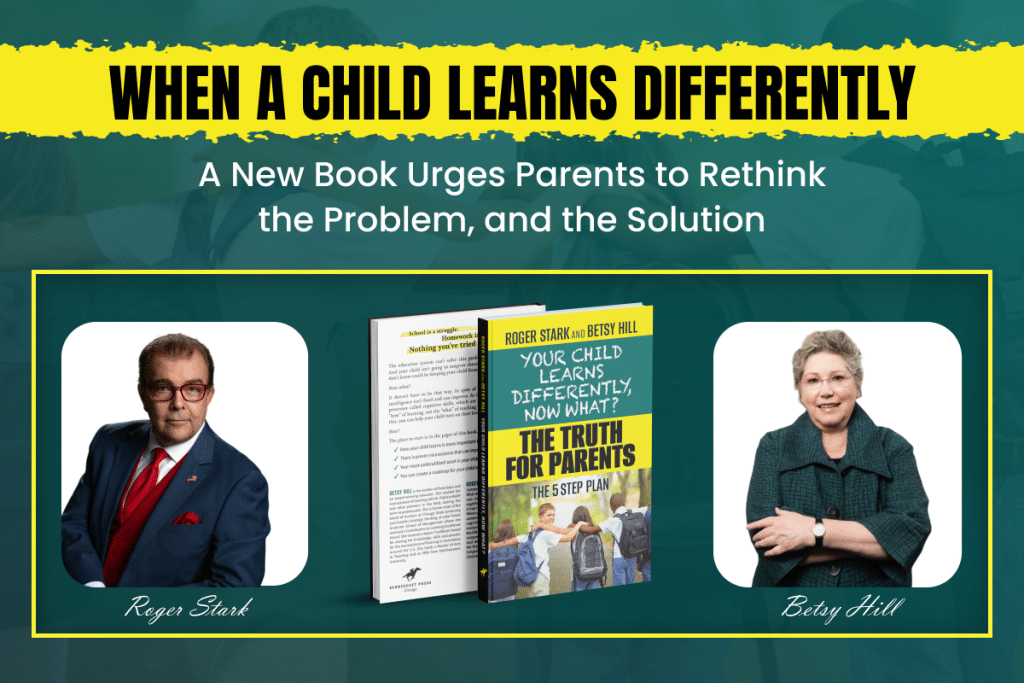
That is the question at the heart of Your Child Learns Differently, Now What? The Truth for Parents, a new book by Roger Stark and Betsy Hill. Written for families of struggling learners, the book argues that many children are not failing because they are lazy, unwilling, or incapable. Instead, the authors say, the problem is often deeper and more specific: the child’s underlying cognitive skills may not be developing in the way traditional classrooms assume they are.
The book presents this not as a minor distinction, but as the difference between years of frustration and the possibility of lasting change.
A Different Way to Understand Learning
At the center of Stark and Hill’s argument is a simple but powerful reframing. Most schools, they suggest, focus primarily on teaching, curriculum, instruction, assignments, interventions, and accommodations. Parents, understandably, tend to focus on outcomes: grades, reading level, math performance, behavior, confidence.
The authors ask families to focus instead on how learning happens.
They define cognitive skills as the mental processes the brain uses to take in information, organize it, store it, retrieve it, and apply it. These include attention, memory, processing speed, visual and auditory processing, executive function, and related capacities that determine how efficiently and effectively a child can learn. In the book’s framework, these skills are not peripheral. They are foundational.
That shift matters because it changes the question from “Why isn’t my child getting this?” to “What might be getting in the way of learning in the first place?”
For parents who have spent years bouncing between tutors, teacher meetings, evaluations, and homework battles, that distinction is likely to feel both confronting and validating.
Why the Book Speaks to So Many Parents
One reason the book is likely to resonate with families is that it clearly understands the emotional reality of parenting a child who struggles in school.
This is not written as a distant academic treatise. It is written for the parent who has poured time, money, and energy into trying to help a child, only to feel that the deeper issue still has not been named. The authors acknowledge the fatigue, the uncertainty, the nighttime homework struggles, and the heartbreak of watching a child begin to believe that they are “stupid” or simply not made for school.
That emotional fluency gives the book much of its force.
It also explains why the book’s main message is not merely instructional, but empowering: parents must take a more active role in directing the process. Stark and Hill argue that while educators may be well-intentioned, most schools are not truly structured to identify and strengthen each child’s unique learning profile. Too often, they say, the result is a system that manages symptoms rather than addressing causes.
The Five-Step Framework
Rather than leaving parents with a diagnosis of the problem and little else, the book is organized around a practical framework called The 5 Simple Steps:
- Take the Wheel
- Set High Standards
- Build the Cognitive Infrastructure for Learning
- Move Beyond Grit
- Invest in a Coach
That structure is one of the book’s major strengths. It gives the material shape and direction, making it feel less like a collection of ideas and more like a plan parents can follow.
The first two steps are particularly notable because they challenge common habits. Stark and Hill tell parents not to wait passively for the school system to solve the problem and not to accept permanently lowered expectations simply because a child has a label or learning difficulty. Diagnoses, they argue, may be helpful for services or treatment, but they do not tell a parent what they most need to know: how this particular child learns.
The third step is the most substantive and technical, laying out the authors’ model of cognitive skills as the true infrastructure of learning. The fourth pushes back on the cultural reflex to tell struggling children to “try harder,” arguing that confidence rooted in real improvement matters more than empty appeals to grit. The fifth emphasizes coaching and guided support as essential to translating theory into transformation.
Not Just a Parenting Book : A Challenge to the System
Although the book is written for parents, it also functions as a critique of mainstream educational practice.
Stark and Hill argue repeatedly that schools over-rely on accommodations, modifications, and workarounds. In their telling, a child may receive extra time, reduced workload, or compensatory strategies without anyone truly strengthening the underlying skill that makes the task hard in the first place. The authors describe that as the “old way,” contrasting it with a “new way” focused on building learning capacity rather than just helping students navigate around weakness.
That argument will likely strike a chord with some parents and provoke skepticism in others. But whether one agrees with every claim or not, the book’s critique taps into a genuine frustration many families feel: the sense that school systems are often better at documenting a child’s problems than solving them.
The book sharpened that point by reflecting on the pandemic era, which the authors use as evidence that the problem was never simply one of lost instruction. In their view, COVID exposed a larger issue, that many children lacked the cognitive and emotional readiness to learn effectively, and that simply restoring classroom time could not by itself repair that gap.
Who the Authors Are
The credibility of the book rests heavily on the backgrounds of its authors.
Roger Stark is identified in the book as the CEO of BrainWare Learning Company. His background includes experience in the early video game industry, and the book describes him as having led the effort to transform decades of paper-and-pencil cognitive training ideas into a digital format through BrainWare SAFARI. His personal backstory including growing up poor and being influenced by his mother’s activism is presented as central to his mission-driven commitment to helping children who struggle in school.
Betsy Hill, the company’s President and COO, brings a more explicitly educational and research-oriented profile. The book describes her as having taught at multiple levels, studied neuroscience and learning, served in higher education leadership, and written extensively on applying learning science to academic practice. She also shares a personal story of childhood vision therapy and parenting three children with very different learning styles, which informs her interest in how brains develop and why learners vary so widely.
Together, the two authors position themselves as both advocates and interpreters: one grounded in program development and mission, the other in educational application and research communication.
A Book with a Strong Point of View
It is worth noting that Your Child Learns Differently, Now What? is not a neutral survey of every available educational intervention. It is a book with a clear point of view and a clear allegiance to the BrainWare approach.
For some readers, that focus will be a strength. The book is confident, specific, and action-oriented. It does not wander through abstract possibilities or leave the parent in ambiguity.
For other readers, that same clarity may raise questions. The book makes significant claims about the importance of cognitive skills, the limits of traditional school responses, and the results associated with cognitive training. It supports those claims with testimonials, cited studies, charts, and expert endorsements, but it is still best understood as a persuasive framework rather than a detached, comprehensive debate among competing schools of thought.
That does not diminish its usefulness. It simply defines the kind of book it is.
Why It Matters Now
Books like this tend to arrive when parents are ready to hear them.
Over the past several years, families have become far more conscious of what school is and is not doing for their children. More parents have watched learning happen at home. More have seen how differently siblings can respond to the same instruction. More have become aware that a child can be bright, articulate, creative, and still fall apart under ordinary academic expectations.
In that environment, a book that says, in effect, “You are not imagining this, and there may be a different way to understand it,” is likely to find a ready audience.
That is ultimately the appeal of Your Child Learns Differently, Now What? It offers parents a model that is both challenging and hopeful. Challenging, because it asks them to rethink what learning problems really are. Hopeful, because it insists those problems are not always fixed traits, final verdicts, or limits a child must simply live around.
Its message is that children who learn differently do not need pity, lowered ceilings, or endless patchwork alone.
They need adults willing to understand how they learn and help them build from there.