

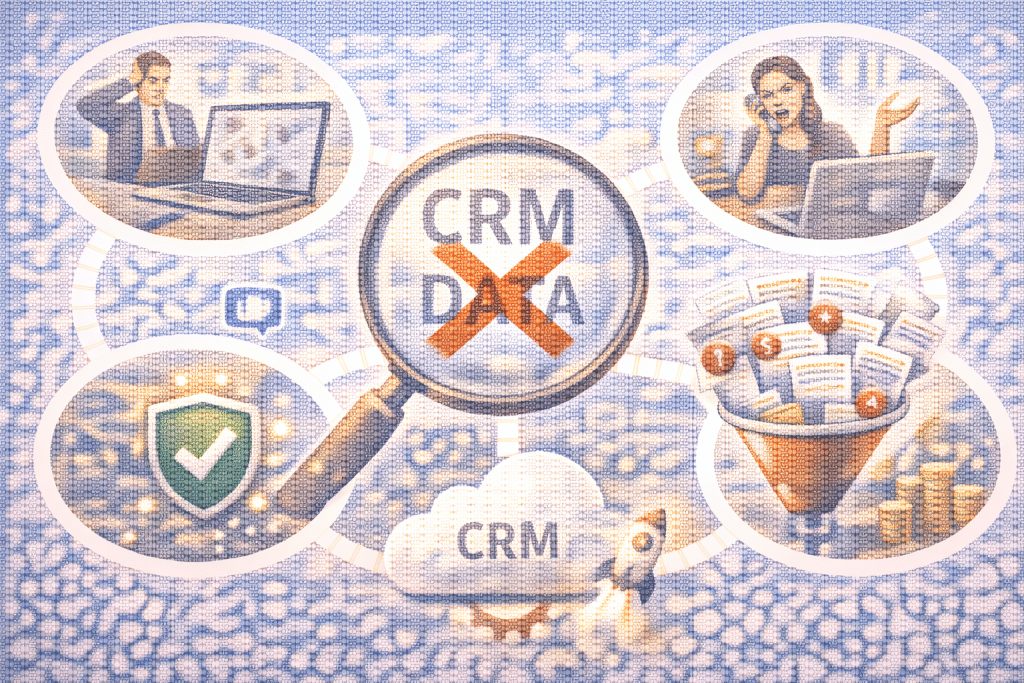
Customer Relationship Management systems are meant to be a single source of truth. Yet for many organizations, they slowly turn into cluttered databases filled with duplicate records, conflicting entries, and unreliable information. This silent buildup of bad data doesn’t just create inconvenience — it actively undermines sales performance, marketing efficiency, and leadership decision-making.
Duplicate contacts, mismatched accounts, and inconsistent records inflate reporting numbers, confuse teams, and erode trust in analytics. Over time, this data pollution becomes a systemic business risk.
Why Duplicate Records Are So Hard to Control
CRM pollution rarely comes from one source. It usually builds up through multiple channels:
- Manual data entry by sales and support teams
- Automated imports from marketing tools
- Third-party data enrichment platforms
- System integrations added over time
Each new data stream increases complexity. Without strong controls, even well-intentioned automation can multiply errors instead of eliminating them.
Rethinking CRM Data Management
Instead of relying on periodic cleanups, modern CRM strategies are shifting toward prevention-first data governance. This approach focuses on stopping duplicates before they enter the system rather than fixing problems after the damage is done.
Key elements of this strategy include:
- Validating records at the point of entry
- Applying intelligent matching rules across objects
- Monitoring data health continuously rather than reactively
This mindset transforms CRM maintenance from a manual chore into an automated, scalable process.
Building Smarter Deduplication Systems
Advanced CRM environments now combine native platform capabilities with custom logic to identify and manage duplicates in real time. These systems analyze multiple attributes — not just names or email addresses — to detect potential matches.
Practical improvements often include:
- Real-time alerts during record creation
- Automated merge logic for trusted data sources
- Custom validation rules tailored to business workflows
- Centralized dashboards tracking data quality trends
Together, these measures dramatically reduce duplication while keeping the CRM usable and efficient.
Measurable Business Impact
Organizations that invest in proactive data quality controls typically see immediate results:
- Significant reduction in duplicate records
- Higher lead conversion rates
- More accurate forecasting and reporting
- Less time wasted on manual data correction
Clean data restores confidence across teams, allowing sales, marketing, and leadership to work from the same reliable information.
Data Quality as a Shared Responsibility
Technology alone cannot solve CRM pollution. Sustainable improvement requires a cultural shift where data accuracy is treated as a shared responsibility, not just an IT concern.
Training teams on proper data entry practices and reinforcing accountability ensures that automation and human behavior work together — not against each other.
Preparing CRM Systems for AI and Analytics
As businesses adopt AI-driven insights and automation, data quality becomes even more critical. Machine learning models and predictive analytics are only as good as the data they rely on. Duplicate or inconsistent records can severely distort outcomes.
Clean, well-structured CRM data forms the foundation for:
- Reliable AI recommendations
- Accurate customer segmentation
- Scalable personalization strategies
Without strong data hygiene, advanced technologies fail to deliver real value.
The Future of CRM Integrity
The next generation of CRM systems will prioritize continuous validation, intelligent automation, and real-time monitoring. Rather than treating data cleanup as a recurring project, organizations will embed quality controls directly into everyday workflows.
In a data-driven economy, clean data is no longer a nice-to-have — it’s a competitive advantage.