

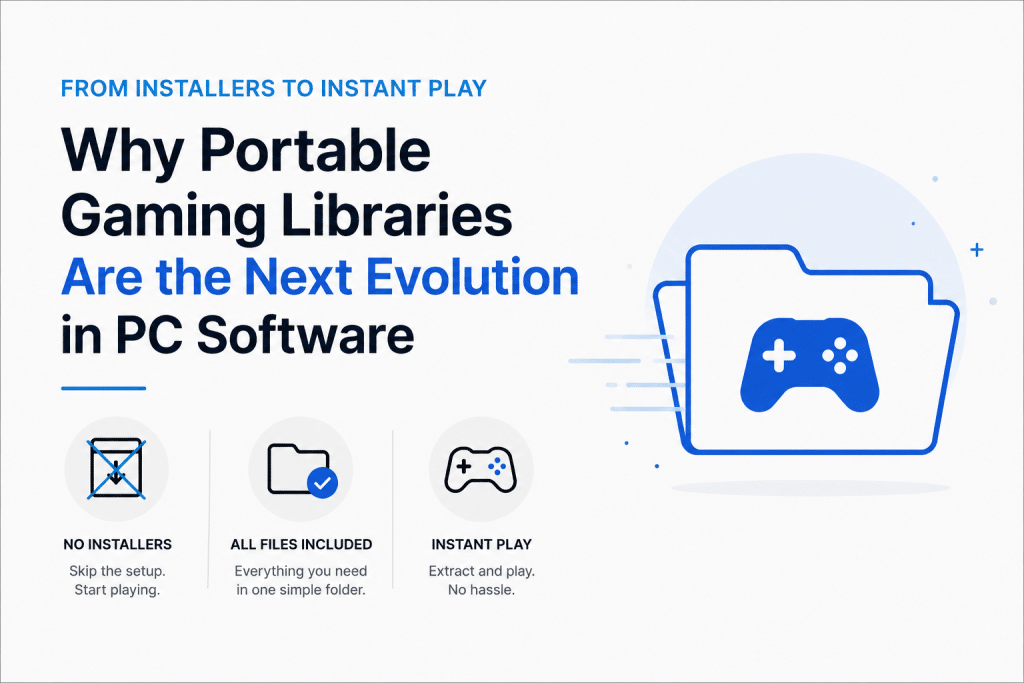
There’s a quiet revolution happening in how we use software, and most people haven’t noticed because it’s defined by what’s missing. No installers. No setup wizards. No configuration screens asking which components you’d like to include. The trend across nearly every category of desktop software is toward portability — applications that work the moment you open them, with no installation step at all. And gaming, the last major holdout in this shift, is finally starting to follow.
The signs are everywhere if you know where to look. Developers distribute tools as single executables that run from any folder. Creative software ships as self-contained packages with every dependency bundled inside. Even complex enterprise platforms are moving toward browser-based interfaces that require nothing on the local machine. The assumption that software needs to be “installed” — written into registries, scattered across system directories, woven into the operating system — is fading fast.
How We Got Here
Traditional software installation made sense when it was designed. In the 1990s and early 2000s, computers had limited storage, limited memory, and operating systems that expected shared libraries. If five programs all needed the same graphics library, it was efficient to install that library once in a system directory and let every program reference it. Installers existed to orchestrate this sharing — putting the right files in the right places so everything could find what it needed.
The problem is that shared dependencies create shared fragility. Update one library for one program, and three others break. Install a new application that ships a slightly different version of a component, and suddenly your old applications start throwing errors. This is the infamous “DLL hell” that plagued Windows users for decades, and it was never really solved — it was just tolerated, because the alternative seemed worse.
The alternative, it turns out, was better all along. Modern hardware has enough storage and memory that sharing libraries between applications is no longer necessary. A portable application that bundles its own copy of every dependency is slightly larger on disk but dramatically more reliable. It doesn’t care what else is installed on your system. It doesn’t write to the registry. It doesn’t conflict with anything. It just works.
Gaming’s Installation Problem
If any software category should have adopted portability first, it’s gaming. Players aren’t system administrators. They don’t want to troubleshoot Visual C++ runtime errors or figure out which version of DirectX a ten-year-old game expects. They want to play. Every minute spent wrestling with an installer, downloading redistributables, or restarting after a failed setup is a minute that actively works against the reason someone sat down at their computer in the first place.
Yet gaming clung to the traditional installation model longer than almost any other software category. Part of this was technical — games are large, and bundling dependencies increases file sizes. Part of it was commercial — storefronts built their ecosystems around installation pipelines that handle DRM checks, account verification, and update management. The installer wasn’t just a delivery mechanism. It was a control point.
But players, especially PC players, have been pushing back against this for years. The popularity of portable game builds — pre-configured packages that include everything a game needs to run — has grown steadily as players discovered that the installation step was never adding value to their experience. It was adding friction. And friction, in software, is something users eventually find a way to eliminate whether the industry helps them or not.
The Pre-Installed Model
The concept behind portable game libraries is the same one driving portability everywhere else in software. Instead of distributing a game as an installer that assembles the final product on the user’s machine, distribute it in its already-assembled state. Every file is where it needs to be. Every dependency is included. Every configuration has been tested. The user downloads an archive, extracts it to any location they choose, and launches the game directly.
This approach eliminates entire categories of support issues. There are no missing DLL errors because every required DLL is in the game’s directory. There are no framework version conflicts because the game carries its own framework. There are no registry-dependent launch failures because nothing relies on the registry. The game is self-contained in the truest sense — it depends on nothing outside its own folder.
Several platforms have built large-scale libraries around this model. Visit SteamUnlocked to see one that has scaled to over 20,000 and counting titles spanning decades of PC gaming history. The breadth of that catalog illustrates something important about the portable model: it works for everything. New releases, legacy titles from the early 2000s, indie games, AAA franchises — the approach is the same regardless of the game’s age, size, or complexity. If it runs on PC, it can be packaged as a portable build.
Portability as Preservation
There’s a dimension to this shift that extends beyond convenience. Software preservation is becoming a genuine concern as digital storefronts delist titles, publishers shut down authentication servers, and games that were sold as permanent purchases become permanently inaccessible. When a game depends on an installer that phones home to a server that no longer exists, the game is effectively dead — even if every file is still on the user’s hard drive.
Portable builds don’t have this vulnerability. A self-contained game package from 2008 will launch on a machine in 2028 the same way it did the day it was packaged, because it has no external dependencies that can be revoked. The game exists as a complete, independent artifact. It doesn’t need permission from a server. It doesn’t need a storefront to validate it. It doesn’t need anything except the hardware to run it on.
This makes portable game libraries one of the most effective forms of software preservation currently operating at scale. Not by design, necessarily, but by consequence. The same properties that make portable builds convenient for players — self-containment, independence from external services, compatibility across system configurations — also make them resilient against the forces that typically cause software to become unavailable over time.
Where This Goes
The trajectory is clear across the software industry. Complexity at the point of delivery is a liability, not a feature. Users have demonstrated, consistently and across every platform, that they will choose the option with less friction. Portable applications won. Containerized services won. Browser-based tools won. In every case, the solution that eliminated the installation step outcompeted the one that required it.
Gaming is following the same path, just on a longer timeline. The technical barriers — large file sizes, platform-specific optimizations, complex dependency chains — are real but diminishing. Storage is cheaper than ever. Bandwidth is faster than ever. And the tools for packaging self-contained applications are more mature than they’ve ever been.
The question isn’t whether portable game libraries will become the norm. It’s how long the industry will take to acknowledge that they already are.