

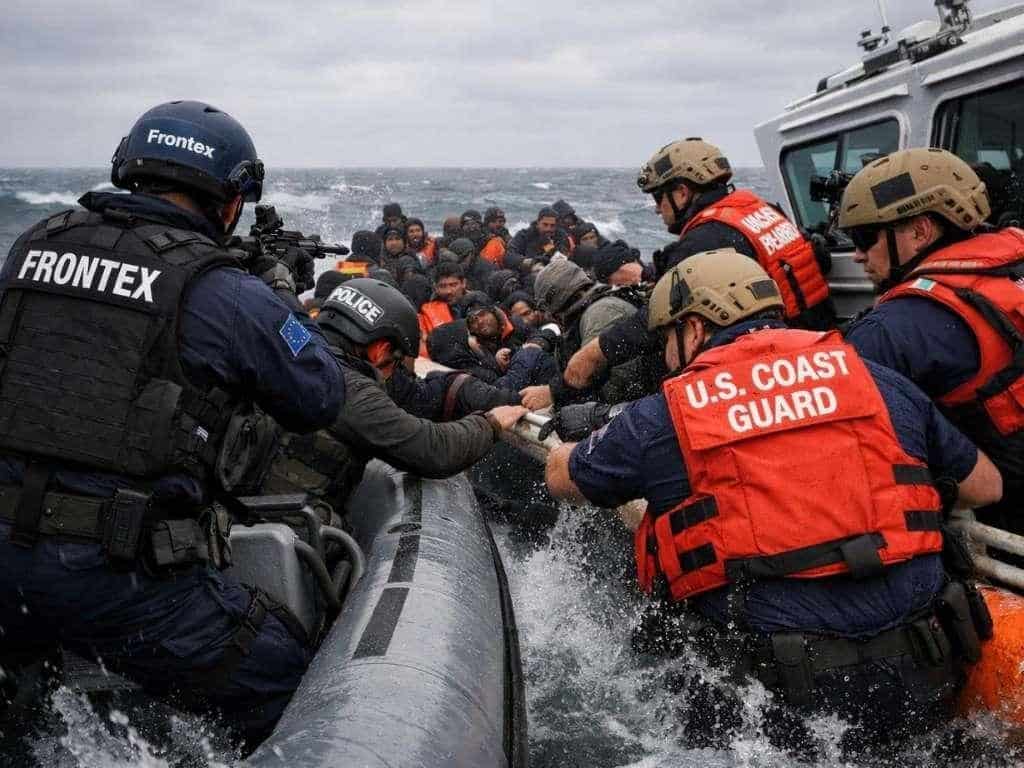
Outside the capitals of Brussels and Berlin, far from the sterile debates of policy briefs and diplomatic communiqués, the reality of modern migration is raw, immediate, and often tragic. For years now, the Mediterranean Sea — once synonymous with sun-lit tourism and leisurely navigation — has become a central, volatile stage in Europe’s reckoning with mass migration. Small wooden boats and overcrowded dinghies laden with hope and desperation arrive at island shores and rocky coves, threading through a labyrinth of geopolitical failures, economic inequalities, climatic upheavals, and conflict-induced displacement. The swell of sea crossings has tested the limits of European border policy, raised urgent ethical dilemmas, and, importantly, forced a reassessment of how Europe prepares those it deploys to manage such complex human flows — from the frigid corridors of ministries to the front lines at sea.
At the heart of this complicated response is an expanding European border apparatus that, until recently, many outside Brussels barely knew existed. Aspiring border officers increasingly turn to Frontexprep course programs to navigate the maze of requirements and expectations that come with joining the bloc’s external border force. These preparatory courses — combined with focused training for a Frontex English test — have become essential tools for candidates whose mission will bring them face-to-face with the harrowing realities of sea migration. Yet these preparatory steps cue a broader challenge: how can a uniformed external border guard, forged in classroom simulations and testing environments, be ready for a sea crossing that, in real life, can be a matter of life, death, and moral hazard?
This is not an abstract policy dilemma. The statistics, shocking in their own right, tell a human story. The European migrant crisis of 2015–2016 saw more than 1.3 million people reach EU shores, chiefly across the Mediterranean, leaving an indelible mark on both politics and public consciousness. Efforts to manage sea migration have grown more sophisticated since then: coordinated rescue missions, aerial surveillance programs, bilateral agreements with out-of-region governments, and joint military-civilian patrols are a testament to the scale of the challenge. Even operations dating back to the mid-2000s, like Operation Hera — an EU-backed maritime initiative aimed at intercepting irregular migrant vessels off West Africa — reflect long-standing attempts to manage irregular trans-Mediterranean movement through coordinated action.
But the Mediterranean is more than a transit route — it is a mirror. The challenges of managing sea migration expose Europe’s deepest unresolved tensions: between security and compassion, sovereignty and shared responsibility, immediate deterrence and long-term integration. For frontline personnel, this means confronting real-world messiness that policy papers can’t fully anticipate. Savvy recruiters know this, which is why today’s Frontex recruitment campaigns don’t just screen for physical and procedural competency — they also seek cultural awareness, psychological resilience, and, crucially, the judgment to make life-saving decisions under pressure.
Yet recruitment is only part of the story. What happens when those recruits step into the waves themselves?
The Mediterranean’s notorious currents and storms can be merciless. Every year, thousands attempt routes that range from the perilous Central Mediterranean passage between North Africa and Italy to the treacherous Aegean crossings from Turkey to Greece. Each route is a military-grade test of human endurance: unseaworthy vessels, unpredictable weather, and overcrowding make every journey a gamble with mortality. And each arrival — successful or tragic — lands squarely on the shoulders of those tasked with both rescue and enforcement.
In many ways, this dramatic maritime theater has reshaped European border management. Frontex — the European Border and Coast Guard Agency created to coordinate member states’ external border responses — has grown from a modest coordinating body into a robust operational force. Its staff and budget have ballooned in the last decade, and its mandate now encompasses aerial and maritime surveillance, rapid deployment teams, and increasingly standardized protocols for border intervention. By 2027, the Standing Corps — the agency’s uniformed contingent — is expected to reach 10,000 officers.
Yet expansion brings scrutiny. Critics argue that mounting the institutional machinery to ‘manage’ migration has, in some cases, come at the expense of human rights protections. Reports and investigations have highlighted troubling practices — including allegations of pushbacks and unlawful returns — that run contrary to international obligations. These controversies spotlight the moral intricacies inherent in balancing border control with humanitarian obligations: a legal tightrope that, in the splash of a keel hitting the waves, becomes deeply personal and urgent. Frontline decision-makers, from commanders to rank-and-file officers, must interpret and act within frameworks that sometimes change faster than the sea swells they monitor.
So in parallel with recruitment campaigns and language or procedural screening tests, there is a pressing need to fortify the ethical and human dimensions of border work. It is not enough to certify that an officer can navigate checklists and vessel patrol patterns; they must also be equipped to handle the raw, unpredictable human realities that unfold miles from shore. Training programs increasingly include scenario-based modules, simulated rescue operations, and legal briefings on asylum law, yet substantial gaps remain between institutional training environments and the unpredictable poetic chaos of human migration.
In reflecting on Europe’s efforts to manage Mediterranean waves of migration, it’s essential to pull back from the tactical minutiae of operations and ask the larger question: What kind of border regime do we want, in practice and in principle? If the goal is deterrence at any cost, then no amount of training or recruitment refinement will soften the moral dissonance of the task. If, however, the priority is to uphold human dignity while managing legitimate security concerns, then Europe’s border workforce must be selected and prepared with extraordinary care, sensitivity, and foresight.
Ultimately, the story of sea migration in Europe is not just about policy mechanics or border enforcement statistics. It is a story of humanity; of families fleeing war and climate devastation, of frontline responders making snap decisions in moments of crisis, of institutions wrestling with values that run deeper than any bureaucratic directive. As the Mediterranean continues to be both a crossroads and a crucible for modern migration, Europe’s ability to manage the sea waves of human movement will remain one of its most consequential tests.
Whether Frontex and its member states rise to meet that test with accountability, compassion, and integrity is a question not just of border management, but of who Europe chooses to be in the chapter of history unfolding on its southern horizon.