

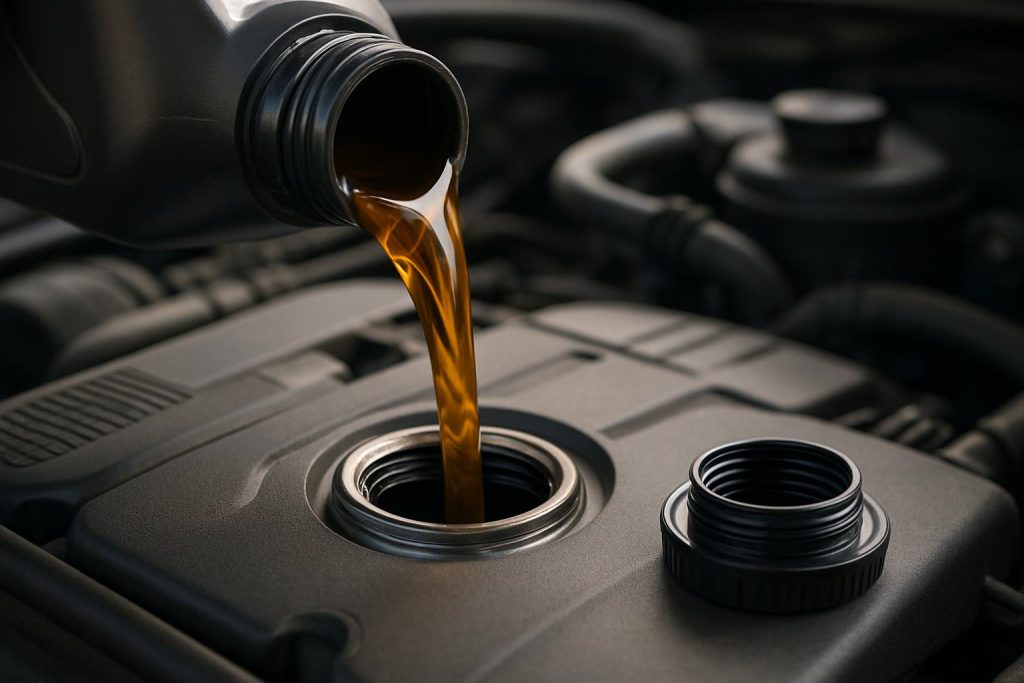
So, how often should you change your oil? This is one of the most discussed topics of vehicle maintenance. But it is also one of the most misinterpreted. Some of the suggestions are old rules. Others are manufacturer-specific guidelines.
This leaves many drivers in Virginia Beach clueless about what is relevant to their car. The answer to this question is in:
- How you drive
- The type of oil you use
- The condition of your vehicle.
Read on to learn more about this.
The old 3,000-mile rule explained
For decades, motorists were advised to replace their oil every 3,000 miles. This guideline was based on:
- Older engine designs
- Lower quality oils
- Less precise manufacturing standards.
But modern cars enjoy the advantages of:
- Tighter engine tolerances
- Advanced oil formulations
- Improved fuel combustion.
In most newer-model vehicles, 3,000 miles is not necessary. Except when you drive in extreme conditions.
Manufacturer-recommended oil change intervals
The owner’s manual of your car is the surest source of information on when to change oil. The majority of contemporary vehicles suggest intervals between 5,000 and 10,000 miles. But this depends on the kind of oil used and engine type.
Factors that manufacturers keep in mind are:
- Engine materials
- Cooling efficiency
- Oil capacity and filtration.
Many people often fail to adhere to the manufacturer’s instructions or assume intervals. This may result in over-maintenance or over-wearing of the engine.
Oil quality matters more than mileage
Oil is not just a lubricant. It plays different roles:
- Cools engine parts
- Lubricates internal surfaces
- Inhibits corrosion.
High-quality oil goes a long way. It:
- Resists heat breakdown
- Maintains viscosity longer
- Catches contaminants better.
Your car mileage might be low. But oils of lower quality degrade more quickly. This explains why two motorists having the same vehicles might require an Auto Service Virginia Beach VA at different periods. It is equally crucial to select quality oil as it is to choose the right timing.
Synthetic or conventional oil: Which is better?
Oils do not all work the same. It is worth noting that the kind of oil that is used directly influences the frequency of change.
Conventional oil has these characteristics:
- Breaks down faster
- Is more sensitive to heat
- Requires changes on shorter intervals.
On the other hand, synthetic oil is:
- More stable at higher temperatures
- Lasts longer under stress
- Provides more protection to modern engines.
Use the oil recommended for your car.
Your driving conditions reduce oil lifespan
Your driving is so much more important than the number of miles you drive.
Some conditions that might demand more regular oil changes include:
- Small journeys that do not warm the engine up completely
- Stop-and-go city traffic
- Frequent idling
- Towing or hauling loads.
A lot of drivers enter the “severe service’’ category unknowingly.
Time matters even if you don’t drive a lot
It is not only about mileage. Even when the vehicle is not in motion, oil degrades.
If you drive infrequently, this is what happens:
- The oil can retain moisture
- Additives break down
- Pollutants are not burnt away.
The majority of manufacturers suggest that the oil needs to be changed at least once every 12 months. It doesn’t matter how many miles were covered.
Oil change indicators and monitors
Most cars have oil life monitoring systems. They compute service intervals depending on the driving behavior, rather than on mileage.
These systems track:
- Engine temperature
- Driving frequency
- Load conditions.
These metrics are helpful. But they are not always right. Drivers are advised to regularly check the condition and level of oil. The experts at the London Bridge Auto and Transmission Repair Shop Virginia Beach can help with that. This is especially important when the vehicle is old or when it is used aggressively.
The role of oil filters
The oil filter plays an equally important role as the oil itself. A plugged or poor-quality filter enables contaminants to pass through the engine.
Quality filters play these roles:
- Trap microscopic debris
- Ensure the correct pressure of oil
- Extend oil effectiveness.
Do not reuse old filters or select bad filters. This affects the whole process of changing oil.
What happens when you neglect oil changes
Failure to change oil does not result in immediate failure. This is why the risk is not taken seriously. The harm occurs over time and internally.
Effects of untended oil service include:
- Increased friction and heat
- Rapid wear on bearings and camshafts
- The presence of sludge. This limits the flow of oil.
Eventually, oil ceases to shield metal surfaces. Internal damage might be very extensive. It can be costly to repair by the time symptoms become apparent.
The bottom line
The right oil change timing depends on:
- Your vehicle
- Type of oil
- Driving environment
- Maintenance practices.
Neglecting the oil changes might not have an immediate negative impact. But the resulting damage to the engine is irreversible over the long run.
Learn how oil functions and work out the periods of service accordingly. This is probably the most efficient method of extending the engine life.