

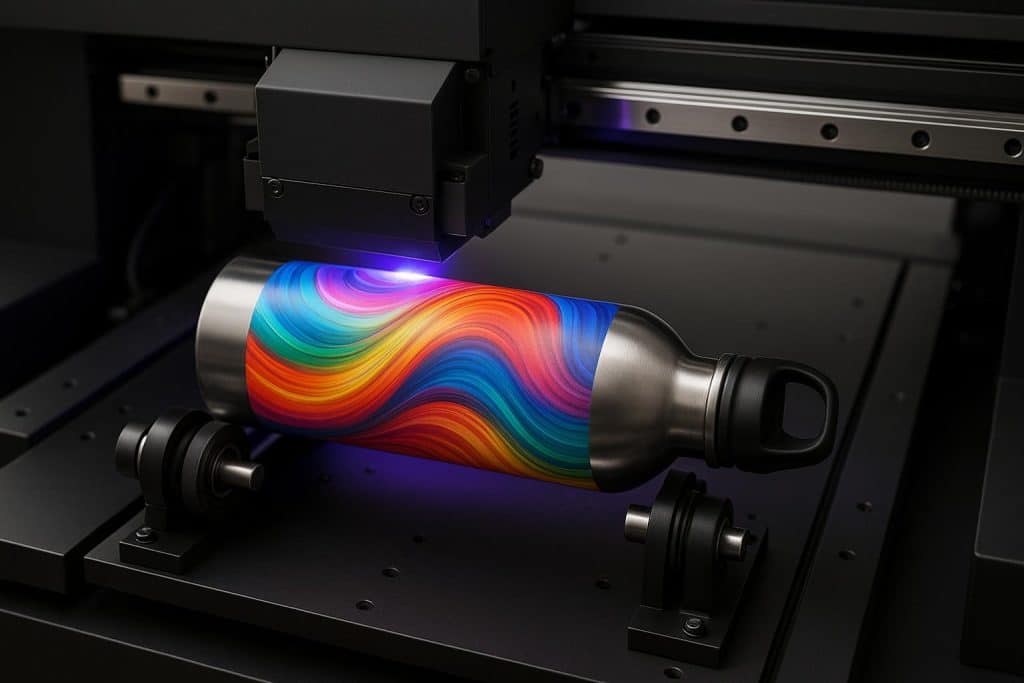
For most of modern printing history, the cylinder has been the enemy. Curved surfaces don’t hold flat designs, ink doesn’t transfer evenly across bends, and anything shaped like a bottle or tumbler has required expensive specialized equipment to decorate. That limitation held for decades. What’s changed recently is that an entire category of affordable, compact rotary UV printers has emerged, and it’s quietly become one of the most interesting corners of the custom manufacturing world.
The businesses moving fastest in this space are capturing a market that didn’t have good options before. Here’s what’s driving the growth, what the equipment does, and why cylindrical printing has become the breakout category of the decade.
The Curved Surface Problem
Every major printing method developed in the 20th century was designed around flat substrates. Screen printing works best on flat t-shirts. Heat transfer requires flat surfaces to press. Offset, flexographic, and digital flatbed systems all assume a planar surface. When manufacturers needed to decorate cylindrical products — bottles, tumblers, pens, vape devices, tool handles, candles, cups, and hundreds of other items — they had to fall back on pad printing, hot stamping, or labels. Each of these methods has serious limitations: pad printing is slow and color-restricted, hot stamping is limited to metallic foils, and labels peel or wrinkle over time.
That’s why the emergence of compact rotary UV systems has been such a genuine shift. For the first time, small and mid-sized shops can produce full-color, wrap-around decorations on curved objects at speeds and costs that make sense for short and medium runs.
How Rotary UV Printing Actually Works
The mechanical principle is elegant. The product — typically a bottle, tumbler, or similar cylinder — is clamped between two rotating cones or pins on a motorized axis. The print head moves horizontally along the length of the product while the product rotates at a synchronized speed, essentially unrolling the surface under a print path. UV-curable ink is deposited in microscopic droplets and instantly cured by LED lamps following behind the print head. The result is a seamless full-color image that wraps around the entire cylinder.
What makes this approach so powerful is the combination of flexibility and durability. Rotary UV systems can handle objects of varying diameters without reconfiguring. The cured ink bonds tightly to glass, metal, plastic, ceramic, and coated surfaces. And because UV ink cures instantly, there’s no drying time between print and shipping — a product can be decorated, boxed, and on its way to a customer in minutes.
For operators focused specifically on this category, dedicated 360° rotary UV printing equipment has become the standard investment, designed from the ground up for continuous cylinder decoration rather than bolted onto flatbed systems as an afterthought.
The Product Categories Driving Demand
The list of products benefiting from rotary UV capability is longer than most people expect:
- Drinkware: Insulated tumblers, water bottles, coffee mugs, wine glasses, and shot glasses — the biggest single category by volume.
- Personal care: Cosmetic bottles, shampoo containers, lotion pumps, and perfume cylinders — increasingly produced in small custom batches for indie brands.
- Industrial and tool handles: Flashlights, screwdriver handles, branded equipment parts, and promotional tools for construction and trade companies.
- Beverages and craft products: Craft beer bottles, small-batch spirits, artisan sauces, and specialty food products looking for distinctive packaging.
- Candles and home goods: Glass candle jars, vases, and decorative cylinders for the independent home goods market.
Each of these categories has seen dramatic growth in custom and small-batch production over the last three years, with rotary UV as the enabling technology.
Why Small Manufacturers Are Winning
Large contract manufacturers still dominate high-volume decoration — bottle runs in the hundreds of thousands, for instance, still go to industrial facilities with robotic lines. But the economics of rotary UV printing favor smaller operators in one crucial way: setup costs. Because there are no screens to prepare, no plates to burn, and no consumables to swap per job, a small shop can profitably accept orders of 25, 50, or 200 units that large facilities wouldn’t touch.
That’s exactly where the market is growing fastest. Small craft brands need low minimums. Regional companies need short-run promotional products. Independent beverage makers need packaging differentiation without committing to massive inventory runs. The demand for flexible, short-run cylinder decoration is enormous, and compact rotary UV printers are the tool meeting that demand.
What to Look For in Equipment
Buying a rotary UV printer is a meaningful capital decision, and specs matter. Print head quality (Epson i3200 and i1600 are current professional standards), number of ink channels (CMYK plus white and varnish is ideal), maximum product diameter and length, and rotation accuracy all directly affect what a machine can produce. The difference between a cheap unit and a commercial-grade one becomes obvious within the first months of production — cheap machines struggle with color accuracy, registration, and durability under daily use.
Manufacturers such as MTuTech have built their product ranges around the specific requirements of US-based custom manufacturers in this space, offering rotary and hybrid UV systems designed for the kind of workflows small and mid-sized shops actually run.
The Bigger Picture
Cylindrical and rotary UV printing represents more than just a new niche. It’s part of a broader shift toward decentralized, small-batch, customized manufacturing reshaping how products get made in the US. The combination of affordable equipment, flexible production, and direct-to-consumer distribution has opened entire product categories to entrepreneurs who couldn’t have competed in them a decade ago.
For anyone watching manufacturing trends, this is the category to pay attention to. The businesses being built around rotary UV capability today are the ones likely to dominate custom product categories years from now. The window is still open, but the serious operators are already taking their positions.