

New Jersey has a dense concentration of small businesses, schools, sports leagues, and community organizations — all of which periodically need custom apparel. For years, that meant dealing with screen printers who required large minimums, long lead times, and per-color pricing that made small runs expensive.
Direct to Film (DTF) printing has changed that dynamic, and it’s showing up in how NJ businesses and consumers approach custom shirts, jerseys, and branded apparel.
What DTF Printing Actually Is
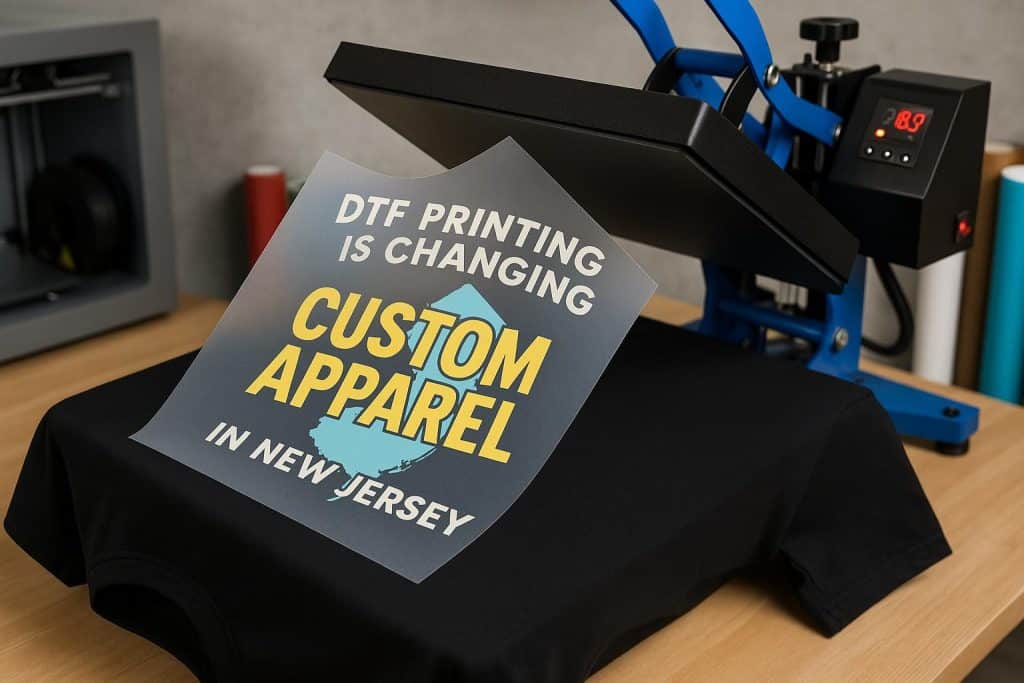
DTF is a process where a design gets printed onto a special film using water-based inks. A white underbase layer is included for dark fabrics. Adhesive powder is applied over the wet ink and cured under heat. The finished transfer gets heat-pressed onto fabric, and the film is peeled away, leaving a flexible, full-color print bonded to the material.
The result works on cotton, polyester, rayon, nylon, and most blended fabrics. No pre-treatment required. No minimum order by nature of the process. The design quality — sharpness, color accuracy, durability — is comparable to what you’d expect from professional screen printing.
What’s different is the economics and turnaround speed.
Why NJ Businesses Are Paying Attention
Screen printing remains cost-effective at high volumes with a single design. A uniform run of 500 identical shirts is where screen printing still makes sense.
But the average New Jersey small business, school team, or event organizer isn’t ordering 500 identical shirts. They’re ordering 20 shirts in three different designs, or 12 staff uniforms that need to be ready by Thursday, or 60 shirts for a graduation party that was planned three weeks ago.
For those use cases, DTF jersey printing in New Jersey has become the practical answer. Suppliers serving the NJ market ship same-day, accept no-minimum orders, and handle full-color designs with no setup fees. DTF Jersey, based in New Jersey, ships transfers the same day they’re ordered — a significant difference for businesses running on tight timelines.
Their full transfers collection covers everything from individual custom transfers to gang sheet ordering for volume buyers.
The Gang Sheet Factor
One of the most cost-effective structures in DTF ordering is the gang sheet. Instead of ordering individual transfers at a fixed price each, you pack multiple designs onto a single large sheet — typically 22 inches wide — and pay per sheet.
A print shop fulfilling 10 different customer designs can tile all 10 on a single gang sheet and pay for the sheet rather than 10 individual transfer orders. The cost per design drops significantly.
This model fits NJ’s business environment well. The state has a high density of small apparel decorators, boutique print operations, and Etsy sellers who regularly need varied designs in small quantities. Gang sheet ordering gives them a cost structure that makes small-batch custom work profitable.
What It Means for the End Consumer
For the person ordering custom shirts for their team, event, or business, the practical outcome is faster delivery at lower cost with no minimums.
You no longer have to order 48 shirts to justify the setup cost. A family of 4 can order matching shirts for a reunion. A local sports team can order 15 jerseys. A school club can get custom shirts for 22 members without a bulk commitment.
The DTF model has effectively democratized custom apparel in a way that wasn’t possible with screen printing’s setup requirements.
The Quality Question
One concern people have about newer printing methods is durability. DTF addresses this directly. Transfers applied correctly — the right temperature, pressure, and timing for the fabric — survive 50+ wash cycles without cracking, fading, or peeling. The water-based inks hold their color through regular laundering.
The white underbase layer means full-color designs look as intended on dark fabrics — something that requires extra setup and cost in screen printing.
For a state like New Jersey with a year-round calendar of events, school activities, sports seasons, and business needs, having a reliable same-day custom apparel option changes how organizations plan and produce branded merchandise.
Looking Forward
DTF printing isn’t replacing every other printing method. Screen printing still wins at high volume. Embroidery remains the standard for certain apparel types. But for the custom apparel use cases that represent the majority of New Jersey’s small-business and consumer demand, DTF has become the practical default.
The combination of no minimums, same-day shipping, full-color output, and competitive pricing makes it the right fit for how NJ businesses and organizations actually operate.