

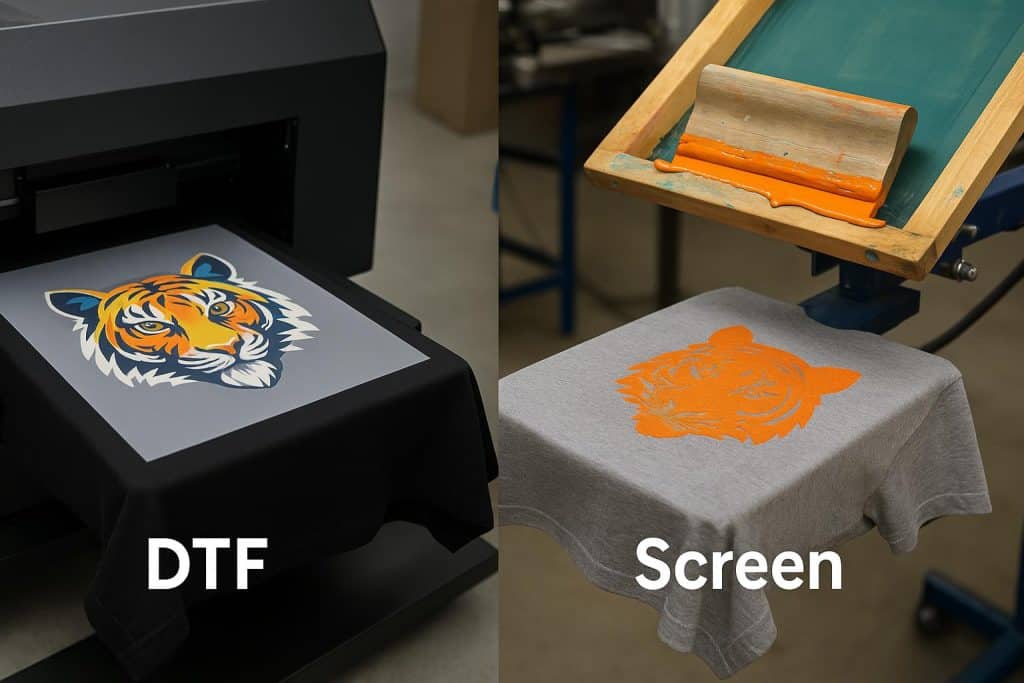
Screen printing dominated custom apparel for decades — and for good reason. At scale, it’s efficient, consistent, and cost-effective. But its economics only hold at volume. For any order under 48 pieces, the setup costs make screen printing the wrong tool. That’s the market segment DTF printing has systematically taken over.
Understanding why this shift is happening — and where it’s going — matters if you’re building a business that touches branded apparel at any level.
The Economics of DTF vs. Screen Print for Small Orders
Screen printing’s cost structure is front-loaded. Before a single shirt is printed, a shop incurs setup costs: film positives, screen exposure, screen coating, registration, and the labor to set up the press. For a two-color design, that’s typically $35-$60 per color in setup fees — $70-$120 before print quantity one.
Once the press is running, per-unit costs drop fast. At 500 shirts, those setup costs are negligible. At 12 shirts, they represent a significant portion of the total invoice.
DTF has no setup cost. The file goes directly into the RIP software, the printer runs, and the transfer is ready. The per-unit cost is higher than screen print at volume — but without any fixed setup overhead, the economics at small quantities flip entirely.
The crossover point varies by design complexity and print shop pricing, but it consistently falls somewhere between 48 and 72 pieces. Below that threshold, DTF produces a lower total cost. Above it, screen print wins.
For the vast majority of small business apparel orders — branded uniforms, promotional shirts, event gear, employee onboarding packages — the quantity is well below that threshold. DTF is not competing with screen printing at the top of the market. It’s dominating a segment that screen printing never served profitably.
What DTF Can Do That Screen Print Can’t
The economic argument alone would be enough. But DTF also extends what’s technically achievable in apparel decoration.
Screen printing requires a separate screen per color. A six-color design requires six setups, six screens, six registration steps. The cost and complexity grow linearly with color count. Full-color photographic artwork — gradients, blended tones, intricate illustrations — is either very expensive or impossible to replicate with spot colors.
DTF prints the full CMYK+W gamut in a single pass. A 12-color illustration costs exactly the same as a one-color logo. Photographic detail, fine gradients, and complex artwork reproduce without simplification or compromise.
DTF also works on the full range of fabric types: cotton, polyester, blends, nylon, canvas. Screen printing on dark garments requires a white underbase print as an additional color — adding cost and setup. DTF handles dark fabric as a standard part of the process.
Who’s Using DTF and Why
The clearest signal that DTF has moved mainstream is the breadth of customers using it. Small businesses ordering staff shirts in quantities of 12-24. Event organizers who need shirts for a fundraiser and can’t commit to a 48-piece minimum. Restaurant groups kitting out new locations on short notice. Boutique clothing brands testing designs before committing to a full production run.
Local print shops specializing in DTF transfer printing, like DTF printing Dallas, TX, have built their entire business model around fast small-run production — which tells you something about where demand is going. The operational model — no minimums, same-day turnaround, single-piece pricing — would have been commercially nonviable in a screen printing operation. DTF technology made it viable, and the market responded.
The growth of this model isn’t a niche trend. It reflects a structural shift in how custom apparel is ordered, priced, and delivered.
When Screen Print Still Makes Sense
Credibility in any market analysis requires acknowledging where the dominant narrative doesn’t hold. Screen printing remains the right answer in specific scenarios.
For orders above 500 pieces with a simple, stable design, screen printing’s per-unit economics are hard to beat. Specialty effects like metallic, puff, high-density, and discharge require different production methods (such as vinyl transfers, discharge printing, or specialty ink processes) and cannot be achieved with standard DTF printing.
For brands where a specific Pantone match is non-negotiable, spot color screen printing provides accuracy that CMYK printing approximates but doesn’t guarantee.
DTF is not the universal replacement for screen printing. It’s the right tool for a specific segment of the market — and that segment turns out to be larger than anyone estimated when DTF printing first became commercially accessible.
The direction of this market is clear. DTF printing is the default choice for on-demand and small-batch apparel decoration, and the gap between local DTF shops and national fulfillment platforms on speed and unit economics continues to widen at the segment where most of the volume lives.