

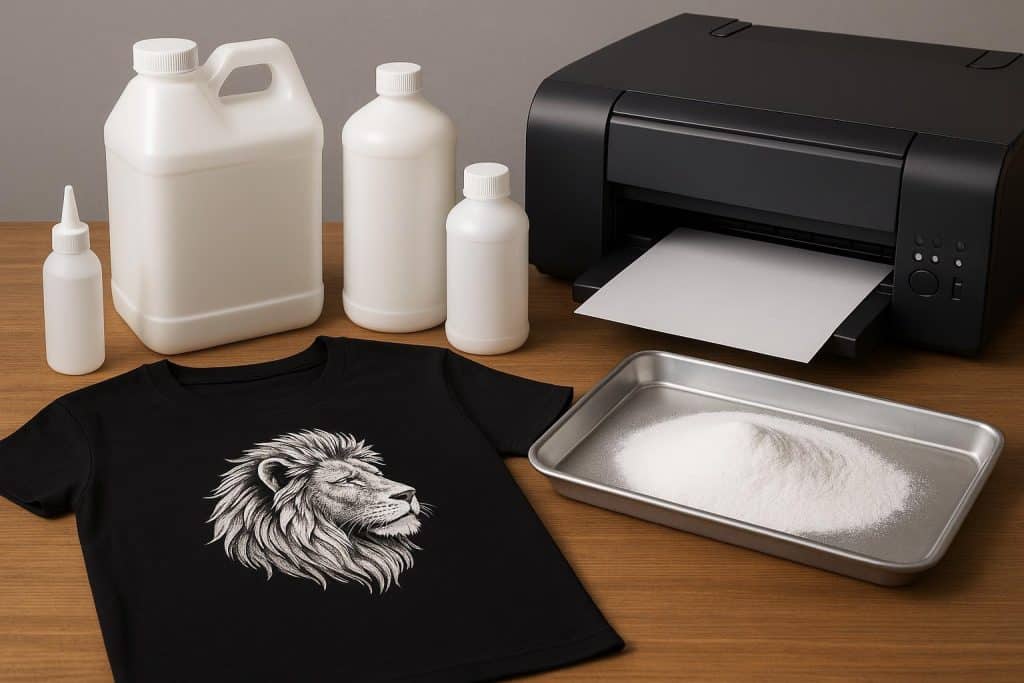
Ask any experienced DTF printer operator which consumable causes the most headaches, and the answer is almost always the same: white ink. It is the most technically demanding ink in the system, the most common source of print defects, and arguably the most important factor in determining the quality of a finished transfer. Yet buyers new to the technology often spend the most time researching printers and the least time thinking about the white ink they will be running through them.
This article breaks down how white ink functions in the DTF process, what can go wrong when you choose the wrong formula, and what to look for when evaluating your options.
The Role of White Ink in DTF Printing
In a standard DTF print workflow, the printer first lays down the CMYK color channels to produce the design image on the PET film. White ink is then applied on top of the color layers as an underbase. When the transfer is pressed onto a garment, this white underbase sits between the color design and the fabric, acting as an opaque foundation that prevents the fabric color from showing through.
This function is what makes DTF printing viable on dark or colored garments. On a black t-shirt, without a white underbase, even saturated color inks would appear nearly invisible. The white layer reflects light back through the color channels, allowing the design to appear as intended regardless of fabric color.
On white or very light garments, the white layer can sometimes be reduced or eliminated depending on the design, but for any shop doing mixed production across fabric colors, white ink will always be in heavy use.
Why White Ink Is Technically Difficult
The properties that make white ink effective are also what make it the most problematic ink to manage. White DTF ink contains titanium dioxide as its primary pigment, which is a dense, heavy compound that tends to settle at the bottom of the cartridge or supply line when the printer sits idle. This settling can cause inconsistent opacity, streaking, or outright print head clogs if the ink is not kept in suspension.
Most DTF printers with white ink channels address this with agitation systems, recirculation loops, or maintenance routines that keep white ink moving. But the ink formulation itself plays a significant role in how quickly and severely settling occurs. Poorly formulated white ink with large pigment particles or inadequate suspension agents will settle faster and more densely, creating problems that no maintenance routine fully solves.
Clogging is the other major failure mode. White ink clogs are more severe than CMYK clogs because the titanium dioxide particles are abrasive and can become semi-permanent blockages in print head nozzles if the ink dries inside the head. Print head replacement is expensive, and repeated clogging cycles are a leading cause of premature head failure in high-volume DTF operations.
What to Look For When Buying DTF White Ink
Pigment particle size. Smaller, more uniform pigment particles suspend more easily and settle more slowly. Reputable manufacturers will have data on their particle size distribution. This is one of the clearest technical differentiators between premium and budget white ink formulas.
Viscosity at operating temperature. Like all DTF inks, white ink needs to fall within the viscosity range specified by the print head manufacturer. Inks that are too thick at operating temperature will not fire correctly and will stress the print head. Quality suppliers publish viscosity specifications and test their formulas across the temperature range typical in a production environment.
Opacity per pass. Some white ink formulas require multiple print passes to achieve sufficient opacity on dark garments, which increases ink consumption and slows production. A high-quality formula should deliver strong, consistent opacity in a single pass for most applications.
Chemical compatibility. White ink that contains additives corrosive to print head components will shorten head life even if it does not cause immediate clogging. This is difficult to evaluate without long-term testing, which is why buying from suppliers with an established reputation in the U.S. market is important.
Supplier support. White ink issues can be difficult to diagnose without help. A good supplier should be able to walk you through troubleshooting when settling, clogging, or opacity inconsistencies occur.
Where to Buy DTF White Ink
One option worth considering for U.S.-based print shops is DTF Printer USA, which offers dtf white ink at $12.55 per liter. At that price point, the cost per transfer for the white channel remains manageable even at moderate production volumes. The company ships from their Stafford, Texas facility and carries a full range of complementary supplies including CMYK inks, transfer films, and hot-melt powders.
For shops that are new to DTF or switching ink brands, DTF Printer USA also offers setup support and technical guidance. Their set up service page outlines what assistance is available for buyers getting their systems dialed in.
Managing White Ink Day to Day
Regardless of which ink you choose, good white ink management practices matter. Run daily nozzle checks to catch settling-related clogging early. Never let white ink sit idle in the head for extended periods without running a purge or maintenance cycle. Store bulk ink in a cool, stable temperature environment and agitate before filling. If your printer has a white ink recirculation system, keep it running during production hours.
White ink is the one input in a DTF system that rewards attention. The shops that consistently produce high-quality transfers on dark garments are almost always the ones that take white ink management seriously, starting with choosing a formula that is engineered to perform.