

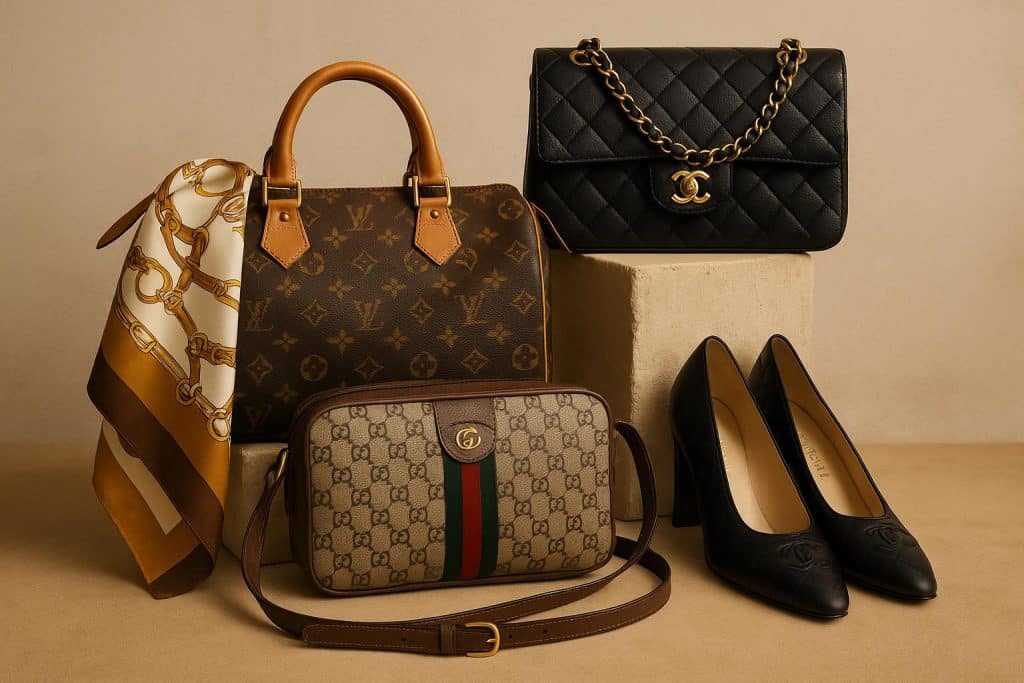
The way people buy and sell high-end fashion has changed considerably over the past decade — and the numbers now confirm what many in the industry have been watching for years. Vintage luxury fashion has moved well beyond the collector’s market and into the mainstream, with buyers in the UK and across the GCC actively choosing pre-owned pieces not just for their price, but for what they represent: quality, provenance, and a kind of individuality that new-season collections rarely offer.
Understanding what’s driving this shift — and what it means in practical terms for anyone looking to buy or sell — is worth unpacking properly.
The Market in Numbers
The global secondhand luxury market is growing at a compound annual growth rate of approximately 10%, with projections running through to 2029. Online platforms account for over 72% of total resale transactions, and that proportion is still rising as authentication technology improves and consumer confidence grows.
The UK’s secondhand fashion market has crossed the £7 billion mark, with close to one in four fashion transactions now involving resale, according to OC&C Strategy Consultants. The country also leads the European secondhand luxury goods market with an 18.3% share in 2025 — a position built on a well-established resale culture, strong brand literacy, and a consumer base that’s comfortable shopping online.
In the GCC, the picture looks different but equally significant. The region’s secondhand luxury goods market was valued at USD 617.3 million in 2024 and is projected to reach USD 1.5 billion by 2033, growing at a CAGR of 9.94%. This is happening against a backdrop in which the GCC’s personal luxury spend reached USD 12.8 billion in 2024 — up 6% year-on-year, even as the global personal luxury market contracted by 2%. The appetite for luxury in this region is not slowing down; it is broadening to include pre-owned and vintage alongside new.
What “Vintage” Actually Means in a Luxury Context
The term “vintage” gets used loosely, and it’s worth being precise about what it means when applied to luxury fashion specifically.
In the fashion industry, a piece is generally considered vintage if it is at least 20 to 30 years old. Items from 25 or more years ago are often classified as “true vintage,” while anything over 100 years old falls into the realm of antiques. Within the luxury category, the term carries additional weight: vintage luxury pieces are typically from established heritage houses — Chanel, Hermès, Louis Vuitton, Gucci, Burberry, Dior — and their value is tied not just to age but to rarity, condition, and the particular era they represent.
Not every old luxury item is a desirable vintage piece. Condition matters enormously, as does provenance (the documented history of ownership), and the cultural or fashion significance of the specific period from which it comes. A Chanel 2.55 bag from the 1980s, for instance, carries different cultural resonance — and, in some cases, a higher resale value — than a current-season equivalent, because it represents a specific moment in the house’s design history.
Why Buyers Are Choosing Vintage
The motivations behind the growth in vintage luxury buying are layered, and they vary somewhat by market.
Rarity and individuality are consistently cited as top drivers. In a market where luxury goods are increasingly mass-produced, vintage pieces offer something genuinely different. A vintage Hermès scarf from the 1970s or a vintage Gucci bamboo bag is not available in any boutique — it exists in limited quantities, and owning one is a statement of taste rather than simply purchasing power.
The financial case for vintage luxury is real, though it applies selectively. Buyers in the UK and the GCC who treat luxury items as both personal and financial decisions tend to focus on categories with a strong resale track record — Hermès Birkin and Kelly bags, Rolex and Patek Philippe watches, and rare Chanel pieces, chief among them. Well-preserved examples with full documentation consistently command strong prices. Not every vintage piece follows this pattern, but for the right categories and houses, the relationship between what you pay and what you can expect to recover is meaningfully different from buying new.
Among younger buyers, especially, sustainability has become a genuine factor in purchase decisions — not just a preference. Deloitte’s 2025 Global Sustainability Survey puts a number to it: 69% of European women under 35 consider environmental impact when buying fashion. Choosing vintage is one of the more straightforward ways to act on that — it extends the life of a garment that already exists rather than generating demand for something new.
Access to discontinued styles is a driver that is harder to quantify but easy to understand. Certain designs — the Fendi Baguette in its original iteration, early Prada nylon pieces, the Dior Saddle bag in specific colorways — were produced for a limited period and are not available new. The only way to own them is through the resale market.
The Authentication Question
Authenticity has always been the biggest concern in the vintage luxury space. Counterfeiting at this level is sophisticated — convincing enough that even experienced buyers can be caught out, let alone someone without a specialist background in a particular brand or category.
Authentication technology has come a long way, and the platforms serving this market have kept pace. AI-powered tools, blockchain-provenance records, and specialist human review are now built into how the best resale platforms operate — not bolted on as extras. For UK and GCC buyers, that shift means the question of authenticity is far more manageable today than it was even a few years back.
The practical implication for buyers is that the risk profile of purchasing pre-owned luxury has changed. Buying through a platform with a rigorous authentication process — one that provides documentation and stands behind its verification — is meaningfully different from purchasing through an unverified listing. Knowing which authentication guarantees are included before completing a purchase is a basic due diligence step for any vintage luxury fashion transaction.
For sellers, authentication certification adds verifiable value to a listing and often translates to a faster sale and a stronger price.
What Drives Value in Vintage Luxury Pieces
For buyers approaching vintage luxury as a considered purchase rather than an impulse, understanding what drives value in this market is useful.
No single factor affects resale value more than condition. Original hardware, a clean interior, and no visible wear translate directly into stronger pricing — and that holds true regardless of how old or rare the piece is.
What comes with a piece matters just as much as the piece itself — and this catches a lot of buyers off guard. Original dust bags, boxes, authenticity cards, and, for watches, service records and papers, all add measurable value. A Rolex with its original box and papers will consistently sell for more than the exact same reference without them.
Era and design significance can add or subtract value depending on the house and the period. For Chanel, pieces from the Karl Lagerfeld era (1983 onwards) command strong prices, as do pieces from the original Coco Chanel period. For Louis Vuitton, vintage monogram canvas pieces from before the house’s collaboration era have a distinct collector following.
When something was made in limited numbers, sold only in certain markets, or pulled from production early, that scarcity tends to show up in the price. Collector demand amplifies this further — the narrower the supply and the more active the interest, the stronger the secondary market valuation tends to be.
The GCC Market: Specific Considerations
For buyers and sellers in the GCC, a few market-specific dynamics are worth noting.
The GCC has historically been a region where new luxury goods have dominated. The stigma around pre-owned items — which existed across multiple consumer categories, not just fashion — has diminished significantly in recent years, particularly as younger, globally connected consumers have driven a cultural shift. Saudi Arabia’s Vision 2030 has also accelerated digital adoption and broader consumption diversification, which includes growing openness to the resale market.
The UAE, and Dubai in particular, functions as the regional hub. It holds the highest luxury market share in the GCC at approximately 56% of regional spend, and its large expatriate population — many of whom are familiar with secondhand luxury from their home markets — has been a consistent driver of resale activity. Platforms operating in this space serve a consumer base that is digitally sophisticated, brand-literate, and increasingly comfortable with online resale.
For GCC buyers shopping from UK-based platforms, one practical advantage is selection. International resale platforms tend to carry a wider range of luxury items than what’s available regionally — vintage and archive pieces in particular, many of which were never widely distributed in the Gulf to begin with. Shipping and logistics are straightforward in most GCC countries, though import duties vary by country and product category and should be factored into the total cost before committing to a purchase.
Selling Vintage Luxury: What to Know
For those looking to sell rather than buy, the vintage luxury market offers a genuine opportunity — but outcomes depend on preparation.
Gathering all original documentation before listing is the single most impactful step a seller can take. Receipts, dust bags, boxes, authenticity cards, and service records all support the listing and the price. Photographs that clearly show the condition of hardware, stitching, interior lining, and any serial numbers or date codes are expected on reputable platforms and speed up the authentication process.
Pricing realistically — based on comparable sold listings rather than aspirational figures — tends to result in faster transactions. The secondhand luxury market is competitive and increasingly transparent; buyers have access to price history data for most sought-after pieces and will benchmark accordingly.
Timing plays a role too, particularly for certain types of pieces. Seasonal items, holiday collections, and anything tied to a specific fashion cycle tend to move faster — and sometimes at better prices — when listed at the right time of year.
The Broader Shift
The data and the buying patterns tell the same story: something has shifted structurally in this market. Vintage luxury fashion is no longer what you buy when new isn’t an option — it’s what a growing number of buyers are choosing first, with a clear sense of what they’re getting and why it matters to them.
For the UK and GCC markets specifically, the trajectory is clear. The infrastructure around authentication, digital platforms, and cross-border logistics has caught up with demand. The cultural shift toward viewing pre-owned luxury as a legitimate — and in many cases preferable — form of acquisition has accelerated. And the pieces themselves, for the right buyer, represent something that new season collections genuinely cannot replicate.
That’s not a niche. That’s a market.