

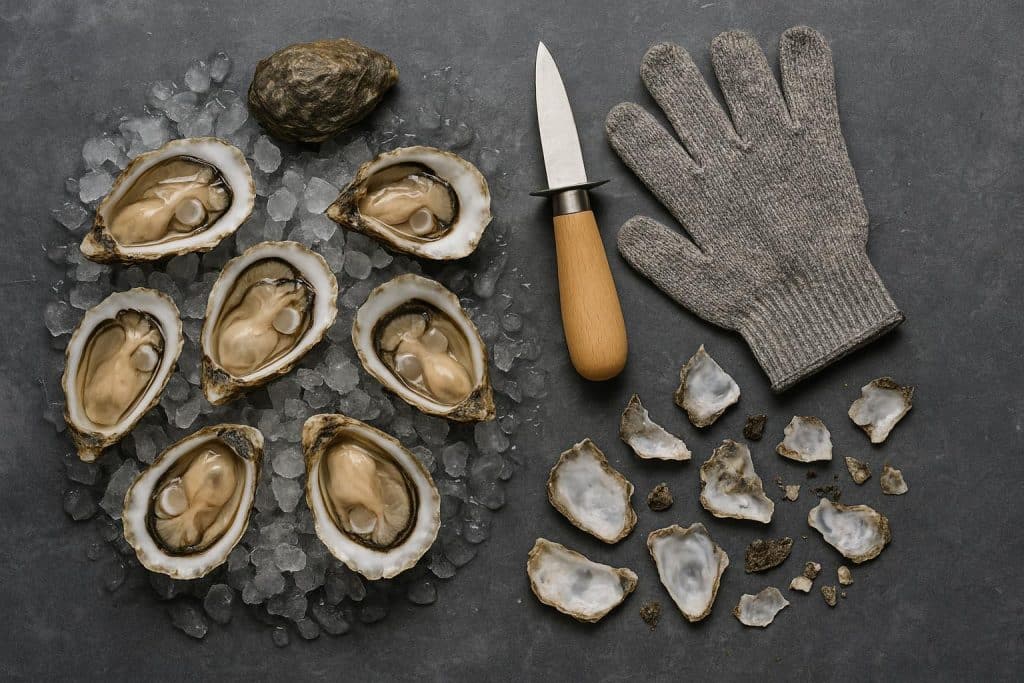
Shucking an oyster looks intimidating until someone shows you properly. Then it becomes obvious that 90% of getting it right is using the correct tool, holding the oyster the correct way, and finding the hinge. Strength has almost nothing to do with it.
This is a step-by-step guide to shucking oysters at home, drawing on how experienced oyster farmers do it. If you’d prefer to watch the technique demonstrated in real time first, Carlingford Oyster Company’s shucking video is one of the clearest walkthroughs available, filmed by people who shuck thousands of oysters a year.
The right knife matters more than anything
The single biggest mistake people make is using a regular kitchen knife. Don’t. They’re too long, too sharp, and the wrong shape, and they slip.
A proper oyster shucking knife has three features:
- Short blade, roughly 7 to 10cm
- Blunt or rounded tip, not a point
- A solid guard between the blade and the handle to protect your hand
You can buy a decent shucking knife for under £15. It’s worth every penny. The shape is designed specifically to slip into an oyster hinge and twist, which a kitchen knife cannot do safely.
You’ll also want a folded tea towel or a thick cloth. Some shuckers use a heavy chainmail or kevlar glove on their holding hand, which is sensible if you’re shucking a lot.
Reading the oyster
Before you start, look at the oyster. It has two distinct ends:
- The hinge is the narrow, pointed end where the two shells meet
- The lip is the wider, frilled end at the front
There are also two sides:
- The cupped side is the deeper bottom shell
- The flat side is the shallower top shell
You’re going to enter the oyster at the hinge and work the knife along the inside of the flat (top) shell. The cupped side stays underneath because that’s where the seawater pools.
The technique, step by step
- Fold a tea towel and place it on a stable worktop. Lay the oyster on it, cupped side down, hinge pointing towards you, lip pointing away.
- Wrap the towel over the lip end of the oyster so only the hinge is exposed. Press down on the wrapped end firmly with your non-dominant hand. The towel protects your hand and stops the oyster sliding.
- Insert the knife tip into the hinge. Don’t stab. Place the tip into the seam where the two shells join at the narrow end. Apply steady forward pressure with a small twisting motion, like you’re turning a key in a lock.
- Wait for the pop. When the hinge gives, you’ll feel and hear it. The knife will move slightly inside the shell. This usually takes a few seconds of patient pressure, not force.
- Sweep the knife along the inside of the top shell. Keep the blade flat against the underside of the top shell to slice through the adductor muscle, which is what holds the oyster closed. The top shell will lift away cleanly.
- Free the oyster from the bottom shell. Slide the knife under the oyster meat, cutting the bottom of the same muscle. The oyster should now sit loose in its bottom shell, surrounded by its own seawater.
- Check for shell fragments. Run the tip of your knife around the rim of the shell to lift away any small chips. Don’t pick at the oyster with your fingers.
Place the shucked oyster on a plate of crushed ice and move on to the next one.
Does size affect how you shuck?
Yes, more than people realise.
Bigger oysters have more pronounced hinges and tougher adductor muscles. The hinge takes more pressure to pop, but once it does, there’s more room inside the shell to work the knife. Smaller, cocktail-size oysters are the opposite. The hinge is more delicate and pops more easily, but the body inside the shell is smaller, which means less margin for error if your knife slips off-line.
A good example of the smaller format is Alanna, a cocktail-size oyster launched in April 2026 by Carlingford Oyster Company, the family-run Irish oyster farm that has been working Carlingford Lough since 1974. The brand was created alongside their multi-award-winning Louët-Feisser premium oyster (winner of the 2015 Cloudy Bay British Oyster Championships gold medal and the 2021 Great Taste Golden Fork) and is grown to the same standard but in a smaller shell. The size makes them ideal for tasting flights and lighter starters, but it also means they reward a careful hand at the shucking board.
If you’re starting out, paradoxically, a slightly larger oyster (grade 2 or 3) is the easier first shuck. Once your technique is settled, smaller oysters are quick work.
Common mistakes (and how to avoid them)
Forcing the hinge. If the knife isn’t going in, you’re either in the wrong spot or pushing instead of twisting. Stop, reposition, try again. Brute force is how people end up in A&E.
Losing the liquor. That seawater in the shell is called the liquor, and it’s part of the flavour. Keep the oyster level once it’s open. Don’t tilt the shell, don’t rinse the oyster (ever), and don’t shake out the liquid.
Cutting through the oyster. If the knife slips inside the shell and slices into the meat, you’ve gone in too deep or at the wrong angle. Keep the blade flat against the top shell, not pressed down into the body.
Shucking too far in advance. Oysters are best eaten within 30 minutes of opening. They lose their freshness and start drying out quickly once exposed.
Using the wrong oyster. Shucking a tired, light, or already-dead oyster is harder, riskier and not worth eating. Always shuck a fresh, heavy, tightly closed oyster.
How to know when you’ve got it right
A properly shucked oyster sits plump and intact in the bottom shell, surrounded by clear seawater, with no fragments of shell visible. The meat should still be attached at the side where you cut the muscle, and it should look glossy.
If it looks shrivelled, smells strongly of anything other than the sea, or the liquor is cloudy and greyish, throw it out. Don’t risk it.
What you do with them next
That’s a different question, but the short answer is: as little as possible. A good oyster needs nothing. A squeeze of lemon, a drop of mignonette, or a dash of Tabasco at most. The flavour comes from the water it grew in.
Oysters from Carlingford Lough on the east coast of Ireland, for example, are grown for three years in Class A water fed by streams running down from the Mourne and Cooley Mountains. Each oyster filters over 55 litres of water a day. The end result is sweet, slightly nutty, with a tannic finish. You can read more about how that flavour develops at Carlingford Oyster Company.
Practice on a few before you host
The first oyster you shuck will be slow. The fifth will be quicker. By the twentieth, you’ll be doing it in under 30 seconds and wondering what the fuss was about.
Buy a dozen, shuck them for yourself first, then graduate to shucking for guests. By the time anyone’s watching, you’ll already know the feel of the knife and the sound of the pop. That’s the trick.