

The VPN market is one of the more confusing corners of consumer software. There are hundreds of options, most of them making nearly identical claims — fastest speeds, strongest encryption, total privacy, best value. The feature lists look the same. The pricing tiers look the same. Even the interfaces look the same.
So how do you actually choose?
The honest answer is that most of the information presented on VPN marketing pages isn’t very useful for making a real decision. What matters is a much shorter list of things — and the single most reliable test isn’t something you can do from a comparison website at all.
The Specs That Actually Matter
Not everything on a VPN’s feature list deserves equal attention. A few things genuinely affect your experience; most are either baseline expectations or marketing padding.
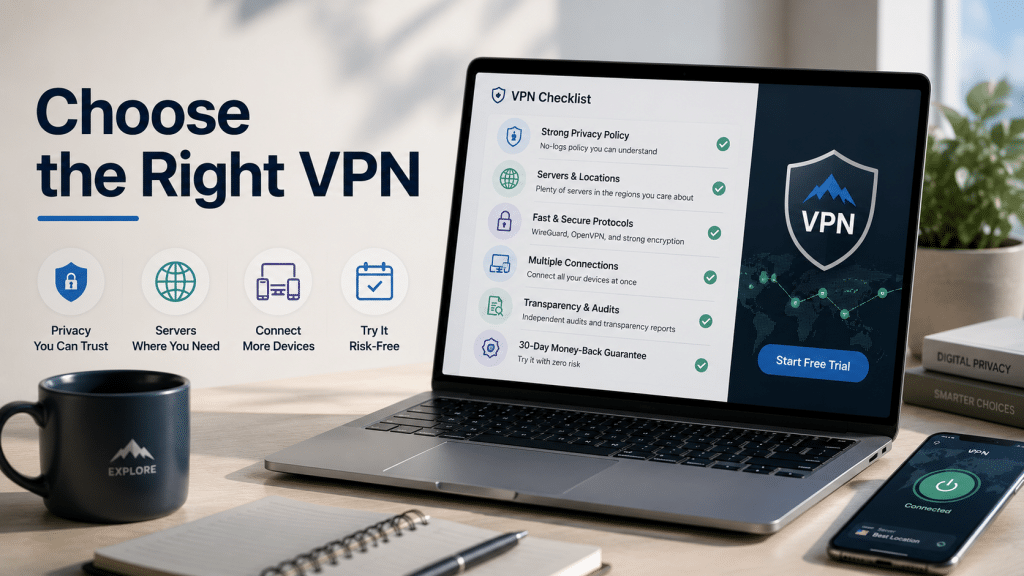
Server count and locations. More servers generally means less congestion and more geographic options. But raw numbers can be misleading — a provider with 5,000 servers concentrated in a handful of countries may serve you less well than one with 2,000 spread across 80. What matters is whether the regions you actually care about are well-covered.
Simultaneous connections. Most VPN subscriptions allow you to connect multiple devices at once — typically between five and ten. If you want to protect your phone, laptop, and a family member’s device under one subscription, check this number before buying.
Protocol support. VPNs use different methods to establish encrypted connections, and the choice affects both speed and security. WireGuard is currently the most widely recommended for general use — it’s fast, modern, and well-audited. OpenVPN is older but thoroughly tested. If a provider only offers proprietary protocols with no independent review, that’s worth noting.
Logging policy. This one matters more than any of the above. What does the provider record about your activity? A genuine no-logs policy means nothing is stored — no browsing history, no connection timestamps, no IP addresses. Vague language in the privacy policy (“we collect minimal data”) is a flag. Specific commitments to not storing specific categories of data are what you want.
The Specs That Don’t Matter Much
“Military-grade encryption.” This phrase appears on almost every VPN’s homepage and means almost nothing in practice. AES-256 encryption — what most VPNs use — is genuinely strong, but the phrase is marketing, not a differentiator. Every reputable VPN uses it.
Speed claims. Providers frequently publish speed test results showing impressive numbers. These are almost always measured under optimal conditions — specific server locations, specific test infrastructure, specific times of day. Your real-world speed depends on your ISP, your physical distance from the server, network congestion, and your device. No published speed claim will tell you how fast a VPN will be on your actual connection.
The number of features. A longer feature list doesn’t mean a better product. Many features — dedicated IP addresses, split tunnelling, obfuscation modes — are genuinely useful for specific use cases but irrelevant for most people. Don’t let a crowded interface or a long feature checklist substitute for the things that actually matter.
Before You Trial Anything: A Quick Research Pass
Even before you start a trial, a bit of upfront research eliminates the obvious problems and means you’re testing providers that are at least worth testing.
The most important thing to look at isn’t the feature list — it’s the privacy policy. Read it with one specific question in mind: exactly what data is not being stored? Vague language (“we collect minimal data to improve your experience”) is a warning sign. Specific commitments to not logging connection timestamps, IP addresses, or browsing activity are what you want.
Next, look for a transparency report: a public record of legal and government data requests the company has received, and how each was handled. A provider that has been publishing this for several years has a verifiable history. One that has no transparency report, or one so vague it contains no real information, is harder to evaluate.
Check whether the provider has been independently audited — a third-party security firm reviewing the infrastructure and confirming the no-logs policy holds up in practice. And check the refund policy. A 30-day money-back guarantee alongside a free trial means you have a generous window before any money is committed.
This pass takes about fifteen minutes and filters out most of the providers not worth your time.
Why a Trial Is the Only Reliable Final Test
Here’s what research can’t give you: your VPN experience depends heavily on your specific location, your ISP, and which server you connect to. A VPN that performs well for someone across town may be slower on your network. A server that’s fast on a Tuesday afternoon may be congested on a Friday evening.
The only way to know how a VPN performs for you is to use it — on your devices, at the times you normally use the internet, for the things you actually use it for.
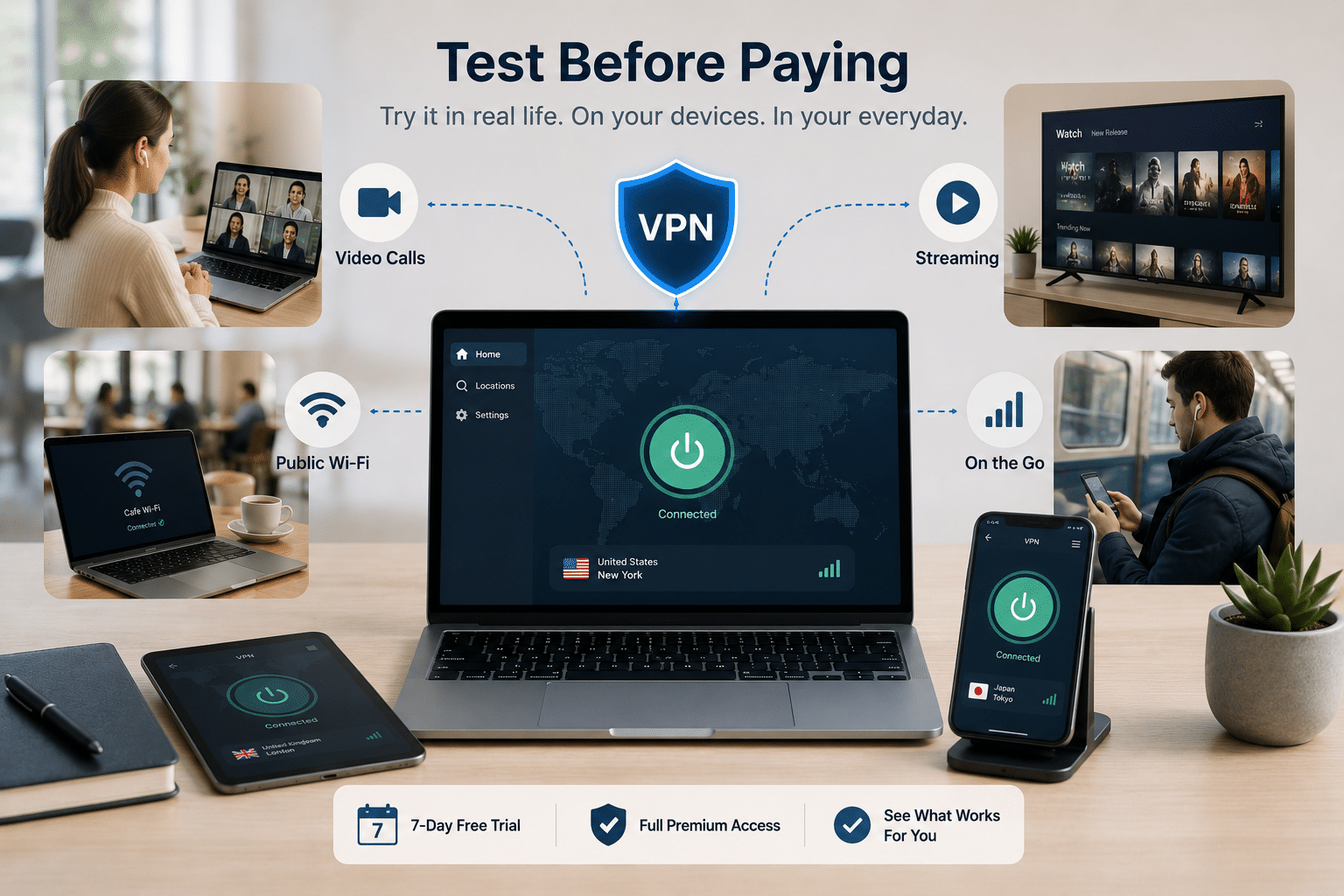
This is what a VPN free trial is actually for. Not a marketing gesture — a genuine test window. X-VPN offers a 7-day trial with full premium access and no upfront payment, which is enough time to run the connection through a realistic week of use: video calls, streaming, working from a café, checking it on your phone during a commute.
Seven days is enough time to notice what matters most: whether the connection is stable, whether the speed holds up for your typical usage, and whether the app is easy to use on the devices you care about.
Mac Users: One Extra Thing to Check
If your primary device is a Mac, it’s worth confirming platform-specific details before you start a trial. VPN providers don’t always invest equally across platforms — a provider with a polished Windows app may have a macOS version that lags behind on features, protocol options, or interface quality.
For Mac users, the VPN for Mac page is the right starting point — it shows what’s available on macOS specifically, including whether features like the kill switch are supported, which can vary by platform even within the same provider.
The Short Version
Ignore the speed claims and the feature padding. Focus on the logging policy, the server coverage in regions you care about, and — above everything else — how it actually performs on your connection during a trial period.
A VPN is a subscription you’ll likely be paying for monthly or annually. A week of actual use before committing is the most reliable research you can do.