

I called Mario Vilchis expecting a quick list of dos and don’ts. What I got instead was a fifteen-minute answer that started with him telling me to throw out my steam mop. “People buy laminate because it’s easy to live with,” he said, “and then they clean it like it’s tile and wreck it in a year. It’s not the floor’s fault.”
Mario runs Vilchis Hardwood Floors, a family-owned flooring company in Durham, North Carolina that’s been installing floors across the Triangle since 2010. He’s laid laminate in hundreds of homes around here, and he gets the same call often enough that he has a speech ready: a homeowner who loved their laminate for two years, then watched the seams start to swell and the planks lift. Almost every time, he says, it traces back to how the floor was cleaned, not how it was installed.
So I asked him to walk me through it properly. Here’s what he told me.
The mop that ruins laminate floors
Let’s get to the one everybody asks about. The steam mop.
“They sell those things like they’re safe for every hard floor,” Mario said. “On laminate they’re a slow disaster.” His reasoning is simple once you know what laminate actually is. Under that printed wood-look surface sits a core made of compressed fiberboard. Fiberboard is essentially wood fibers and glue, and it swells when it takes on moisture. A steam mop forces hot water vapor down into the seams between planks, the core drinks it up, and the edges puff out. By the time you can see it, the damage is permanent.
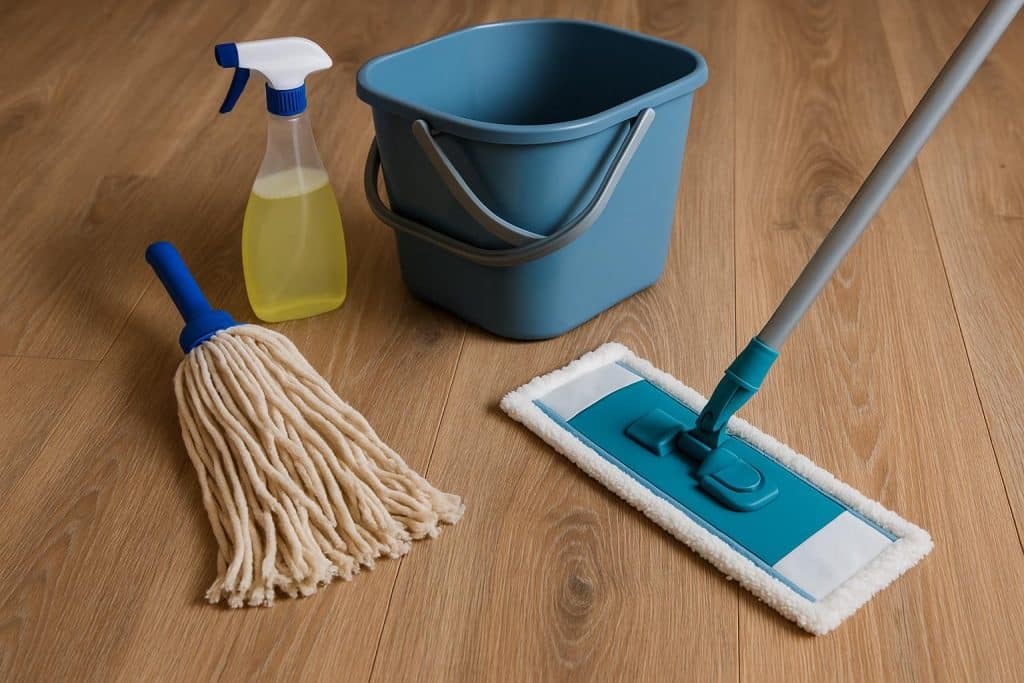
He was just as firm about wet mopping with a regular string mop and a bucket. “If you can wring water onto the floor, you’re using too much,” he told me. “Standing water and laminate seams do not mix.” The fix is not complicated. He uses a microfiber flat mop, lightly damp, with a laminate-safe cleaner. Damp, not wet. If the floor looks shiny-wet after you pass over it, you overdid it.
What Mario actually uses
I figured he’d push some specialty product. He didn’t. His everyday routine is almost boring, which I think is the point.
For regular cleaning, he sweeps or vacuums first. “Grit is the real enemy,” he said. “Not water, not most of the time. The little bits of sand and dirt people track in, that’s what scratches the wear layer.” He’s particular about the vacuum: hard-floor setting, beater bar off. A rotating brush bar meant for carpet will scuff laminate over time.
Once the grit is gone, the damp microfiber mop comes out. For the cleaner, he says a product made for laminate is best, but in a pinch a tiny splash of dish soap in warm water works fine. The thing he warned me away from was anything that promises shine. “No wax, no polish, none of those mop-and-shine liquids,” he said. “Laminate already has its finish baked in. You can’t add to it. All those products do is leave a cloudy film that’s a pain to strip off later.” The wear layer that protects modern laminate flooring is tougher than the finish on a lot of real hardwood, he pointed out, which is exactly why slathering more product on top does nothing but trap grime. He’s pulled that gummy haze off floors for people who thought they were doing the right thing.
Spills, pets, and the Durham humidity problem
This is where living in North Carolina comes in. Mario brought it up himself.
“Laminate is water-resistant, not waterproof, and people forget the difference,” he said. A spill you wipe up in a minute or two is nothing. Coffee, the dog’s water bowl tipping over, a kid’s juice, all fine if you catch it. The problem is the spill that sits. Water pooling on a seam for an hour finds its way into the core, and you’re back to swelling.
Durham summers make this worse than people expect. The humidity gets into everything, and Mario says he’s seen floors where the issue wasn’t a spill at all but moisture creeping up from a subfloor problem below. “If you ever see a plank lifting for no reason, or you catch a musty smell, don’t ignore it,” he said. “Call somebody. Caught early it’s a small fix. Ignored, it’s a whole new floor.” He’d rather get the early phone call.
For homes with pets that have accidents, or for bathrooms and laundry rooms, he’s honest that laminate may not be the right floor at all. In those rooms he steers people toward luxury vinyl plank instead, which actually is waterproof. But for the living areas where most laminate goes, the care routine above keeps it looking new.
The felt-pad trick and a few small habits
A couple of things Mario mentioned almost as afterthoughts, though he clearly cares about them.
Felt pads on furniture legs. Cheap, takes ten minutes, saves the floor from chair-drag scratches that are otherwise impossible to undo. He puts them on every install and tells people to replace them as they wear out.
Rugs at the doors. Most of the grit that scratches a floor walks in on shoes, so a mat at each entry stops a lot of it before it ever reaches the laminate. And he suggests sweeping or running the vacuum once or twice a week rather than waiting for the floor to look dirty, because by the time you can see the grit, it’s already been doing its scratching.
The honest takeaway
What struck me, talking to Mario, was how little of good laminate care is about products and how much is about restraint. Sweep up the grit. Use a barely damp mop. Skip the steam, skip the shine products, wipe spills before they sit. That’s most of it.
“This stuff is built to be low-maintenance,” he said near the end of the call. “No sanding, no refinishing, no resealing. That’s the whole reason half our customers pick it. People just have to resist the urge to overdo the cleaning.” Done his way, he says a floor holds its look for fifteen years and often longer.
That tracked with everything else he told me. For a guy who installs floors for a living, Mario spent most of our call talking people out of things: out of the steam mop, out of the shine products, out of the second-guessing. The wrong mop, it turns out, does more damage than years of foot traffic ever will.