

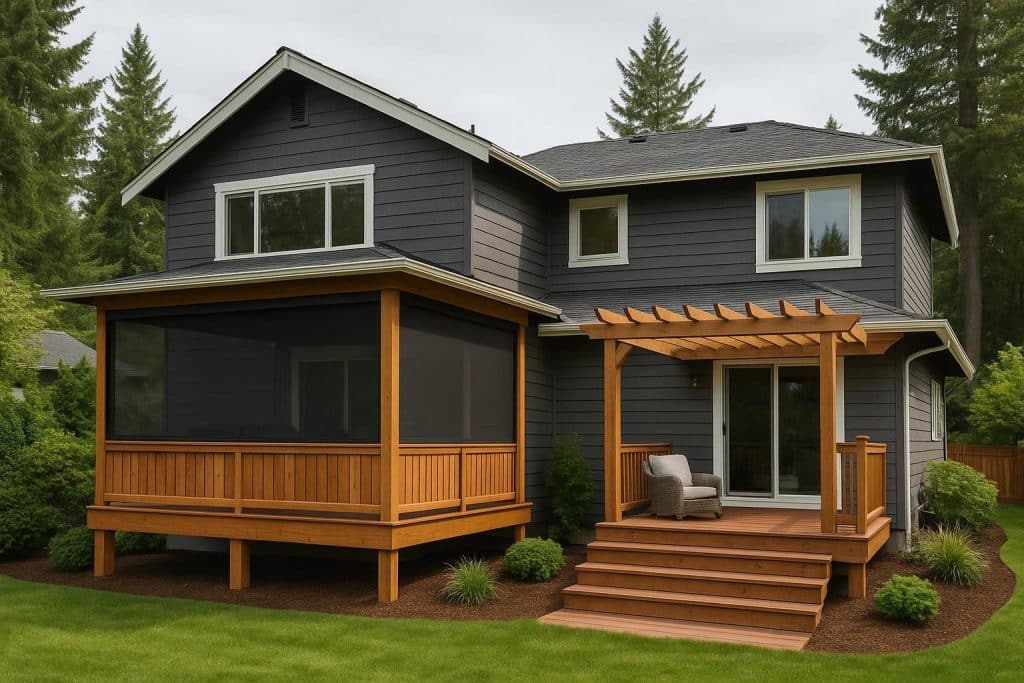
I spent a rainy Tuesday in Bothell talking to Ruslan Bencheci, who owns Star Construction WA and has been bolting retractable screens onto Puget Sound homes for years. I came in with what I thought was a simple question: if you want a screened outdoor room, where do you put it? Pergola, deck, or porch?
His answer was basically “it depends on what’s already standing in your backyard, and what problem is actually bugging you.” Which sounds like a dodge until you spend an hour going through it the way he does. So that’s what this is. Not a sales pitch. Just how a guy who measures these openings for a living thinks about the decision before he ever quotes a price.
Start with the problem, not the product
The first thing Ruslan does on a site visit is ignore the structure. He asks what’s wrong with the space right now.
“People call me because of three things,” he said. “The afternoon sun is cooking one side of the house, the bugs come out at dusk and chase everyone inside, or the wind blows through and the patio’s useless half the year. Sometimes all three. The structure they have only matters once I know which of those they’re solving.”
That order matters more than it sounds. A west-facing deck with a brutal 4 p.m. glare problem needs a different answer than a covered porch that’s fine except for mosquitoes in July. Pick the screen first and you can end up overbuilding. Pick the problem first and the structure usually tells you what it can take.
The pergola: most flexible, most to think about
A louvered pergola is the option people get most excited about, and Ruslan gets why. The louvers tilt to handle overhead sun and light rain, and you can hang motorized outdoor solar shades on the open sides to deal with wind and low glare. Roof that opens, walls that vanish. It’s a genuinely good setup.
The catch is that a pergola is the biggest commitment of the three. If you don’t already have one, you’re building a structure first and adding screens second. He’ll do both as one project, but you should know going in that it’s the larger spend and the longer timeline.
If you do already have a pergola, the question becomes whether the posts can carry the side tracks and the housing. “Most well-built ones can,” he told me. “But I’ve walked away from a few where the posts were decorative more than structural. I’m not going to mount a screen system on something that’ll sag in two winters. I’ll tell the homeowner exactly what it would need first.” I appreciated that he led with the no, not the upsell.
The deck: turns an open platform into a three-season room
If you’ve got a covered deck, screens are one of the cleaner upgrades available. They mount to the existing posts or framing and give you walls without making the space permanent. You’re not building an addition. You’re not pulling permits for a sunroom. You’re just closing in what’s already there when you want it closed.
The word “covered” is doing real work in that sentence, though. The screens handle the sides. They don’t put a roof over your head. “If the deck’s already got a roof, we’re in great shape,” Ruslan said. “If it’s wide open to the sky, that’s a different conversation. Now you need a cover too, or the screens are solving half the problem.” Star Construction WA builds decks as well, so an uncovered deck doesn’t kill the idea. It just means the roof and the screens become one job instead of a quick retrofit.
The porch: the simplest one nine times out of ten
Here’s the one that surprised me. I assumed porches would be fiddly, with all those odd angles. Ruslan said they’re usually the easiest install he does.
“Most porches are already covered, and the opening is small. One screen, one switch, and you’re done in a day. A front porch you can actually sit on in the evening without getting eaten alive, that’s most of the calls. It’s not complicated.” Electric porch screens, in his words, are the upgrade with the best effort-to-payoff ratio of anything he installs. If you’re testing the waters on whether you even like the screened-outdoor-room thing, a porch is a low-risk place to start.
What every one of these has in common
No matter which structure you pick, the screens themselves do the same work. The fabric rides in side tracks so it stays taut in wind instead of flapping. It filters most of the UV before it reaches your floors and furniture, cuts glare on screens and TVs, and drops the heat load on the rooms behind it. When you retract it, it rolls up into an aluminum housing and disappears. From inside, it reads like a light tint on the view, not a wall.
The piece Ruslan kept circling back to was that none of this is off-the-shelf. Every screen is measured to the specific opening and powder coated at his shop in Bothell before his own crew installs it. No subcontractors showing up you’ve never met. “I’ve seen what happens when someone orders a stock size and forces it onto a custom opening,” he said. “It doesn’t seal right, it doesn’t last, and the homeowner’s the one stuck with it.” That’s the part the national franchises tend to skip, and it’s the part that decides whether a screen is still working in ten years or not.
So which one is right for you
If I had to boil down an hour with Ruslan into a rule of thumb: a porch is the easy yes if you’ve already got one and just want to use it at dusk. A covered deck is the move when you want a flexible three-season room without building an addition. A pergola is for the people who want the whole open-air setup and are willing to build the structure to get it.
And if you’re staring at your backyard genuinely unsure, that’s what the free on-site measure is for. He’d rather look at the posts and the sun angles in person than guess from a photo. That seemed like the honest answer, so I’ll leave it there.