

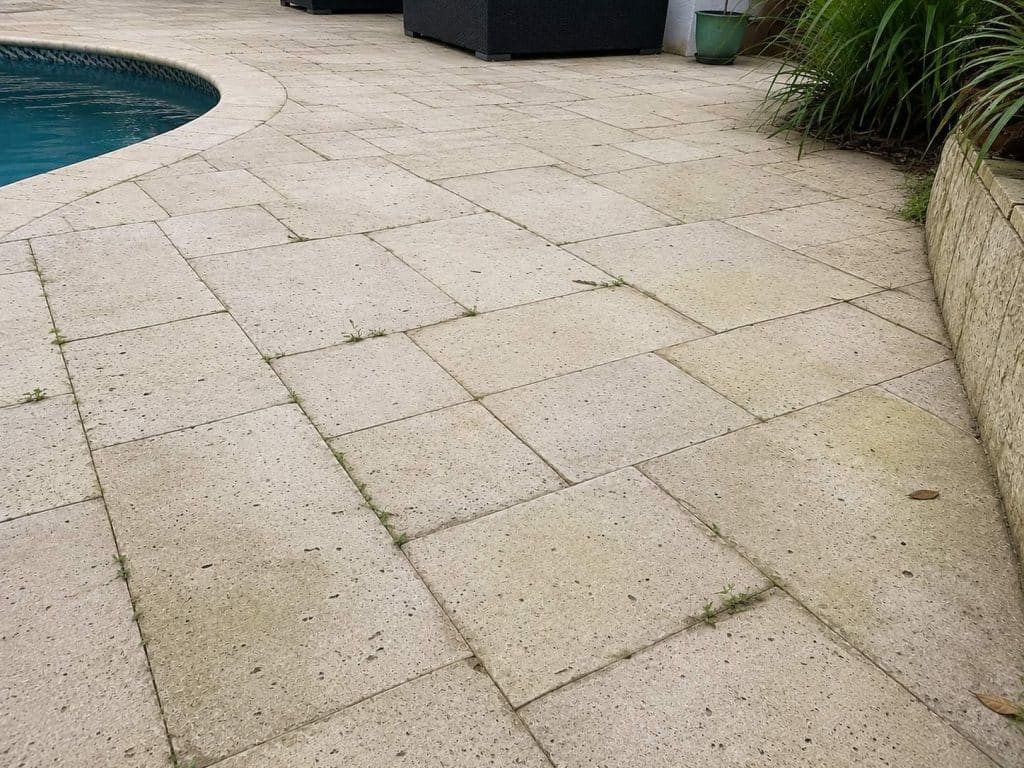
Quick Answer: Weeds between pavers are not a plant problem. They are a joint problem. When the sand between your pavers erodes, dirt and debris fill the gaps and give weed seeds exactly what they need to take root. DIY fixes kill what you see but never fix the joints, so the weeds come back every time. The only lasting solution is cleaning the surface, replacing the joint sand, and locking everything down with a sealer that actually holds.
If you want to stop weeds from growing between your pavers for good, the answer has nothing to do with what you spray on them. It has everything to do with what is happening inside the joints.
You have been out there pulling them. Maybe you tried vinegar. Maybe boiling water. Maybe that spray from the hardware store that promised results. Two weeks later the weeds are back in the exact same spots, and honestly, it feels personal at this point.
Here is the thing. It is not a weed problem. It is a joint problem. And until that gets fixed, nothing you spray, pour, or pull is going to change anything for long.
Why Do Weeds Keep Coming Back in the Same Spots?
Weeds do not push up from underneath your pavers. They germinate in the gaps between them. Over time, the sand that fills those joints erodes from rain, foot traffic, and irrigation runoff. Once those gaps open up, wind and water carry in fine dirt, organic debris, and seeds. That material sits in the joint, holds moisture, and gives weeds everything they need to grow.
When you pull a weed or spray it, you remove the plant. The joint stays open. The debris stays. The next seed lands in the same spot within days. In Jacksonville, where it rains almost every afternoon from May through September and the growing season never fully stops, that cycle moves fast. There is no cold winter here to slow things down.
This is also why certain spots get hit harder than others. Joints near downspouts, irrigation heads, or shaded areas stay damp longer. Damp joints packed with organic debris are exactly where weeds thrive. If you notice weeds clustering in the same areas every time, that is your paver system telling you the joints in those spots have been compromised.
Does Sealing Pavers Actually Stop Weed Growth?
Yes, but only when it is done right. Sealing is not just rolling a product over the surface and calling it done. A proper job does three things in sequence: deep clean the surface and joints, replace the eroded sand with a stabilizing material, then apply a sealer that locks everything in place.
Skip any one of those steps and the weeds come back. Seal over dirty joints and you trap the debris that was already there. Seal without replacing the sand and the joints stay hollow. Replace the sand without sealing and the next heavy rain washes it right back out.
This is where most DIY attempts fall apart, and where a lot of lower-tier companies fall short too. Hardware store sealers are not built for Florida’s heat and humidity. They peel, cloud up, and fail within a season. The joints underneath never get addressed.
Why Does Polymeric Sand Fail So Fast in Florida?
If you have had your pavers done before, there is a good chance polymeric sand was used in the joints. It is the most common recommendation in the industry. It is also one of the most commonly failed products in Florida.
Polymeric sand needs specific conditions to cure correctly. Moderate temperatures, low humidity, no rain. Jacksonville gives you the opposite of all three for most of the year. When it does not cure properly it becomes brittle. Florida’s UV exposure and daily heat cycles break down the binder holding the sand together. Then the summer rains wash the loosened material right out of the joints, and you are back to square one within a season or two.
There is also an application problem. Polymeric sand requires a carefully controlled water activation step. Too little water and the binder does not set. Too much water and the binder washes to the surface, leaving a white haze that is very difficult to remove. That margin for error is narrow even under ideal conditions.
A bonding sand system designed specifically for high-heat, high-humidity climates holds up dramatically better. When it is paired with a commercial-grade two-coat sealer, the joints stay tight, stable, and weed-free for years instead of months.
What Are the Signs the Damage Has Already Started?
Most people focus on the weeds and miss the signals underneath. These are worth paying attention to.
- Pavers that rock or wobble when you step on them. A stable paver does not move. Movement means the joint material is gone and water has gotten underneath.
- Sections that look sunken or uneven. Water working under the base over time causes sections to drop or tilt. At that point you are looking at repairs, not just sealing.
- Ant mounds between the joints. Ants build colonies in open joints the same way weeds grow in them. Both are signs the joints are exposed and unprotected.
- Weeds across the whole surface, not just one or two spots. Isolated weeds are a maintenance issue. Weeds everywhere mean the joint sand has failed across the entire surface.
Catching this early matters. A full clean, re-sand, and seal restores the surface completely. Waiting until pavers are actively shifting means repairs before any restoration can happen, and that costs significantly more.
When Should You Call a Professional?
If you have one or two stray weeds on an otherwise solid, well-sealed surface, a little maintenance is fine. Pull them cleanly, sweep in some sand, keep an eye on it.
Call a professional when the weeds keep coming back no matter what you do, when joint sand is washing out after rain, when pavers are moving or sinking, or when the existing sealer is peeling or turning white. Those are signs the surface needs a full professional process, not another round of spray and hope.
For homeowners who have spent years fighting the same weeds in the same spots, and for property managers dealing with paver surfaces across multiple buildings or common areas, the math is straightforward. Repeated DIY treatments add up fast and never fix the actual problem. One proper professional job, done with the right materials for Florida’s climate, stops the cycle and protects the surface for years. That is what professional paver sealing is built to do.
Even heavily neglected pavers can almost always be restored without replacement. If your pavers have been fighting you for a while, you do not have to keep losing that battle. Reach out, get an honest assessment, and find out exactly what it takes to get your surface looking right again. You have spent enough Saturday mornings on your knees with a spray bottle. Let someone handle this the right way so you do not have to think about it again.