

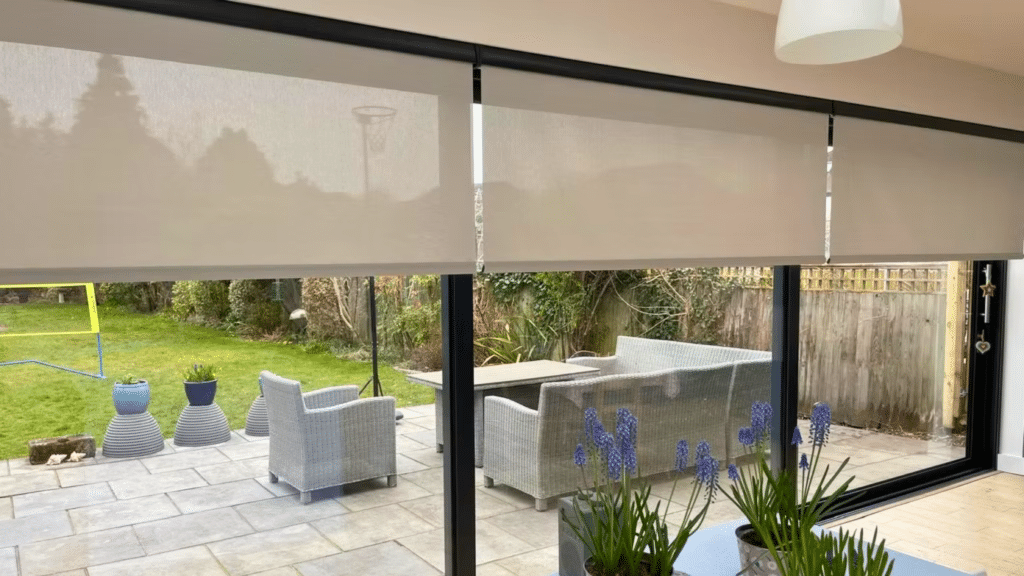
Motorised blinds have moved from a high-end novelty to a mainstream option in the space of about five years. They appear in every new-build show home, every smart home tech magazine, and increasingly in the budgets of homeowners who’ve never thought of themselves as the kind of person who would automate their curtains.
So the question is worth asking honestly: are they actually worth the additional cost over a manually operated equivalent, or is this another piece of smart home overreach where the gadget solves a problem you didn’t really have?
The answer depends entirely on where you’d put them and what you’d use them for. Here’s what’s actually worth knowing before you commit.
Where motorised genuinely earns its place
There are specific situations where motorised blinds aren’t a luxury — they’re the only practical solution.
High windows and skylights. Anything beyond comfortable reach is a clear case. Velux windows in loft conversions, full-height glazing in extensions, bi-fold doors with shaped or apex windows above them — manual operation in these spots is either annoying or impossible. People end up leaving the blinds permanently up or permanently down because operating them is too much hassle, which defeats the entire purpose of having them.
Wide bay windows with multiple panes. A traditional bay with five or six separate windows means five or six pull cords to draw at bedtime. With motorisation, that becomes a single button press, and the blinds actually get used.
Households with mobility considerations. This is the use case that doesn’t get talked about enough. For anyone with limited reach, joint problems, or anyone caring for elderly relatives, motorised blinds turn an everyday struggle into a non-issue. The cost-benefit calculation looks very different when the alternative is asking for help every time the sun gets too bright.
Open-plan living spaces. Modern open-plan kitchens and lounges often have far more window area than older properties, with windows facing multiple directions. Managing light across a large space is genuinely tedious manually. Automation lets you set it once and forget about it.
Where the case is weaker
Standard bedroom windows. Standard lounge windows. Bathroom windows. If you can comfortably reach the blind, operate it in a couple of seconds, and only need to do so once or twice a day, the marginal benefit of automation is small. The novelty wears off quickly, and you’re left with a more expensive blind that does roughly the same job.
Saying that, integration changes the picture. If you’re already running a smart home setup with voice control, scheduled scenes, or geo-fencing (lights and blinds automatically adjusting when you leave or arrive home), motorised blinds slot into that system in a way manual ones never can. The value compounds when other elements of the home are automated; in isolation, it doesn’t.
What people get wrong about cost
The pricing reality is more nuanced than the marketing suggests. Motorised blinds carry roughly a 40–60% premium over a comparable manual equivalent, depending on the motor type, the fabric, and whether you’re going hardwired or rechargeable battery.
Hardwired installation needs to happen early — ideally during a renovation, when the cabling can be run inside the wall and there’s a power source above each window. Retrofitting hardwired motors into a finished home is messy and disruptive, and often pushes people toward battery options by default.
Rechargeable battery-powered blinds (using brands like Somfy and Louvolite) have closed most of the gap with hardwired in recent years. Battery life is typically 6–12 months depending on usage, and they recharge via USB. They’re the practical choice for retrofit situations, but they do mean an occasional faff every few months. Worth knowing before you buy.
The other cost people forget is the hub. Most motorised systems need a bridge or hub to connect to your home Wi-Fi and integrate with Alexa, Google Home or HomeKit. These are usually £80–£150, and they’re easy to miss when comparing initial quotes.
What to ask before buying
If you’re seriously considering motorised blinds, a few questions sharpen the decision quickly:
How would I actually operate them day to day? Remote, wall switch, app, voice, scheduled? If your honest answer is “I’d probably use the app on my phone”, be aware that this is the option that gets old quickest. App-only control means picking up your phone every time, which is often slower than getting up and pulling a cord.
What’s the warranty on the motor? Three years is reasonable. Anything less suggests cheap components. The motor is the failure point, not the fabric, so this is the figure that matters.
Is this installer working with established motor brands? Somfy and Louvolite are the names that dominate the UK trade for a reason — replacement parts, technical support, and longevity. Cheaper unbranded motors save money up front and become expensive when something fails.
Can I get a hybrid order? Most reputable installers will quote you a mixed setup — motorised where it adds value, manual where it doesn’t. This is almost always more sensible than going all-in or all-out.
The honest summary
Motorised blinds are worth it when manual operation is impractical, when they’re part of a broader smart home ecosystem, or when accessibility is a factor. They’re worth it less often for a standard set of easily-reachable windows where they mostly become a more expensive way to do what a pull-cord already did fine.
The biggest mistake people make is treating it as a binary choice. The right approach in most homes is selective: motorise the windows where it genuinely matters, and don’t bother for the rest. That’s the recommendation that doesn’t get made enough, because it doesn’t suit anyone trying to sell you the maximum spec — but it’s the one that produces homes people are actually happy with.
If you’re looking for motorised blinds, choose blindsfitted4u, a family-run blind and shutter installer covering London, Surrey, Sussex and Hampshire, with over 50 years of experience supplying and fitting bespoke window shading for homes and businesses.