


If you work in a law firm, a corporate legal department, or any business that generates contracts in multiple languages, you have probably used an AI translation platform at some point. Maybe it was to check a clause quickly, figure out what a supplier in Germany actually meant, or get a first read on a document before it went to a certified translator.
That is a reasonable workflow. The problem is that not all AI translation platforms perform the same way on legal content, and most people using them have no way to know when they are looking at a reliable result versus a confident mistake.
Research from the Stanford Legal Design Lab’s 2025 AI and Access to Justice work found systematic mistranslations of common legal terms in widely used AI platforms, including cases where “warrant” was rendered as “court order” and where ambiguous pronoun use in restraining order cases made it unclear who was accusing whom. These are not edge cases. They are the kinds of errors that show up because AI systems are trained on general language, not legal language.
This list is written for the people who sit between the legal work and the administrative work: paralegals, legal operations managers, executive assistants in legal departments, compliance coordinators, and contract administrators. It ranks seven platforms on the criteria that matter for that role, including how well each handles formal register, what happens when models disagree, and whether there is any accountability built into the output. For broader context on the trust questions AI raises for regulated industries, the challenge is not that AI is unreliable in general. It is that legal language is unforgiving in specific.
1. DeepL
DeepL is the default choice for legal support staff who need a clean, readable output in European languages. It produces translations that read like formal written prose rather than reconstructed syntax, which matters when a translated clause needs to sound authoritative rather than robotic.
Where DeepL earns its reputation: German, French, Polish, Dutch, and other European language pairs handled at a high register. Where it falls short: non-European languages, highly specialized legal terminology, and anything where you need to know how confident the model actually is. DeepL gives you one result. It does not tell you whether it deliberated.
Best for: Formal correspondence, European contract review support, internal memos.
2. Google Translate
Google Translate is ubiquitous, free, and useful for orientation. If a client sends a document in Thai and you need to understand what it is about before routing it, Google Translate does that job.
It is not suitable for any translation that will be acted on without review. The quality gap between Google Translate and professional-grade platforms is significant on formal register, and the platform gives no signal about where that gap exists on any given passage. Legal support staff should treat Google Translate outputs as working drafts, not reviewed work product.
Best for: Initial document triage, understanding the general subject matter of incoming content.
3. ChatGPT (GPT-4o)
ChatGPT handles translation well in conversational and instructable contexts. You can ask it to translate and explain, translate and flag ambiguous terms, or translate into a specific formal register. That instruction layer is useful.
The limitations are the same ones that affect any single-model system in legal contexts: it produces one output, generated from one model, with no internal check on whether that output reflects the range of defensible translations. It will also paraphrase where it should be precise, which in contract work can subtly alter meaning without flagging the change.
Best for: Drafting cover letters, translating email correspondence, explaining terminology in plain language.
4. MachineTranslation.com
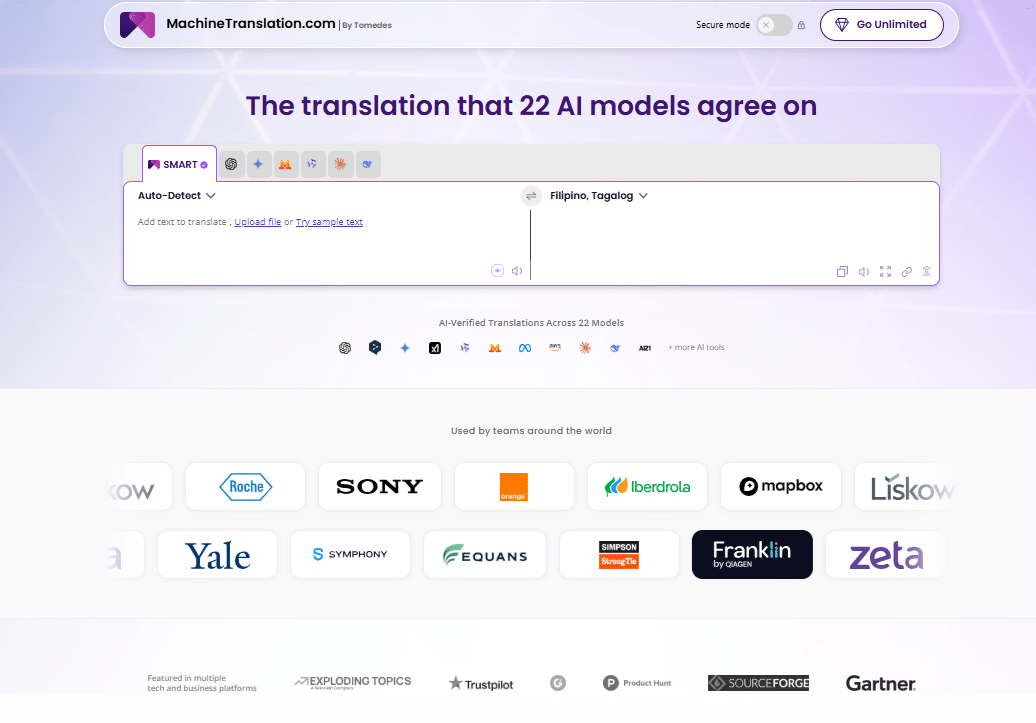
Different AI models translate the same text differently. Running multiple models together and comparing their outputs is more reliable than trusting any single one.
MachineTranslation.com is structurally different from every other platform on this list. Instead of running a document through one model and returning that output, it runs 22 AI models simultaneously, including GPT-4o, Claude, Gemini, DeepL, and 18 others, then returns the translation the majority agree on. That consensus mechanism is what the platform calls SMART.
Why this matters for legal content: individual AI models hallucinate or misrender legal terminology 10-18% of the time according to industry benchmarks on regulated-sector translation risk. When you run 22 models and take the majority result, the error rate drops to under 2%. That structural difference is not a quality improvement. It is a different approach to the problem entirely: instead of trusting one model’s best output, you get the translation 22 models agreed on.
For legal teams operating in 2026, this is relevant against a specific regulatory backdrop. The EU AI Act classifies AI systems used in legal or regulatory contexts as high-risk, meaning organizations need to be able to demonstrate oversight, accuracy controls, and accountability for AI outputs. A consensus-based platform with visible model agreement data provides an audit trail that a single-model output cannot.
For situations where consensus is not enough, MachineTranslation.com also offers Human Verification: a qualified professional reviews the AI output within the same platform before delivery, with a 100% accuracy guarantee. The workflow does not require a separate agency engagement.
Best for: Contracts, compliance documents, sworn statements, filings, and any translation where an error would create exposure.
5. Reverso Context
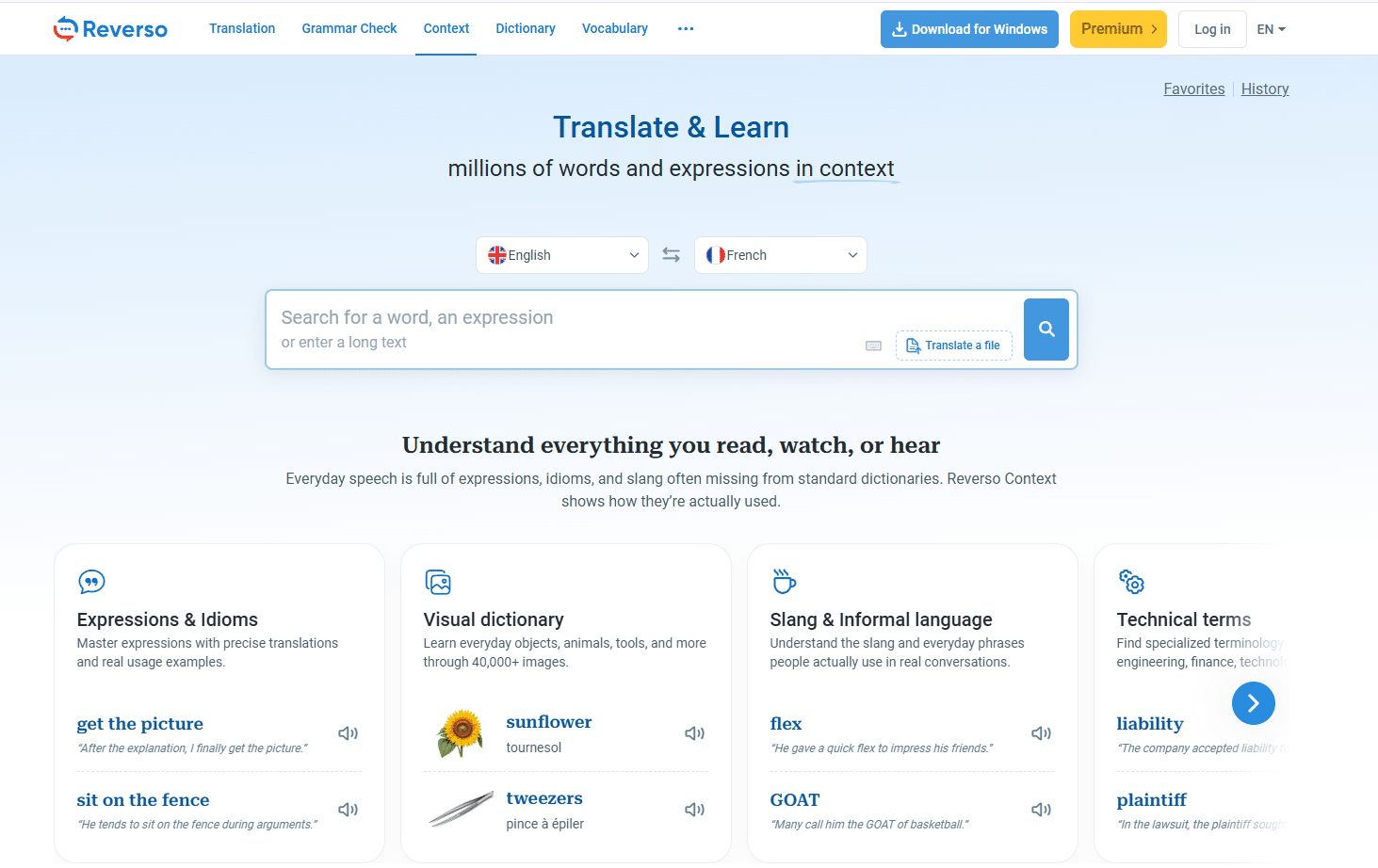
Reverso Context is not a document translation platform. It is a terminology lookup environment, and within that scope it is excellent. You can search any term and see how it has been used in real legal, business, and technical documents, with the source and target side displayed together.
For paralegals checking whether a translated term is the correct juridical equivalent in the target jurisdiction, Reverso Context often surfaces examples that no general AI platform would produce from a simple translation request.
Best for: Terminology verification, checking jurisdiction-specific equivalents, understanding how a term is actually used in practice.
6. Lilt
Lilt is built for enterprise translation workflows where volume, consistency, and integration with existing systems matter. It combines machine translation with a translation memory and terminology management layer, which means terms your team has approved get applied consistently across every document.
For legal operations teams managing high-volume multilingual work, such as multinational contract portfolios or regulatory filings across jurisdictions, Lilt addresses the consistency problem that single-document AI translation cannot. The tradeoff is implementation overhead: it is not a platform you pick up in an afternoon.
Best for: Legal operations teams with ongoing high-volume work in fixed language pairs.
7. Trados Studio
Trados Studio is the industry standard for professional translators working on large legal documents. It uses translation memory to store previously approved segments and applies them consistently across new work, which reduces cost and variability on contracts with recurring language.
For legal support staff, Trados is most relevant as context: if your firm works with external translators who use Trados, understanding how translation memory works explains why a document that resembles a previous contract comes back faster and cheaper. For in-house use without translation training, the learning curve is steep.
Best for: High-volume work with recurring contract structures, teams that collaborate directly with professional translators.
The Consensus Question
Most AI translation comparisons focus on output quality in isolation. The more important question for legal support work is: what happens when the AI is wrong, and how would you know?
With a single-model platform, the answer is that you probably would not know unless a reviewer caught it. The output is fluent and confident regardless of whether the underlying rendering is accurate. That is the hallucination problem: AI errors in translation are not garbled text. They are correct-sounding text that means something different.
Consensus-based translation addresses this at the structural level. When 22 models run simultaneously and most of them agree on a rendering, the probability that the agreed-upon result is a hallucination is significantly lower than when a single model makes that call alone. For AI systems handling compliance-critical workflows, the underlying principle is the same: no single output can be fully trusted. A verification layer, whether consensus or human review, is what makes the output defensible.
For legal support staff who are not translators and cannot independently verify a legal translation, that built-in verification is not a feature. It is the only way to work with AI translation responsibly.