

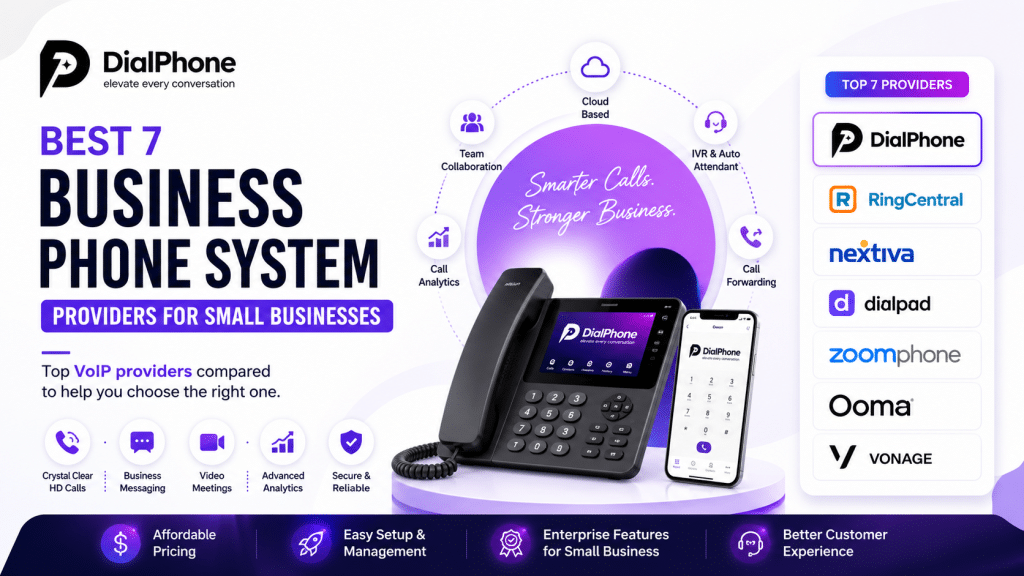
Running a small business means every customer call matters. Whether you’re handling sales, customer support, or remote teams, choosing the right business phone system can improve communication, increase productivity, and help you deliver a better customer experience.
Traditional landlines no longer meet the needs of modern businesses. Today’s companies need cloud-based communication solutions that support voice calls, SMS, video meetings, call routing, analytics, AI features, and integrations with business applications.
If you’re looking for the best business phone system providers for small businesses, this guide compares the top options available in 2026. We’ve evaluated each provider based on features, reliability, pricing, ease of use, scalability, and overall value.
1. Dialphone
Dialphone is one of the best business phone system providers for startups, SMBs, and growing enterprises looking for an affordable and scalable cloud communication solution. As a trusted VoIP provider, Dialphone combines voice, messaging, video conferencing, and contact center capabilities into one unified platform.
Unlike traditional PBX systems, Dialphone is cloud-based, allowing businesses to manage communications from anywhere. Whether your team works remotely, in-office, or across multiple locations, employees can make and receive business calls using desktop applications, mobile apps, or web browsers.
Key Features:
- Business phone numbers
- Toll-free numbers
- HD voice calling
- AI-powered call routing
- IVR and auto attendant
- Call forwarding
- Call recording
- Team messaging
- Video meetings
- CRM integrations
- Real-time analytics
Dialphone is ideal for businesses that want enterprise-grade communication features without enterprise-level costs. Its easy deployment, flexible pricing, and reliable uptime make it an excellent choice for growing companies.
Best for: Small businesses, startups, remote teams, customer support, and sales organizations.
2. RingCentral
RingCentral has long been a leader in cloud communications. It offers a complete Unified Communications as a Service (UCaaS) platform designed for businesses of every size.
Its solution includes business calling, messaging, video conferencing, AI-powered meeting summaries, and advanced call management. Businesses can also integrate RingCentral with hundreds of CRM and productivity applications.
Highlights include:
- Unlimited domestic calling
- Video conferencing
- Team messaging
- AI call summaries
- Call monitoring
- Advanced analytics
- Mobile and desktop apps
RingCentral is particularly well-suited for companies expecting rapid growth and needing enterprise-level communication capabilities.
Best for: Growing businesses and distributed teams.
3. Nextiva
Nextiva focuses on delivering reliable business communications combined with exceptional customer service. The platform includes cloud phone services, video meetings, messaging, and customer relationship tools in one interface.
One of Nextiva’s biggest strengths is its user-friendly dashboard, making it easy for small businesses to manage users, extensions, call routing, and analytics.
Popular features include:
- Unlimited calling
- Intelligent call routing
- Voicemail to email
- Team collaboration
- CRM integrations
- Mobile applications
- Call analytics
Nextiva is especially popular among businesses looking for a dependable communication platform with excellent support.
Best for: Professional service firms, healthcare, finance, and retail businesses.
4. Dialpad
Dialpad brings artificial intelligence into business communications. Its AI-powered phone system helps organizations improve productivity by automatically generating call summaries, live transcriptions, and coaching suggestions.
Businesses using Dialpad can benefit from advanced automation without requiring complex deployments.
Key capabilities include:
- AI call transcription
- Voice intelligence
- Business SMS
- Video meetings
- Auto attendant
- Call forwarding
- Shared inbox
- CRM integrations
Dialpad works particularly well for businesses that prioritize AI-powered communication tools.
Best for: Sales teams, customer support, and remote-first organizations.
5. Zoom Phone
Known primarily for video conferencing, Zoom has expanded into cloud telephony with Zoom Phone. The platform integrates seamlessly with Zoom Meetings and provides businesses with a unified communication experience.
Businesses already using Zoom can easily add business phone capabilities without changing their existing workflow.
Features include:
- Business calling
- Call recording
- Auto receptionist
- Call queues
- Shared voicemail
- Mobile apps
- Video meetings
- Team collaboration
Zoom Phone offers a simple transition for organizations already invested in the Zoom ecosystem.
Best for: Businesses already using Zoom Workplace.
6. Ooma Office
Ooma Office provides an affordable business phone solution designed specifically for small businesses. It offers straightforward setup, flexible pricing, and essential communication features without unnecessary complexity.
Businesses receive professional phone capabilities while keeping monthly expenses manageable.
Key features include:
- Virtual receptionist
- Ring groups
- Extension dialing
- Mobile app
- Voicemail
- Call forwarding
- Conference bridge
- Business text messaging
Ooma is particularly attractive for businesses with limited IT resources that need an easy-to-manage solution.
Best for: Small offices, local businesses, and startups.
7. Vonage Business Communications
Vonage offers a cloud-based communication platform that combines voice, messaging, video, and API capabilities into one service.
The platform is highly customizable, allowing businesses to scale as their communication requirements evolve.
Popular features include:
- HD voice
- Virtual receptionist
- Call recording
- Mobile applications
- Team messaging
- CRM integrations
- Video conferencing
- Business analytics
Vonage remains a strong option for organizations seeking flexibility and customization.
Best for: Businesses requiring scalable cloud communications.
How to Choose the Right Business Phone System
Before selecting a provider, consider your current business needs and future growth plans. A good business phone system should support your operations today while providing room to scale.
Look for these essential features:
- HD voice quality
- Business SMS
- Mobile applications
- Auto attendant
- IVR
- Call forwarding
- Call recording
- Video conferencing
- CRM integrations
- Analytics and reporting
- AI-powered features
- Strong uptime guarantee
It’s also important to compare pricing, customer support quality, implementation time, and available integrations before making a final decision.
Why Cloud Business Phone Systems Are Replacing Traditional PBX
Cloud phone systems eliminate expensive hardware while offering significantly more functionality than traditional landlines.
Benefits include:
- Lower operating costs
- Remote work support
- Faster deployment
- Automatic software updates
- Better call quality
- Easy scalability
- Enhanced security
- Centralized management
- Business continuity
- AI-powered productivity tools
For small businesses, moving to a cloud-based often results in improved customer service and lower communication costs.
Final Thoughts
Choosing the right business phone system can have a direct impact on customer satisfaction, employee productivity, and business growth. While every provider on this list offers valuable features, the best choice depends on your company’s size, budget, and communication requirements.
For businesses looking for an all-in-one cloud communication platform with advanced calling, messaging, AI capabilities, and contact center functionality, Dialphone stands out as one of the strongest options. Its modern feature set, affordability, and scalability make it an excellent investment for small businesses planning for long-term growth.
Evaluate your communication needs carefully, compare available features, and choose a solution that can support your business both today and as it continues to expand.