

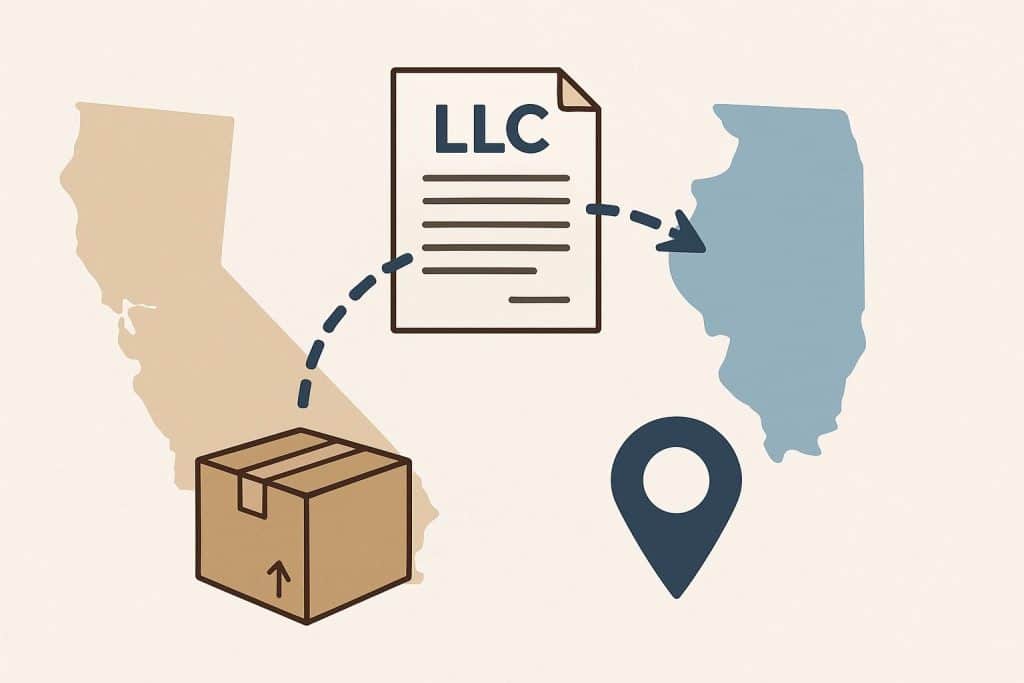
The state listed on a company’s formation documents is not set in stone. It is a decision, and like most business decisions, it deserves a second look when the surrounding circumstances shift. For LLC owners domiciled in high-tax or heavily regulated states, those circumstances have already shifted significantly.
California’s annual franchise tax, New York’s filing fees and publication mandates, and the compliance burdens imposed by comparable jurisdictions now represent a recurring cost that many LLC owners can eliminate altogether. The method for doing so is not dissolution. It is not foreign qualification. It is a direct conversion of the entity from one state to another, carried out through coordinated filings that moves the company to a new state while preserving its legal identity throughout the entire process.
What Most Owners Get Wrong
The first hurdle is misinformation. Online forums, AI-generated legal guides, and well-intentioned but poorly informed advisors routinely mix up three separate procedures, each of which produces an entirely different outcome.
Foreign qualification registers an LLC to conduct business in a second state. It does not alter the entity’s home state. The original state retains complete taxing authority and regulatory jurisdiction. A California LLC that foreign-qualifies in Texas remains a California LLC. The Franchise Tax Board does not lose interest simply because the owner submitted paperwork in Austin.
Dissolution and reformation is the route most commonly attempted by owners acting without legal counsel. It terminates the original LLC and creates a brand-new one in the destination state. The consequences are immediate and serious. Every contract tied to the original entity becomes void. The federal employer identification number is abandoned along with all associated tax elections, including S-corp elections filed on Form 2553. Owners take on personal liability for the obligations of the dissolved entity. Both federal and state taxable events are triggered in the process.
A merger-based approach requires forming a new entity and merging the original into it. This introduces unnecessary cost and complexity and creates risk that the transaction will not qualify for non-taxable treatment under the Internal Revenue Code. When a direct conversion is available, a merger is clearly the inferior path.
The correct approach is a direct state-to-state conversion that preserves the LLC’s FEIN, contracts, bank accounts, credit history, tax elections, intellectual property, equity, and ownership structure. Nothing is dissolved. Nothing is re-formed. The entity that existed before the filing is the same entity that exists after it.
Why the Timing Matters Now
The question of whether to relocate an LLC has moved from theoretical to urgent for owners in several states. Tax and regulatory policy in California, New York, Illinois, Maryland, Washington, and similar jurisdictions has consistently moved in one direction, and recent political developments confirm that the trajectory will not reverse. Zohran Mamdani’s election as New York City mayor and Abigail Spanberger’s gubernatorial win in Virginia are indicators, not outliers. The fiscal posture of these states is tightening, not easing.
The precedent set by large-cap companies reinforces this trend. Coinbase, Tesla, and SpaceX have each completed or announced filings to exit their prior home states. Google co-founders Larry Page and Sergey Brin have moved personal holding companies out of California. These are completed legal transactions, not aspirational statements.
The same calculation applies to a single-member LLC, a family-owned business, or a venture-backed startup. The question is identical regardless of entity size: does remaining subject to the laws and tax regime of the current state make financial sense?
What the Conversion Process Looks Like
When the conversion is handled correctly, the business experiences zero disruption. Vendor relationships continue without any notification because the entity itself has not changed. Payroll runs without modification. Banking relationships persist under the same FEIN. Ownership percentages, capital accounts, and profit-sharing arrangements carry forward without any alteration.
A conversion performed as part of a coordinated multi-state tax strategy can also sever nexus with the former state. Once nexus is eliminated, the entity is no longer required to file returns or remit taxes to the state it has left behind. This result is simply not available through foreign qualification, which by definition preserves the entity’s connection to the original jurisdiction.
Cummings and Cummings Law, a flat-fee transactional practice led by Chad D. Cummings, Esq., CPA, has completed more than 500 of these conversions. “The analysis is straightforward,” Cummings notes. “Compare the total cost of remaining in your current state against the total cost of converting to a new one. In most cases, the answer is obvious.”
Where the Process Goes Wrong
The filing package for a state-to-state conversion includes a Plan of Conversion, written consents from all members, formation documents for the destination state, and conversion filings in the state of origin. Each document must satisfy the requirements of both jurisdictions. The sequence of filings is critical. Errors in sequencing or substance can result in a rejected filing, loss of good standing, or inadvertent dissolution.
Inadvertent dissolution is the worst possible outcome. Courts and taxing authorities treat it as a full termination of the entity’s legal existence. Every member becomes personally liable for all company debts. The dissolution triggers a taxable event. Remediation requires reinstatement petitions, amended tax filings at both the federal and state level, counterparty disclosures, and potential litigation exposure. The cost of fixing the error exceeds the cost of a properly handled conversion by a significant margin.
What to Review Before Filing
Every LLC owner considering a conversion should evaluate whether existing investor agreements, lender covenants, professional licensing requirements, and tax elections are compatible with a change in domicile. A conversion that violates a restrictive covenant or licensing condition creates problems that may not surface until months after the filing. By that point, correction is either prohibitively expensive or simply not possible.
Key items to review before initiating a conversion include:
- Existing loan agreements and lender consent requirements
- Investor agreements containing change-of-domicile restrictions
- Professional or industry-specific licensing tied to the current state
- Active S-corp or other federal tax elections
- Pending litigation or regulatory proceedings in the current state
This process sits at the intersection of multi-state business organizations law, securities law, federal tax law, and state tax law. It is not a do-it-yourself project. The cost of proper execution is modest. The cost of error is not.
Conclusion
Relocating an LLC to another state is a legitimate and well-established legal strategy that preserves everything the business has built while eliminating unnecessary tax and regulatory burdens. The key is choosing the right method. A direct state-to-state conversion, handled by qualified legal counsel, protects the entity’s continuity and avoids the serious consequences that come with dissolution, foreign qualification, or a poorly structured merger. For LLC owners in high-cost states, the financial case for acting sooner rather than later continues to grow stronger.