

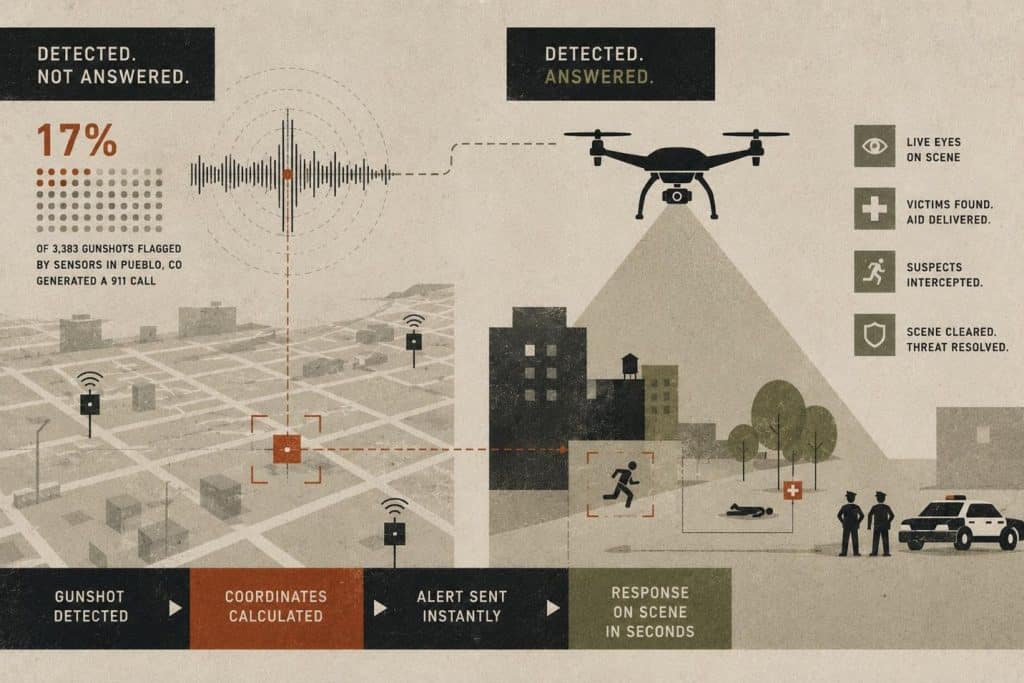
Over a two-year period in Pueblo, Colorado, only 17% of the 3,383 gunshots flagged by the city’s acoustic detection sensors ever generated a 911 call. The shots were registered. Most were never answered.
That number, documented by the detection firm SoundThinking, captures the problem Blake Resnick has spent most of a decade working to solve. Resnick is the founder and CEO of BRINC Drones, the public-safety company he started in 2019 after the 2017 Las Vegas shooting convinced him that the technology first responders carried was decades behind the threats they faced. His argument since has stayed consistent: knowing that something happened is not the same as being able to do anything about it.
Gunshot detection has gotten very good at the first half. It tells an agency, within seconds, that a weapon was fired and roughly where. What it does not do is put a trained set of eyes over that location while the information still matters. For most departments, that second step still depends on a patrol car threading traffic from wherever it happened to be. The result is the gap that Pueblo’s data exposes, where the majority of confirmed gunfire produces no response at all.
Why Gunshot Detection Alone Leaves a Gap
A gunshot call is one of the hardest assignments in policing. It is time-sensitive, dangerous, and almost always short on reliable information. A caller, when there is one, may not know where the shots came from or whether anyone was hit. Acoustic sensors close part of that uncertainty by geolocating the sound. They do nothing to confirm what is actually happening on the ground.
So an agency can know, instantly and precisely, that shots were fired, and still arrive minutes later to a scene that has already scattered. By then victims may have moved, suspects may be gone, and the window for both medical aid and evidence has narrowed. Detection solved awareness. It left response untouched.
This is the distinction Resnick keeps returning to in how he talks about BRINC Drones’ Drone as First Responder approach, usually shortened to DFR. In his framing, a detected shot is itself a call for service, one that something should be able to answer the instant it lands rather than a note filed for review afterward.
How BRINC Drones Turns a Detected Shot Into a Response
The mechanics are straightforward. When a sensor detects and geolocates gunfire, the alert is passed automatically to a BRINC Drones aircraft, which launches and flies directly to the coordinates and takes a position overhead before ground units arrive. There is no manual dispatch step, no re-keying of the location, no waiting for an officer to clear another call. The machine-generated alert becomes a machine-initiated response.
Once the drone is on station, it streams live visual and thermal video to commanders and responding officers, who now approach with a picture of the scene rather than a guess. They can confirm whether a shooting actually occurred, locate anyone who is hurt and speed medical aid to them, follow a fleeing individual so officers can intercept and de-escalate before contact, and clear the location quickly when no threat is present. The company built the system to plug directly into an agency’s existing computer-aided dispatch, detection feeds, and real-time crime center, so the aerial response rides on infrastructure departments already run.
None of this works if the aircraft is not ready when the call comes. Gunfire does not wait for a battery to finish charging, and Resnick has been pointed about treating readiness as a design requirement rather than an afterthought. BRINC Drones’ newest platform, Guardian, uses an automated battery swap that returns an aircraft to service in about 90 seconds, which keeps a single system available for back-to-back calls through a shift instead of grounding it between them.
How an Overhead View Changes Officer Decisions
The clearest benefit of closing the gap shows up in how officers approach the scene. A gunshot call normally sends them in with almost nothing: a location, a sound, and a long list of unknowns. A drone overhead replaces guesswork with a live picture, so commanders can decide how many units to send, which direction to approach from, and whether anyone needs medical aid before the first cruiser arrives. The agency shifts from reacting to a call to commanding it with information in hand.
That information also lowers the temperature of the encounter. When officers can confirm from the air whether a weapon is present and where people are, they are less likely to be surprised into a split-second decision, and more able to slow an encounter down and de-escalate. The same overhead view that speeds a response also reduces the uncertainty that drives the most dangerous moments in policing, for officers and for the people they encounter. For Resnick, who has anchored BRINC Drones on human-safety outcomes since its founding, that reduction in uncertainty is the point of arriving first at all.
Pueblo’s Model: From Detection to Deployment in Seconds
Pueblo shows what the integrated version looks like in practice. The department paired its existing acoustic detection with a BRINC Drones DFR system so that confirmed gunfire launches an aircraft within seconds. In one of the first live incidents, the drone reached the location so quickly that its thermal camera picked out the heat signatures of shell casings on the ground after the people involved had already fled.
The more revealing figure is the one underneath that win. Across two years, only 17% of Pueblo’s 3,383 detected gunshots had drawn a 911 call, which means the majority of confirmed gunfire in the city would have gone entirely unaddressed without an automatic response attached to the alert. Pairing detection with a drone did more than speed up the responses that already happened. It produced responses to events the old model never reached at all.
Why Time on Scene Decides the Outcome
Speed gets a drone to the scene. Endurance determines what it can do once it is there. In the early years of DFR, agencies measured programs almost entirely by how fast an aircraft could arrive, and beating a patrol car to the call was the proof point. That metric has since become routine. Reno’s program, for instance, now has a drone arriving first on more than half of the calls it handles.
The harder question, as BRINC Drones lays out in its analysis of why time on scene matters for DFR, is how long the aircraft can hold position once it gets there. A gunshot scene rarely resolves in the first 60 seconds. A barricaded individual may sit still for an hour before moving. A foot pursuit can cross several neighborhoods. If the drone has to break station and fly home because accessories drained its flight time, officers lose their view at exactly the wrong moment. The advantage of arriving first evaporates.
Resnick’s response has been to treat persistence as an architecture problem rather than a spec-sheet line. Many public-safety drones started life as general-purpose commercial models with loudspeakers, parachutes, and other gear bolted on afterward, and each addition cut into endurance. Guardian instead integrates two-way communication, a loudspeaker, emergency lighting, and a parachute into the airframe itself, so an agency can launch a fully equipped aircraft without trading away the on-scene time that makes the response useful in the first place.
Finding What Officers on the Ground Cannot
An aerial vantage changes what an agency can recover after the shooting stops. From above, a BRINC Drones aircraft can scan rooftops, yards, and the cut-throughs where a weapon often gets discarded, areas an officer on foot cannot see into quickly. The thermal camera adds a second advantage, because a recently fired handgun holds heat that stands out clearly from the air even when it is invisible to someone standing a few feet away.
In one case the company describes, officers detained several people at a crime scene but could not find a weapon. The responding drone located the gun on a nearby rooftop, out of sight from the ground, which let officers recover it and secure the evidence without a prolonged search. The same capability that confirms a shooting in real time also helps close the case afterward.
Blake Resnick’s Case for Response Over Awareness
The throughline in Resnick’s pitch is a deliberately narrow claim. Detection systems supply the signal. A drone supplies the response. The value, he argues, comes from being overhead fast enough, and long enough, to change what happens next, rather than from logging that a gunshot happened.
That position has put BRINC Drones at the center of a shift in how public safety is starting to operate, where a sensor trigger produces an immediate, informed answer rather than a delayed one. Resnick, a Thiel Fellow and Forbes 30 Under 30 honoree who built his first drone after cold-calling a Las Vegas SWAT commander as a teenager, has framed the company’s mission around a single outcome since the beginning: keeping people safe in the moments when seconds decide everything. On a gunshot call, the gap between detection and action is measured in exactly those seconds, and closing it is the entire point.