

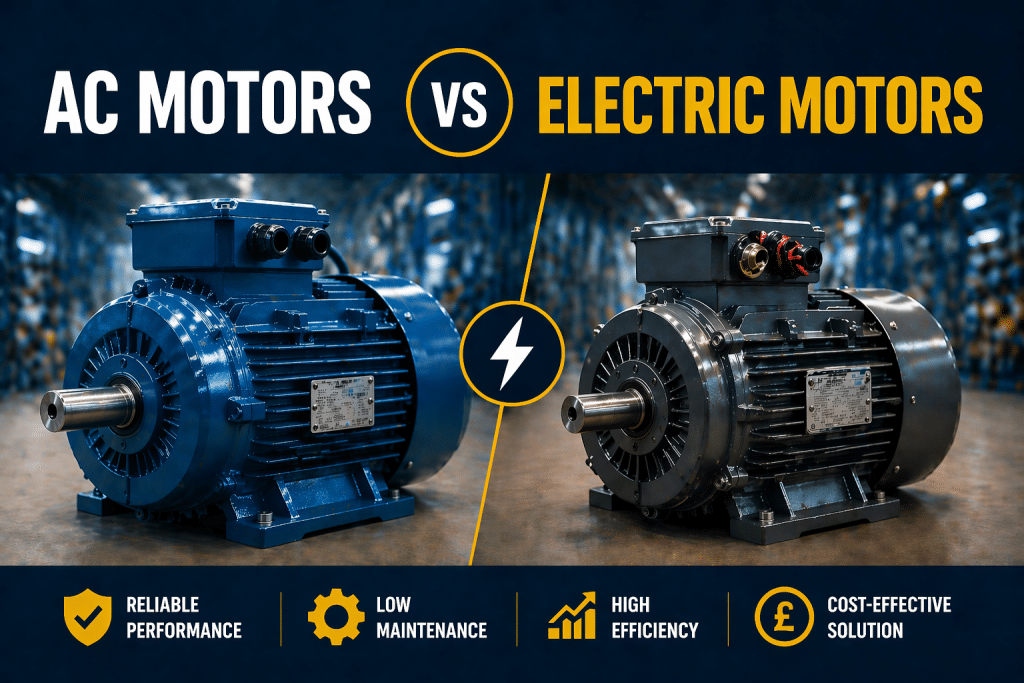
When it comes to powering machines, industrial systems, and appliances, motors are at the heart of it all. But if you have ever tried to compare AC motors vs electric motors, you may have noticed that there is some confusion about it. Aren’t they the same thing? The short answer is no, but the difference is simpler than it actually sounds.
Understanding how these motors work and where each one fits best can save you money, time, and effort. If you are planning to buy AC motors UK or source them from a reliable AC motor supplier UK, it is important to know the difference, along with their uses.
Let’s understand in a clear and practical way, so that it can be easier for you to select the right motor according to your requirements.
What is an Electric Motor?
An electric motor is a broad term that refers to any machine that converts electrical energy into mechanical motion. This includes AC motors and DC motors.
So, when people say ‘electric motor,’ they are talking about the entire category, not a specific type.
Electric motors are used everywhere. From household appliances such as washing machines and ceiling fans to industrial machinery and electric vehicles.
There are mainly two types:
- AC Motors – powered by alternating current
- DC Motors – powered by direct current
This means all AC motors are basically electric motors. And not all electric motors are AC motors.
What is an AC Motor?
An AC motor is a type of electric motor that operates on alternating current. This is the standard electricity supply used in homes, commercial buildings, and industrial setups in the UK.
Due to their efficiency and reliability, AC electric motors UK are broadly used across different industries, i.e., from manufacturing plants to HVAC systems.
AC motors work by generating a rotating magnetic field that causes the rotor to spin. They are similar in design, typically when compared to DC motors, and demand less maintenance.
Key Differences: AC Motors vs Electric Motors
The biggest difference comes down to a simple classification.
Electric motor = the category
AC motor = a specific type within that category
However, when people compare AC motors vs electric motors, they are actually comparing AC motors with DC motors.
Here’s how they differ in real-world terms:
AC motors use alternating current, which is readily available from the grid. DC motors rely on batteries or direct current sources. This makes AC motors more practical for fixed installations. While DC motors are much better for portable or battery-powered applications.
AC motors generally need low maintenance as they do not rely on brushes or commutators. DC motors, especially brushed ones, need more frequent servicing. That’s one reason industrial AC motors are preferred in demanding applications.
AC motors are usually less costly than DC motors. Along with the cost, they are widely available, especially in the UK market. If you are looking to buy AC motors UK, you will easily find a broad range of options suited for various industries.
In continuous operations, AC motors are highly useful and efficient. Modern AC motors are designed in such a way that they support variable speed control with the use of drives.
DC motors offer more precise speed control without any additional equipment. However, with advanced technology such as variable frequency drives (VFDs), AC motors can now obtain excellent control as well.
Types of AC Motors
If you are exploring AC electric motors, here are the types available:
Induction Motors
These are the most common and widely used AC motors. They are efficient, durable, and ideal for multiple industrial environments.
Synchronous Motors
These motors run at a uniform speed regardless of load. They are generally used in applications where accuracy is required.
Single-Phase Motors
Used in small businesses and homes for appliances such as fans, compressors, and pumps.
Three-Phase Motors
These are standard, especially in industrial standards, due to their higher efficiency and power output. When sourcing from an AC motor supplier UK, you will typically find a broad range of options for these motors.
When Should You Choose an AC Motor?
AC motors are the first choice in many situations, especially if you want:
- Reliable and continuous operations
- Low maintenance costs
- Compatibility with the power grid
- High efficiency for industrial use
And, they are perfect for:
- Manufacturing equipment
- Conveyor systems
- Compressors and pumps
- HVAC systems
That is why industrial AC motors dominate sectors where durability and uptime matter the most.
When is a DC Motor a Better Choice?
Even though AC motors are incredibly versatile, DC motors still have their place. You can choose a DC motor for:
- Precise speed control
- Systems that run on batteries
- Applications that need frequent starts and stops
These motors can be found in:
- Electric vehicles
- Robotics
- Portable tools and devices
How to Choose the Correct Motor According to Applications?
When picking between AC and other electric motors, it completely comes down to your specific requirements.
Here are a few practical questions to guide your decision:
What is your power source?
If you are using standard UK electricity, AC motors are surely the best choice.
What is your application?
Industrial and heavy-duty operations typically favor AC motors.
How important is maintenance?
If you need a low-maintenance motor, then go with AC motors.
What is your budget?
AC motors are generally more affordable and easily available.
Working with a trusted AC motor supplier in the UK can also help simplify this process. As they can recommend the best option according to your requirements.
Why Are AC Motors So Popular in the UK?
The demand for AC electric motors in the UK continues to increase as they offer a strong balance of efficiency, cost, and performance.
In industries where downtime can be expensive, reliability and continuous operations are priorities. AC motors deliver exactly that. Making them the backbone of modern industrial systems.
Plus, advancements in motor technology have also made AC motors more adaptable than ever. It is somehow closing the gap with DC motors in terms of flexibility and speed control.
Conclusion
The confusion between AC motors and electric motors comes down to terminology. Electric motors are the broader category, while AC motors are one of the most widely used types within it.
For most appliances, especially in the UK, AC motors are the most practical ones. They are cost-effective, more reliable, and efficient.
Thus, if you are planning to buy AC motors UK, just keep the application, power source, and long-term operating needs in mind. And when in doubt, consulting with an experienced AC motor supplier UK, such as Industrial Motor Warehouse, can make all the difference in choosing the appropriate motor for your setup.