

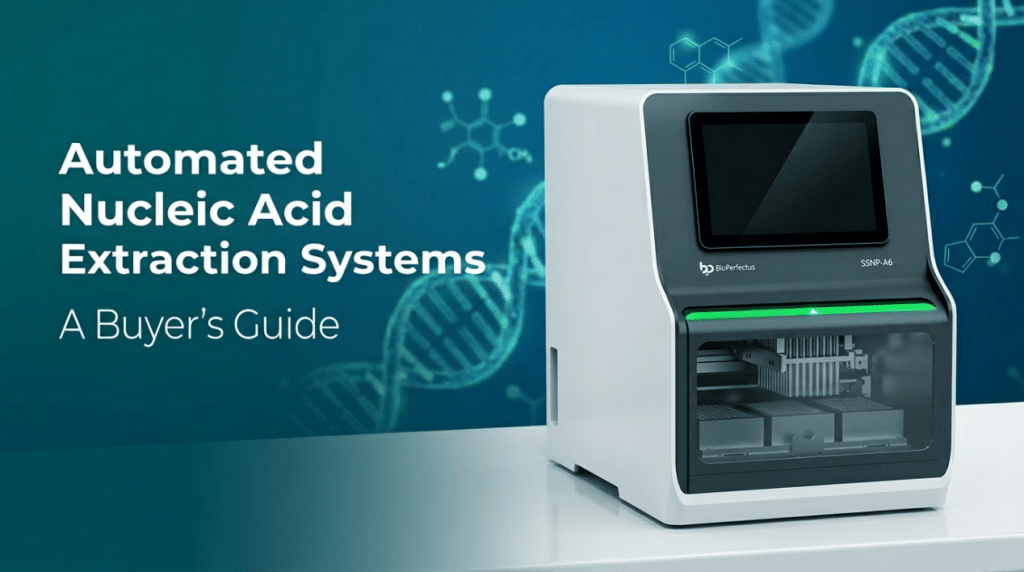
Automated nucleic acid extraction systems have become essential tools in modern molecular biology laboratories. In molecular diagnostics, life science research, and biosafety workflows, the initial step of nucleic acid extraction directly determines data quality, throughput, and reproducibility.
As sample volumes increase and laboratories demand higher efficiency, automated extraction platforms are rapidly replacing traditional manual methods.
Why Automated Nucleic Acid Extraction Matters
Traditional methods, including phenol-chloroform extraction and manual spin-column protocols, remain in use but carry significant limitations: they are labor-intensive, time-consuming, involve hazardous reagents, and are highly vulnerable to human error during phase separation and pipetting.
Automated systems directly address every one of these pain points:
- Higher throughput: Process up to 96 or more samples per run, versus fewer than 20 with manual handling
- Reproducibility: Standardized, software-controlled protocols eliminate operator-to-operator variability and batch inconsistency
- Hands-on time reduction: Frees up technicians for higher-value analytical tasks
- Biosafety: Closed-system workflows minimize operator exposure to infectious or hazardous samples
- Contamination control: Integrated UV lamps and HEPA filtration prevent cross-run carryover
- Regulatory compliance: Automated audit trails and traceable protocols support GLP/GMP and lab accreditation requirements
How do These Systems Work?
Modern automated nucleic acid extraction instruments automate the classic bind–wash–elute cycle.
The typical process includes:
- Lysis
Samples are mixed with lysis buffer to break open cells or viral particles and release nucleic acids. - Binding
DNA or RNA binds to silica membranes or magnetic beads under specific salt conditions. - Washing
Contaminants such as proteins, lipids, and salts are removed through a series of wash buffers. - Elution
Purified nucleic acids are released into a clean elution buffer for downstream applications.
Depending on the platform design, this is achieved through robotic pipetting arms, magnetic rod/plate mechanisms, vacuum manifolds, or centrifugal force.
Most contemporary systems feature intuitive touchscreen interfaces, pre-loaded application protocols, and connectivity for integration with laboratory information management systems (LIMS).
Types of Automated Nucleic Acid Extraction Systems
Modern automated platforms vary by extraction principle and throughput requirements.
Classified by Extraction Principle:
- Magnetic bead–based (mainstream): Nucleic acids bind to silica-coated magnetic beads; a magnetic rod or plate then transfers beads through wash and elution buffers. No centrifuge required — highly automation-friendly, scalable to 96-well plates, and resistant to clogging. Ideal for high-throughput clinical and research labs.
- Spin column/silica membrane–based: Nucleic acids bind selectively to a silica membrane under specific salt conditions, then are eluted with low-salt buffer. Produces high-purity nucleic acids but requires centrifugation or vacuum pressure and can be prone to clogging with viscous samples.
Classified by Throughput Requirements:
- Low throughput: 1–32 samples/run (small labs, niche testing)
- Medium throughput: 32–96 samples/run (routine clinical or research labs)
- High throughput: 96+ samples/run, often modular for continuous workflow
Automated systems usually support both DNA and RNA extraction, compatible with PCR, NGS, and pathogen detection.
Key Factors to Consider When Choosing an Automated Nucleic Acid Extraction System
- Throughput Capacity
Labs processing infectious disease samples or high testing volumes may require 96-well or modular platforms. - Extraction Method
Magnetic bead-based systems are currently the most automation-friendly option and dominate modern laboratories.
More Exploration: Why Modern Labs Are Switching to Magnetic Bead-based Nucleic Acid Extraction
- Extraction Efficiency and Purity
Evaluate recovery rate (yield), purity (A260/280 ratio), and contaminant removal capability, as these directly impact downstream PCR or NGS results.
- Sample Compatibility
Different systems support various sample types, including blood, tissue, swabs, environmental samples, and cell cultures. - Integration with Downstream Workflows
Ensure compatibility with PCR, qPCR, NGS, or pathogen detection workflows. - Automation Level
Some systems support continuous loading, barcode scanning, and LIMS integration. - Cost Considerations
Optimize your lab budget and procurement strategy by evaluating initial instrument investment, reagent consumption, maintenance costs, and small-batch order flexibility (especially for small and medium-sized labs).
Top Recommendations by Lab Needs
To illustrate how different systems fit different laboratory needs, the following examples highlight three automated extraction platforms commonly used in modern laboratories.
- For Small-to-Medium Routine Labs — Nucleic Acid Extraction System SSNP-2000B
A compact, iF Design Award 2022–winning system processing 1–32 samples in 13.5–45 minutes via the magnetic bead method.
- For High Throughput — Nucleic Acid Extraction System SSNP-A6
Full 96-well plate capacity (1–96 samples, 12–57 min) in a compact 380 × 540 × 520 mm footprint with ≥98% magnetic bead recovery. Built-in UV light and HEPA filter included. CE-IVDR, FDA Listed, and NMPA certified.
- For Continuous & Unpredictable Workflows — Nucleic Acid Extraction System SMPE-960
Three independently operating modules allow new batches to start without waiting for the previous run to finish. Handles 1–96 samples at ≥98% recovery within 15–45 minutes.
Tip: To achieve optimal performance from automated systems, laboratories should also consider the compatibility of extraction kits and reagents.
- Use magnetic bead-based kits for automated platforms
- Select kits validated for your specific sample type
- Ensure reagents are compatible with downstream assays
- Follow manufacturer-recommended protocols for best yield and purity
Proper pairing of instruments and reagents ensures consistent extraction efficiency and reproducible results.
All devices and kits are available at BPLabline.
Why Many Laboratories Choose BPLabline
BPLabline provides a comprehensive portfolio—supplying not only automated nucleic acid extraction instruments but also the complete range of compatible extraction kits (both spin column and magnetic bead formats) from a single source. This eliminates cross-vendor compatibility concerns and simplifies procurement for labs managing tight budgets or small procurement teams.
Key service advantages include:
- SME-friendly: Transparent pricing and flexible terms tailored to small and medium-sized laboratories
- Reliable technical support: Responsive assistance throughout instrument setup and workflow optimization
- Fast delivery: Quick turnaround from inquiry to shipment, minimizing instrument downtime
Conclusion
Automated nucleic acid extraction systems have transformed molecular laboratory workflows by improving throughput, reproducibility, and biosafety.
When selecting an extraction platform, laboratories should carefully evaluate factors such as throughput requirements, extraction method, sample compatibility, and workflow integration.
With the right system in place, laboratories can significantly improve efficiency while ensuring reliable nucleic acid purification for downstream molecular applications.
To learn more about automated extraction solutions designed for modern biology laboratories, explore BPLabline’s portfolio of automated nucleic acid extraction systems and compatible extraction kits.
Frequently Asked Questions
- What is the advantage of automated nucleic acid extraction?
Automated extraction systems improve reproducibility, reduce hands-on time, and minimize contamination risk compared with manual extraction methods.
- What is the most common automated extraction method?
Magnetic bead-based extraction is currently the most widely used approach due to its compatibility with high-throughput automation.
- How many samples can automated nucleic acid extraction systems process per run?
Systems range from low-throughput (1-32 samples, ideal for small labs) to high-throughput (96-well plates for busy clinical workflows), with run times of 12-57 minutes.
- What certifications should I look for when buying?
Prioritize CE-IVDR, FDA-listed, and NMPA certifications to ensure regulatory compliance for clinical diagnostics and biosafety standards.