


Defining Digital Growth Infrastructure and Its Economic Impact
The digital world is always moving forward. For businesses to succeed today, we need more than just good ideas. We need strong foundations that can adapt and grow.
This is where digital growth infrastructure becomes essential. It is not just about technology. It is about building the right systems and connections to drive sustainable growth. These systems help companies make wise choices and reach more customers effectively.
We will explore what digital growth infrastructure truly means. We will see how it helps companies improve investment efficiency. We will also examine how its impact varies across regions and what the future holds for these vital systems. Our goal is to help you understand how to build scalable systems for modern e-commerce and search.
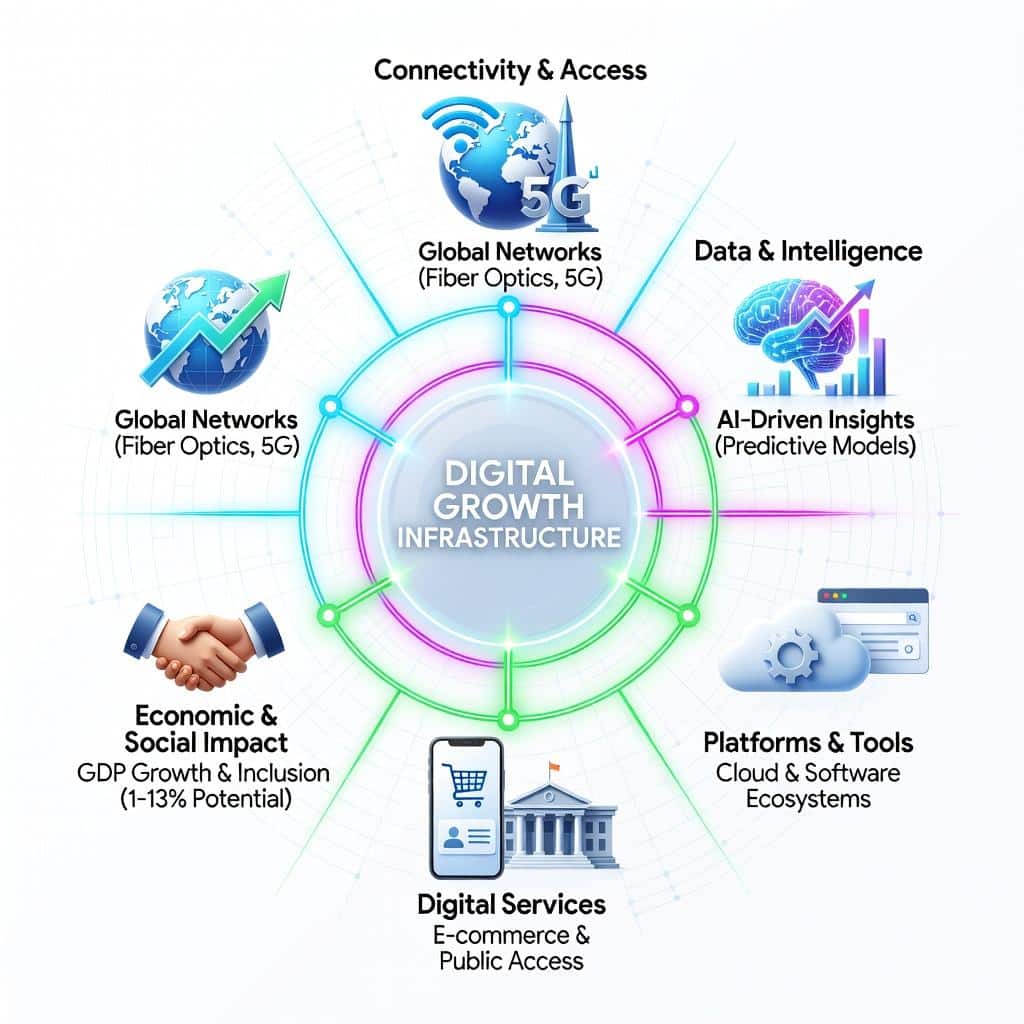
When we talk about infrastructure, our minds often go to traditional physical assets like roads, bridges, and power grids. These are vital for commerce and daily life. However, digital growth infrastructure represents a new paradigm. It encompasses the foundational technological frameworks—data centers, high-speed internet connectivity (like fiber optics and 5G), cloud computing platforms, software-defined networks, and the intricate web of digital services built upon them. Unlike traditional infrastructure, which primarily facilitates physical movement and energy, digital infrastructure enables the seamless flow of information, data, and digital services.
This shift from physical assets to intangible capital is profound. Digital infrastructure is the nervous system of the modern economy, powering everything from e-commerce transactions to complex AI computations. It’s the bedrock upon which businesses build their competitive positioning, optimize their operations, and scale their reach. For instance, platforms like India’s Aadhaar, a biometric digital ID system, enable more than 1.4 billion users to access banking, government benefits, and other digital services, demonstrating the massive potential for economic inclusion and efficiency that robust digital infrastructure provides. Scaling digital ID alone can drive GDP growth by 1-13%, translating to an estimated $5 trillion in economic gains worldwide, as highlighted by the McKinsey Global Institute’s Digital Identification report.
The broader implications for economic growth, innovation, and competitiveness are immense. By reducing information flow barriers and transaction costs, digital infrastructure fosters greater market efficiency. It accelerates innovation by providing developers with powerful tools and platforms, enabling new business models and services at an unprecedented pace. For businesses, this means greater productivity, improved decision-making, and the ability to compete on a global scale. It transforms how companies operate, innovate, and connect with their customers and partners.
The World Economic Forum’s Connected Future Initiative spearheads efforts to shape the next generation of Digital Public Infrastructure (DPI), emphasizing global collaboration to integrate frontier technologies like AI, XR, and quantum computing. This highlights that adequate digital growth infrastructure isn’t just about speed and access; it’s about building a secure, interoperable, and ethically governed ecosystem that can support the demands of tomorrow’s technologies. The distinction between traditional and digital infrastructure lies in this dynamic, interconnected, and constantly evolving nature, making it a critical area for strategic investment and development. For businesses looking to leverage cutting-edge tools and strategies, understanding the core components of an AI-driven growth infrastructure is paramount for achieving sustainable competitive advantage.
Case Study: How Digital Systems Optimize Corporate Investment
To truly understand the impact of digital growth infrastructure, we can look at real-world scenarios where its implementation has been rigorously studied. A compelling case comes from China, specifically examining the effects of the “Broadband China” policy on corporate investment efficiency. Launched in 2013, this policy aimed to significantly upgrade the country’s broadband network, transforming it into a high-speed, ubiquitous digital backbone. This initiative provides a quasi-natural experiment to observe how improved digital infrastructure influences corporate behavior.
Studies using sophisticated econometric models, such as the Difference-in-Differences (DID) model and Instrumental Variable (IV) approaches, have provided robust empirical evidence. The DID model compares changes in investment efficiency in cities designated as “Broadband China” pilot cities (the treatment group) against those not yet included (the control group), before and after the policy intervention. This method helps isolate the policy’s causal effect. Instrumental Variable (IV) approaches further address potential endogeneity issues, ensuring that the observed effects are indeed due to digital infrastructure improvements rather than other confounding factors. For instance, historical infrastructure proxies, such as the distribution of Ming Dynasty post stations, have been used as instrumental variables to validate the long-term suitability of infrastructure development, thereby strengthening causal inference.
The findings are striking. The Broadband China policy has significantly improved corporate investment efficiency, particularly by reducing inefficient investment and overinvestment among Chinese listed companies. Specifically, the policy was found to reduce inefficient investment by 0.0027 to 0.0035 (at the 1% significance level) and overinvestment by 0.0063 to 0.0085 (at the 1% significance level). This is particularly relevant given that approximately 40% of sampled Chinese listed firms exhibited overinvestment behaviors before the policy intervention, with a mean overinvestment (Oinv) of 0.387. The fact that nearly half (44.8%) of the sampled firms were located in Broadband China pilot cities indicates a balanced distribution of treatment, lending credibility to the results.
These quantitative reductions in inefficient investment and overinvestment underscore a fundamental benefit of advanced digital infrastructure: better resource allocation. When companies operate within a high-speed, reliable digital environment, they gain access to more timely and accurate information, enabling more precise capital allocation decisions. This leads to less capital being tied up in unproductive projects and a more efficient deployment of resources towards growth-generating opportunities. The causal link established through these empirical methods demonstrates that investing in digital growth infrastructure is not merely a technological upgrade but a strategic economic lever that directly enhances corporate financial health and productivity. The International Review of Economics & Finance provides a detailed analysis of this phenomenon, emphasizing the importance of such policies for economic development.
Mitigating Information Asymmetry through Digital Growth Infrastructure
One of the core ways digital growth infrastructure enhances corporate investment efficiency is by fundamentally altering the information landscape. In traditional markets, information asymmetry—where one party in a transaction has more or better information than the other—can lead to suboptimal decisions, higher transaction costs, and increased risk of inefficient investment. Digital infrastructure acts as a powerful antidote to this problem.
By providing ubiquitous, high-speed connectivity, digital systems facilitate market transparency. Firms gain real-time access to vast amounts of data, including market trends, competitor activities, supply chain dynamics, and customer feedback. This influx of information allows for more precise decision-making, reducing guesswork and speculation. For example, a manufacturing firm with access to real-time sales data can adjust production schedules to better match demand, preventing both overproduction (wasted capital) and underproduction (lost sales).
The ability to process and transmit signals efficiently through advanced digital networks significantly mitigates information frictions. This isn’t just about internal data; it extends to external monitoring. Investors can access more comprehensive and up-to-date information about companies, leading to greater investor confidence and more efficient capital markets. Companies, in turn, can communicate their performance and strategies more effectively, reducing the likelihood of being undervalued or misunderstood.
By reducing information asymmetry, digital growth infrastructure empowers firms to make more informed investment decisions, thereby optimizing resource allocation. This precision in capital deployment is crucial for sustainable growth, ensuring that financial resources are directed towards projects with the highest potential returns and away from those that might otherwise be undertaken due to incomplete or delayed information.
The Role of Management Efficiency in Scalable Systems
Beyond information asymmetry, another critical mechanism linking digital growth infrastructure to improved corporate decision-making is enhanced management efficiency. Digital tools and platforms, enabled by robust infrastructure, allow organizations to streamline operations, flatten hierarchical structures, and improve internal communication, thereby increasing operational agility.
Traditional corporate structures often involve multiple layers of management, which can slow down decision-making and create communication bottlenecks. Digital infrastructure, particularly through enterprise resource planning (ERP) systems, collaborative platforms, and real-time analytics dashboards, facilitates the flattening of hierarchies. Information can flow directly from the front lines to top management and vice versa, reducing the need for numerous intermediary approvals. This direct communication fosters a more responsive and adaptive organization.

This management mediation is crucial. When managers have immediate access to comprehensive data and can communicate effortlessly across departments, they can identify problems faster, evaluate opportunities more accurately, and implement decisions more quickly and precisely. This directly impacts investment efficiency. For example, if a digital management dashboard reveals underperforming assets or market shifts, management can reallocate capital promptly, preventing prolonged inefficient investment. This is where a truly Unified digital growth infrastructure becomes invaluable, integrating various operational and analytical tools into a cohesive system.
Empirical evidence from the Broadband China case study supports this. The policy’s impact on reducing overinvestment was significantly mediated by improvements in management efficiency, indicated by a negative interaction term (-0.0003). This suggests that the benefits of digital infrastructure are amplified when companies leverage it to improve their internal governance, decision-making layers, and overall corporate governance. By fostering better internal controls and promoting digital transformation within the organization, firms can achieve greater organizational alignment and ensure that investment decisions are not only data-driven but also executed with maximum efficiency.
Enhancing Decision-Making via Digital Growth Infrastructure
The synergy between robust digital growth infrastructure and improved management efficiency directly enhances decision-making capabilities within firms. With real-time analytics and data-driven insights, companies can move beyond intuition-based choices to make strategic decisions grounded in evidence.
Digital infrastructure provides the backbone for collecting, processing, and analyzing vast datasets. This allows management to monitor key performance metrics, identify trends, and forecast future outcomes with greater accuracy. For instance, predictive analytics, powered by high-performance computing and extensive data, can help firms anticipate market demand, optimize inventory levels, and even predict potential supply chain disruptions. Such foresight minimizes investment risks and maximizes potential returns.
Strategic alignment is also significantly improved. Digital platforms enable cross-functional teams to collaborate seamlessly, share insights, and ensure that all departments are working towards common goals. This cohesive approach ensures that investment decisions are not made in silos but are integrated into the broader corporate strategy.
Furthermore, digital infrastructure facilitates precision scaling. Businesses can test new products or services in smaller markets, gather immediate feedback, and use data to refine their offerings before a larger rollout. This iterative process, supported by rapid data collection and analysis, reduces the risk of large-scale investment failures. Performance metrics become transparent and accessible, allowing for continuous feedback loops and adjustments. This operational transparency empowers managers to swiftly course-correct, ensuring that capital is always deployed effectively and efficiently.
Navigating Regional Disparities and Infrastructure Maturity
While the benefits of digital growth infrastructure are clear, their impact is not uniformly distributed. Regional differences, particularly in existing infrastructure levels and city tiers, play a significant role in how effectively these policies translate into economic growth and corporate efficiency. This heterogeneity is a crucial consideration for policymakers and businesses alike.
Studies have consistently shown that the effects of digital infrastructure policies are more pronounced in regions with higher levels of infrastructure maturity. For example, the Broadband China policy’s impact on reducing inefficient investment (by 0.0031) and overinvestment (by 0.0095, at the 1-5% significance level) was significantly more substantial in regions with high infrastructure levels. This suggests a “rich get richer” phenomenon, where areas with existing digital foundations can more readily leverage new investments to achieve greater economic benefits.
City tiers also present a notable disparity. Firms located in provincial capital cities, which typically have more developed infrastructure, better access to talent, and stronger economic ecosystems, experienced greater benefits from the Broadband China policy. For these firms, the policy reduced inefficient investment by 0.0031 and overinvestment by 0.0088 (at 1-5% significance). In contrast, firms in non-capital cities, often characterized by less advanced infrastructure and fewer resources, saw less pronounced improvements.

This urban-rural divide, along with differences between city tiers, highlights critical policy disparities. While universal access is a goal, the capacity to utilize digital infrastructure fully varies. Regions with lower infrastructure levels may struggle with digital inclusion, widening the gap in economic resilience and local growth potential. For instance, rural SMEs still lag significantly behind their urban counterparts in reliable broadband access (56% vs. 82% in 2023 UK data).
Therefore, policy recommendations must be differentiated. A one-size-fits-all approach is unlikely to maximize benefits across an entire nation. Governments should prioritize targeted investments in underdeveloped regions to bridge these gaps, ensuring that basic digital infrastructure is robust before expecting advanced economic impacts. This might involve specific incentives for firms in less-developed areas to adopt digital tools or direct subsidies for infrastructure build-out. Understanding these variations through heterogeneity analyses is essential for crafting equitable and effective digital development strategies that ensure the transformative power of digital infrastructure reaches all segments of society.
Future Directions for Digital Public and Private Systems
Looking ahead, the evolution of digital growth infrastructure is inextricably linked to the emergence of frontier technologies. Artificial intelligence (AI), extended reality (XR), and quantum computing are not just buzzwords; they represent the next wave of innovation that will demand even more sophisticated and resilient digital foundations. However, our current digital systems, both public and private, were not designed with these advanced technologies in mind, creating potential bottlenecks and necessitating strategic foresight.
The World Economic Forum’s Connected Future Initiative emphasizes that existing Digital Public Infrastructure (DPI) often fails to align with the requirements of AI, XR, and quantum computing. This misalignment can lead to inefficiencies, security vulnerabilities, and interoperability challenges. For instance, AI-driven applications require immense computational power and high-speed, low-latency data transfer, pushing the limits of current network capabilities. XR technologies demand ultra-reliable, high-bandwidth connections to deliver immersive experiences without lag. Quantum computing, while still nascent, will introduce new paradigms for data security and processing, requiring a complete re-evaluation of cryptographic standards and data handling protocols.
Therefore, future research and policy must focus on several key areas:
- AI Integration and Ethical Governance: Developing AI-compatible DPI frameworks is crucial for ethical AI deployment. This includes establishing robust data governance standards, ensuring data privacy, and building mechanisms for algorithmic transparency and accountability.
- Interoperability and Scalable Frameworks: As digital ecosystems become more complex, interoperability between different systems and platforms will be paramount. This requires embracing open standards and modular architectures that allow for seamless data exchange and service integration. Scalable frameworks will ensure that infrastructure can grow with demand without requiring complete overhauls.
- Long-Term Impact and Research Limitations: While studies like Broadband China provide valuable insights, their long-term impact beyond 2021, especially on innovation and firm competitiveness across diverse sectors, requires further investigation. We also need to explore the impact of underinvestment, which often shows insignificant results in current studies, and conduct sector-specific analyses beyond the general listed firms.
- Global Collaboration: No single nation or entity can tackle these challenges alone. International cooperation is essential for developing common standards, sharing best practices, and ensuring equitable access to advanced digital infrastructure globally. Initiatives like the OECD’s work on DPI for Digital Governments provide valuable frameworks for this collaboration.
Governments, in particular, have a critical role to play in maximizing the benefits of digital infrastructure while addressing regional disparities. This involves:
- Targeted Investment: Prioritizing digital infrastructure build-out in underserved areas to ensure universal access and bridge the urban-rural divide.
- Incentivizing Adoption: Providing tax incentives or subsidies for Small and Medium-sized Enterprises (SMEs) to adopt digital tools and upgrade their management systems.
- Skills Development: Investing in digital literacy and advanced tech skills training to ensure the workforce can leverage new infrastructure effectively.
- Regulatory Adaptation: Creating agile regulatory environments that foster innovation while safeguarding data privacy and security.
The journey towards a fully digitized and interconnected future is ongoing. By proactively addressing emerging tech bottlenecks and fostering a collaborative environment, we can ensure that digital growth infrastructure remains a catalyst for economic prosperity, innovation, and sustainable development worldwide.
Frequently Asked Questions about Digital Growth Infrastructure
How does digital infrastructure differ from traditional physical assets?
Traditional infrastructure focuses on physical transport and utilities, such as roads, bridges, and power grids, that facilitate the movement of goods and energy. In contrast, digital growth infrastructure centers on intangible assets such as data centers, high-speed internet connectivity, cloud computing platforms, and software-defined systems. Its primary function is to enable the rapid exchange of information and data, supporting digital services, e-commerce, and advanced analytics, which is crucial for SEO scalability and modern business operations.
Can digital systems actually reduce corporate overinvestment?
Yes, empirical studies, such as those analyzing China’s Broadband China policy using Difference-in-Differences (DID) models, have shown that robust digital systems significantly reduce corporate overinvestment. This occurs by improving management efficiency and mitigating information asymmetry. With better access to real-time data and streamlined internal processes, firms can make more precise capital allocation decisions, thereby avoiding the misallocation of resources to unproductive ventures.
Why do regional differences matter for digital policy?
Regional differences, including existing infrastructure levels and city tiers (e.g., provincial capitals vs. non-capitals), profoundly affect the impact of digital growth infrastructure. Studies reveal that the benefits of digital initiatives are often more pronounced in provincial capitals and regions with higher existing infrastructure maturity. This means that policy recommendations must be differentiated and tailored to address the specific needs and developmental stages of various areas, ensuring equitable access to and utilization of digital resources across the board.
Conclusion
The journey through the landscape of digital growth infrastructure reveals its undeniable importance as a cornerstone of modern economic success. From enabling the seamless flow of information to profoundly influencing corporate investment decisions, digital infrastructure is no longer a mere enabler but a critical driver of economic growth, innovation, and competitive advantage.
Our case study on the Broadband China policy provided compelling empirical evidence: robust digital systems, backed by strategic policy, demonstrably reduce inefficient investment and overinvestment by enhancing management efficiency and mitigating information asymmetry. This translates directly into better resource allocation and more precise decision-making for businesses.
However, we also recognized that the impact of this infrastructure is not uniform. Regional disparities, particularly between provincial capitals and other areas, and variations in the maturity of existing infrastructure necessitate differentiated policy approaches to ensure digital inclusion and equitable economic development.
As we look to the future, the integration of frontier technologies like AI, XR, and quantum computing will continue to shape the demands on our digital foundations. Building scalable systems that are secure, interoperable, and ethically governed will be paramount. For businesses, this means embracing digital transformation not just as a technological upgrade, but as a strategic imperative for future-proofing and achieving sustainable growth.
Investing in digital growth infrastructure is an investment in a connected, innovative, and prosperous future. It’s about building resilient, scalable systems that will define success in the digital age, drive global connectivity, optimize SEO, and foster sustainable development for all.