

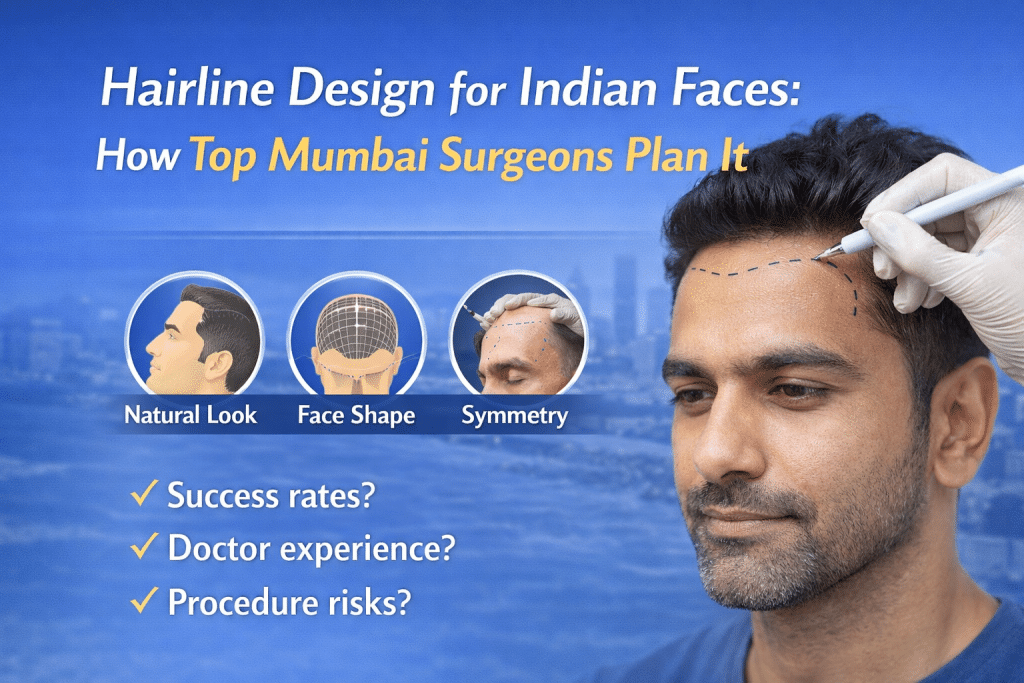
Many people considering a hair transplant focus almost entirely on the number of grafts or the technique being used. But experienced surgeons will tell you that the hairline itself — where it begins, how it curves, and how it frames the face — often matters more than anything else. A technically flawless transplant can still look unnatural if the hairline is drawn without considering the individual’s facial structure, ethnicity, and age. This is especially relevant for Indian patients, whose facial proportions and hair characteristics require a thoughtful, culturally aware approach to design.
Why Hairline Design Is More Complex Than It Looks
The hairline is not simply a line drawn across the forehead. It is a transition zone — a gradual blend from skin to hair that, when done well, looks completely natural. For Indian faces, this zone often needs to account for a broader forehead, stronger facial features, and darker hair that creates higher visual contrast against the scalp. Because of this contrast, any irregularity or unnatural density pattern becomes more visible compared to lighter hair types.
A poorly designed hairline can age a person incorrectly, look overly sharp or theatrical, or simply not suit the face it frames. These outcomes are difficult to reverse, which is why planning this stage carefully is considered essential by experienced hair restoration surgeons.
How Surgeons Assess Facial Structure Before Designing a Hairline
Before a single graft is placed, a well-trained surgeon evaluates several factors:
- Facial shape — oval, round, square, heart-shaped, or oblong
- Forehead height and width
- The position of the temples and their natural recession pattern
- Age of the patient and likely future hair loss progression
- Existing hair density and the donor area available
For Indian patients specifically, surgeons also consider the natural hairline patterns common to South Asian faces. Many Indian men have a naturally lower hairline in their youth, and recreating this in someone who has experienced significant loss can actually look artificial if not balanced against their current age and facial proportions.
The goal is not to restore the hairline of a 20-year-old onto a 40-year-old face. It is to create something that looks appropriate, natural, and sustainable.
The Role of Irregularity in a Natural-Looking Result
One of the most important principles in hairline design is intentional irregularity. A perfectly straight hairline looks artificial because no natural hairline is actually straight. Skilled surgeons introduce micro-irregularities — small variations in the placement of individual grafts — to mimic how hair actually grows in nature.
This includes:
- Placing single-hair grafts at the very front of the hairline for a soft, feathered edge
- Varying the angle and direction of grafts to match natural growth patterns
- Creating slight asymmetry between the left and right sides, as natural hairlines are rarely perfectly symmetrical
- Designing small temple peaks that reflect ethnic and individual variation
For Indian hair, which tends to be thicker and coarser than East Asian or Caucasian hair, surgeons must be particularly careful about graft density at the front. Placing too many thick grafts in the transition zone can result in a pluggy or unnatural look.
Respecting Ethnic Identity in the Design Process
Hairline design should never be a one-size-fits-all template. What looks natural on a European face may not suit an Indian face at all. Surgeons working with South Asian patients are increasingly aware that ethnic identity plays a meaningful role in what a “natural” result actually looks like.
This means avoiding hairline designs that flatten or westernize the patient’s natural appearance. It means understanding the typical hairline shapes seen across different regions of India — from North to South — and tailoring the design accordingly. It also means having an honest conversation with the patient about what is achievable given their donor density, scalp laxity, and the extent of their hair loss.
Clinics like Kibo Clinics approach hairline planning as a detailed pre-surgical consultation process, evaluating facial anatomy alongside hair characteristics before any design decisions are made.
Final Thoughts
Hairline design is both a science and an art. For Indian patients, it requires a surgeon who understands facial geometry, ethnic aesthetics, and the biological realities of how transplanted hair behaves over time. The best outcomes come not from the most aggressive restoration, but from the most thoughtful one — a hairline that fits the face it belongs to, looks natural at every age, and holds up well as time passes. If you are exploring hair restoration, give as much attention to how your hairline will be designed as you do to which technique will be used.