

Every day, Australians go to work expecting a normal routine. Yet, statistics show that a significant portion of the workforce will face a severe injury or illness during their working years, forcing an early, unexpected exit from their careers. Total and Permanent Disability (TPD) insurance is designed to act as a critical financial safety net in these exact scenarios. The problem, however, is that most people have no idea if their coverage is actually adequate.
If you find yourself wondering How much tpd insurance should you get, you are certainly not alone. Getting this number right is one of the most important financial decisions you will ever make. Severe underinsurance can leave your family struggling to pay off insurmountable debt while managing a health crisis. On the other end of the spectrum, overinsurance slowly drains your current income through unnecessary and expensive premiums.
This post will guide you through a practical, step-by-step framework to calculate exactly how much coverage you require. We will explore the common pitfalls of default policies, detail the hidden expenses of severe injuries, and explain why having the right legal backing is just as important as having the right policy.
What Actually is TPD Insurance?
TPD insurance provides a lump-sum payment if you become permanently disabled and are medically determined to be unable to work again. This financial boost is meant to help you cover immediate medical bills, clear out ongoing debts, and replace the income you would have earned until your planned retirement age.
When evaluating policies, the most critical factor to understand is the policy definition. There are two primary definitions that drastically affect your premiums and your likelihood of a successful claim:
- Any Occupation: This policy will only pay out if your injury or illness prevents you from working in any job that suits your education, training, or experience. Because the criteria are much stricter, these policies usually have lower premiums. However, they are significantly harder to claim against.
- Own Occupation: This definition pays out if your disability prevents you from returning to your specific current job. If a highly specialized surgeon develops a severe tremor, an “Own Occupation” policy would pay out, even if that surgeon could theoretically find work as a general medical consultant. These premiums are higher, but the coverage is far more comprehensive.
Consider a scenario where a healthy 35-year-old suffers a severe spinal injury or develops a chronic neurological condition. The immediate physical limitations are devastating, but the financial ripple effects can easily bankrupt a family. TPD insurance steps in precisely when regular income stops, providing a lump sum to stabilize the situation.
The True Cost of Permanent Disability
To calculate your ideal coverage, you first need a realistic understanding of what permanent disability actually costs. The financial impacts extend far beyond standard hospital bills.
Immediate Expenses
The moment a severe disability occurs, costs begin to accumulate rapidly. You will face expenses for specialized medical treatments, extended hospital stays, and extensive physical or occupational rehabilitation. Furthermore, you will likely need to fund major lifestyle adjustments. This can include modifying your home with wheelchair ramps and accessible bathrooms, or purchasing a specialized vehicle to accommodate mobility aids.
Long-Term Financial Impact
The long-term costs are often the most difficult to conceptualize. You are looking at the complete loss of your future earning capacity. Every paycheck you expected to earn from today until age 65 disappears. Additionally, you must account for ongoing daily care needs, continuous medical prescriptions, and the severe impact on your retirement savings. Without regular superannuation contributions, your retirement nest egg will stagnate.
(Note: When assessing your needs, it is helpful to reference an infographic or chart from financial bodies estimating the average lifetime cost of care for a severe disability in Australia, which often exceeds several million dollars.)
Step-by-Step: How Much TPD Insurance Should You Get?
Calculating adequate TPD coverage does not require a degree in finance. By following a straightforward formula, you can arrive at a highly accurate estimate of your personal needs.
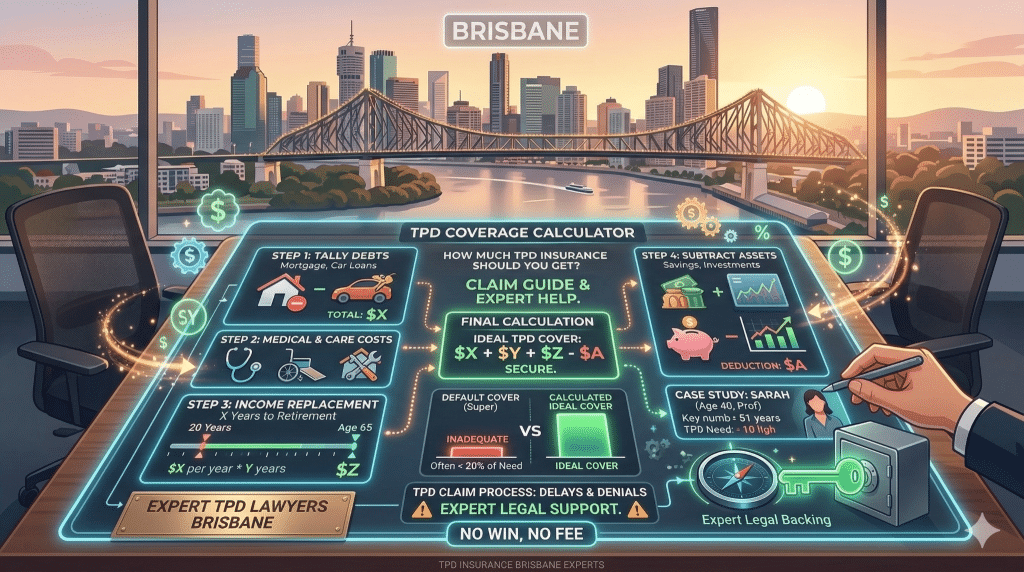
Step 1: Tally Your Debts
Your primary goal is to secure your family’s baseline living situation. Calculate the total cost to completely clear your mortgage, eliminate all personal loans, and wipe out credit card debt. Removing the burden of debt means your family will not lose their home if your income stops.
Step 2: Estimate Medical and Care Costs
Factor in an upfront financial buffer for necessary lifestyle modifications and initial medical expenses. While exact medical costs are hard to predict, financial advisers generally recommend allocating a lump sum of $100,000 to $200,000 strictly for immediate medical stabilization and home alterations.
Step 3: Calculate Income Replacement
Determine how much annual income is required to sustain your family’s current lifestyle. Multiply this annual figure by the number of years you have left until your planned retirement. For example, if your family needs $80,000 a year to live comfortably, and you are 20 years away from retirement, your baseline income replacement need is $1.6 million.
Step 4: Subtract Existing Assets
You do not have to insure for money you already have. Deduct easily accessible savings, liquid investment portfolios, and any other insurance payouts you might receive, such as trauma cover.
Case Study: Sarah, the 40-Year-Old Professional
Let us look at a hypothetical example. Sarah is a 40-year-old professional earning $100,000 a year. She plans to retire at 65.
- Debts: Sarah has a $400,000 mortgage and $20,000 in car loans. (Total: $420,000)
- Medical Buffer: She allocates $150,000 for potential medical and modification costs.
- Income Replacement: Her family needs $70,000 annually to maintain their lifestyle. Multiplied by 25 years until retirement, this equals $1,750,000.
- Total Need: $2,320,000.
- Existing Assets: Sarah has $100,000 in savings and accessible investments.
- Final Calculation: Sarah requires approximately $2,220,000 in TPD coverage to ensure total financial security.
To ensure your math aligns with current financial standards, we highly recommend consulting a TPD calculator tool or referencing the Australian Securities and Investments Commission (Moneysmart) guidelines on life insurance.
The Danger of Default Superannuation Cover
A widespread misconception among Australian workers is that the default TPD cover provided automatically through their employer’s superannuation fund is perfectly sufficient. This assumption leaves thousands of families financially stranded every year.
Data frequently shows that the average default super TPD cover provides a payout of roughly $100,000 to $200,000. As demonstrated in Sarah’s case study above, this default amount is often less than 20% of what an average income earner actually needs to survive a lifelong disability.
Furthermore, default superannuation policies almost exclusively use the stricter “Any Occupation” definition. Because the super fund negotiates bulk insurance rates to keep premiums low for members, the terms are heavily weighted in favor of the insurer. Making a successful claim on a default super policy is notoriously difficult, requiring extensive medical proof that you cannot perform any job whatsoever.
Why the TPD Claims Process is Notoriously Difficult
Securing the right policy amount is only the first part of the equation. Actually accessing that money when a tragedy occurs is a completely different battle. It is vital to remember that insurance companies are fundamentally profit-driven businesses. Their primary objective is to minimize payouts to protect their bottom line.
Claims are frequently delayed or outright denied due to minor technicalities. Insurers often dispute the severity of medical evidence, heavily scrutinize the exact wording of the policy definitions, or reject claims based on missed disclosure requirements from years prior.
Fighting a massive insurance corporation while simultaneously attempting to manage a life-altering medical condition takes an immense emotional toll. Claimants often find themselves buried in complex paperwork, facing endless requests for supplementary medical assessments, and enduring months of financial uncertainty.
How Expert TPD Lawyers in Brisbane Can Protect You
This inherently imbalanced power dynamic is exactly why specialized legal professionals exist. Attempting to navigate a complex TPD claim alone while battling a severe illness is a recipe for immense stress and potential financial ruin.
When you engage Expert TPD lawyers in Brisbane, you immediately level the playing field. These specialized legal professionals understand the intricacies of insurance law and know exactly how insurance companies operate. They thoroughly analyze complex, jargon-heavy policy documents to find clear pathways to claim approval that everyday individuals would easily miss.
The benefits of legal representation are substantial. Your legal team takes over all communication with the insurer, entirely shielding you from stressful phone calls and endless bureaucratic hurdles. They work directly with your treating doctors and independent medical specialists to gather compelling, undeniable medical evidence that fits the exact criteria of your policy.
Additionally, reputable law firms typically operate on a “No Win, No Fee” basis. This structure guarantees that claimants are not forced to pay upfront legal expenses while seeking justice. You only pay legal fees if the lawyers successfully secure your TPD payout, entirely removing the financial risk of seeking professional help.
Frequently Asked Questions (FAQ)
Can I hold multiple TPD policies?
Yes, it is possible to hold multiple TPD policies, often across different superannuation funds. However, calculating the cumulative premiums and understanding how the policies interact during a claim is complex. Professional advice is strongly recommended to ensure you are not paying redundant fees.
Do I pay tax on a TPD payout?
If your TPD insurance is held outside of superannuation, the lump sum is generally tax-free. If the policy is held within your superannuation fund, you may be subject to tax upon withdrawing the funds, depending on your age and the specific components of your super balance.
What happens if my TPD claim is denied?
A denied claim is not the end of the road. Insurers frequently reject valid initial applications. You have the right to request an internal review or escalate the matter to the Australian Financial Complaints Authority (AFCA). Engaging a specialized lawyer immediately after a denial dramatically increases your chances of a successful appeal.
Conclusion
Determining the appropriate level of TPD insurance requires a careful, honest look at your current debts, your family’s lifestyle, and your future financial needs. Relying blindly on the default cover provided by your superannuation fund is a massive gamble that could leave you drastically underinsured when you need support the most.
Taking the time to accurately calculate your needs is a vital first step. However, having a robust policy is only effective if the claim is actually paid. Having the right legal backing ensures that insurance companies honor their commitments.
We encourage you to log into your superannuation portal or review your life insurance statements this week. Take note of your current coverage and run through the calculation steps provided above. If you suspect you are underinsured, or if you are currently facing a health crisis and need to explore your claiming options, do not wait. Reach out today to schedule a free, no-obligation policy review or claim assessment with our dedicated team of legal professionals.