

Jewelry has always carried stories, yet traditional engraving gives you only a limited amount of space to tell them. A projection necklace changes that idea completely. Instead of displaying every detail on the surface, it stores a microscopic image inside a tiny optical lens that reveals a photo, message, or design when viewed through light.
That single feature shows how jewelry has started borrowing ideas from precision optics, laser engineering, and advanced manufacturing. The result isn’t a passing novelty, but a reflection of a broader shift across an industry where technology now influences how jewelry gets created, customized, produced, and experienced.
Even market data supports that shift. Fortune Business Insights estimates the global jewelry market will reach $254.13 billion in 2026 and $387.36 billion by 2034, with personalization standing out as one of the strongest purchase drivers. Digital production methods, customization platforms, and smarter manufacturing have become central parts of that growth instead of optional additions.
Jewelry Has Become a Tech Product (The Technology Behind Tiny Images)
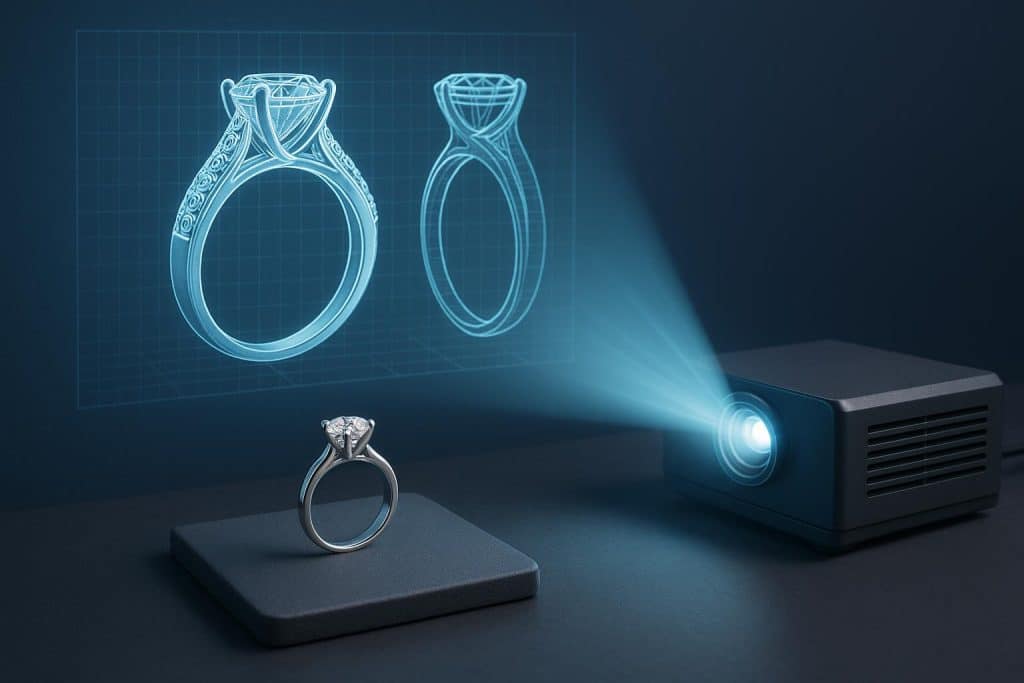
Gold, silver, and gemstones are still on the rise. The difference is that software, optics, and manufacturing systems now contribute just as much to the finished product. Modern jewelry production depends on technologies that were once limited to industrial engineering:
- → Computer-aided design (CAD) creates highly accurate digital models.
- → 3D printing produces wax prototypes with exceptional precision.
- → Laser engraving captures microscopic details impossible through hand engraving.
- → Computer-controlled manufacturing improves consistency across production batches.
- → Micro-optical components introduce entirely new product categories, including projection jewelry.
These advances shorten production timelines and give designers greater creative freedom. A customer no longer needs to settle for preset designs. Small adjustments, custom engravings, or completely original concepts can move from digital file to finished jewelry with far fewer production barriers than a decade ago.
One example appears in projection jewelry, where manufacturers compress a high-resolution photograph into a microscopic format using precision imaging techniques. Specialized laser equipment transfers that image onto an optical element small enough to fit inside a pendant. Creating a clear projected image demands accurate calibration measured in fractions of a millimeter. Without that level of engineering, the hidden photograph loses clarity.
That blend of craftsmanship and engineering represents one of the biggest changes in jewelry manufacturing today.
Online stores such as ShopMinx offer projection jewelry alongside conventional personalized gifts to keep up with the broader consumer demand for products that combine sentimental value with advanced production techniques instead of relying on decoration alone.
“What makes projection jewelry so interesting is that the technology stays hidden. People see a beautiful necklace or ring first, then discover there’s a tiny photo inside. That surprise element is what makes it feel so special.” — Hilyn Mellanez, Operations Manager at ShopMinx
Why Is Projection Jewelry Getting So Much Attention?
People want jewelry with emotional value, and projection technology gives them a discreet way to carry memories every day.
Traditional engraving has limits: a ring can fit initials, and a bracelet can display a short date. A projection pendant, on the other hand, can preserve an entire photograph inside a miniature optical stone.
That difference changes the buying experience. So, instead of asking:
- “Which metal should I choose?”
- “Which gemstone looks best?”
Customers now ask:
- → Which memory should I carry?
- → Which photo represents this relationship?
- → Which moment deserves a permanent place?
Projection jewelry has become especially popular for anniversaries, memorial gifts, birthdays, weddings, and long-distance relationships because they create an emotional connection without sacrificing style. Advances in micro-optics, laser engraving, and precision manufacturing continue to improve image clarity and production consistency, which makes personalized projection jewelry accessible to a much wider audience.
What Makes Projection Necklaces Different From Traditional Personalized Jewelry?
A projection necklace stores a miniature photograph inside a tiny optical lens, so the image appears through direct viewing or light projection. Unlike conventional engraving, the memory remains hidden until someone interacts with the jewelry.
That subtle interaction changes the emotional experience. Customizations on both include:
| Traditional Personalization | Projection Personalization |
| Initials | Full photographs |
| Short dates | Family portraits |
| Brief messages | Pet images |
| Surface engraving | Hidden optical display |
Why Personalization Is Driving Jewelry Innovation
According to McKinsey & Company’s report, personalization supported by technologies such as AI, augmented reality, and data-driven shopping experiences can increase retail sales by 10% to 30%, depending on the product category and customer experience. Those technologies help shoppers visualize custom products before placing an order, which reduces uncertainty and increases purchase confidence.
Also, in a jewelry industry trends report by Accio, an AI agent platform, custom jewelry has recorded roughly 40% year-over-year growth, driven by digital design tools that let customers co-create pieces through AI-assisted visualization and AR previews before production begins.
Projection necklaces fit naturally into that movement.
Instead of selecting a stock pendant, customers contribute something deeply personal. Technology doesn’t replace emotional value, but it gives people another way to preserve it.
Projection Technology Points to the Future of Jewelry
Projection necklaces won’t replace classic diamond rings or timeless gold chains.
They don’t need to.
Their value comes from introducing something traditional jewelry couldn’t easily offer before: a hidden photograph preserved inside an elegant accessory small enough for everyday wear.
As digital manufacturing continues to improve, projection technology will likely inspire new formats beyond necklaces, including bracelets, rings, and keepsake collections with richer customization options.
The jewelry industry has always blended craftsmanship with innovation. Projection jewelry simply proves that the next chapter may rely as much on optics, precision engineering, and thoughtful personalization as it does on precious metals and gemstones.
Research references:
- Accio. Jewelry industry trends
https://www.accio.com/business/jewelry_industry_trends - Corporate Vision. What technology is involved in the production of jewellery making? https://www.corporatevision-news.com/2019-what-technology-is-involved-in-the-production-of-jewellery-making/
- Fortune Business Insights. Jewelry market size, share & industry analysis. https://www.fortunebusinessinsights.com/jewelry-market-102107
- McKinsey & Company. What is personalization? https://www.mckinsey.com/featured-insights/mckinsey-explainers/what-is-personalization
- Professional Jeweller. Feature: How tech is redefining jewellery manufacturing. https://www.professionaljeweller.com/feature-how-tech-is-redefining-jewellery-manufacturing/
- T2C Online. The rise of photo projection necklaces in personalized jewelry. https://t2conline.com/the-rise-of-photo-projection-necklaces-in-personalized-jewelry/