

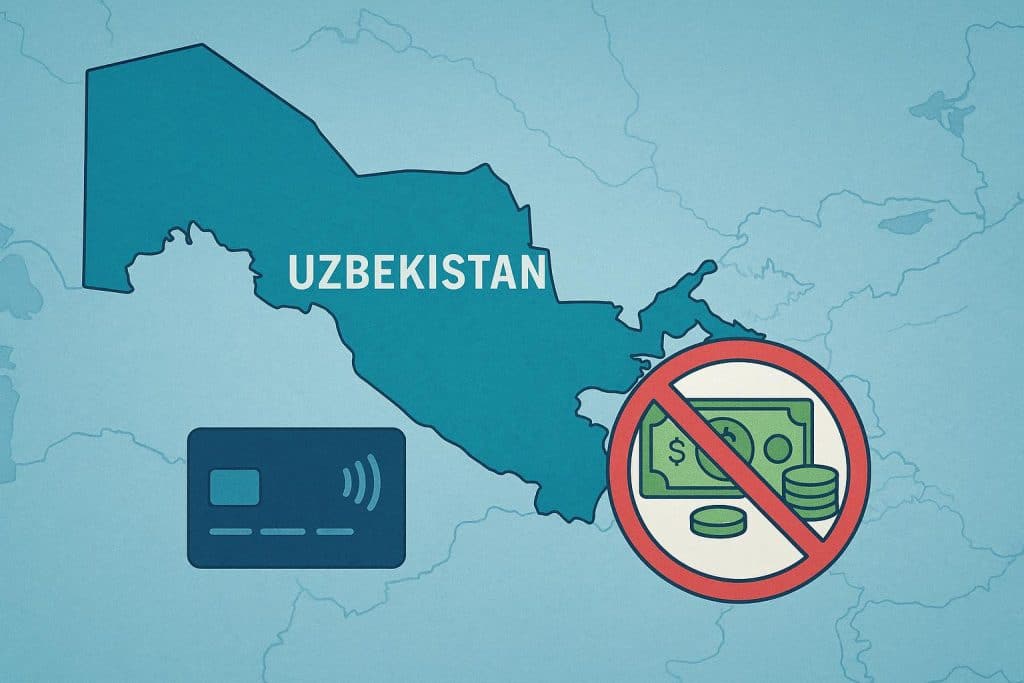
Starting April 1, Uzbekistan introduced new restrictions on the use of cash for certain goods and services. The changes do not eliminate cash entirely but instead target specific sectors where informal transactions have traditionally been widespread.
In practice, this marks a shift in the role of cash: it remains in circulation but is gradually being pushed out of larger and more regulated transactions.
Given the scale and speed of implementation, the reform has become one of the most notable in the region. It is already drawing attention across CIS countries, including Russia, where similar measures to reduce cash circulation are under discussion.
What Has Changed
Mandatory cashless payments now apply to:
- government services;
- utility payments;
- alcohol and tobacco products;
- gas stations (including fuel and EV charging);
- goods and services priced above 25 million UZS;
- certain transactions involving real estate and vehicles.
In total, the restrictions cover around 28,000 product categories, or roughly 7% of the country’s total turnover.
The primary goal is to reduce the “unobserved economy.” Authorities aim to shrink it by at least 1.3 times and increase the share of cashless payments in trade and services to 75% or more.
How the Mechanism Works
The reform is implemented primarily through payment infrastructure.
Cash register systems have been updated so that cash payments are disabled for certain categories. If such items appear in a receipt, the “cash” payment option is automatically blocked.
To pay in cash, these items must be removed from the purchase. Control is enforced automatically through updated software and integration with tax systems.
Escrow for Large Transactions
Additional changes affect high-value transactions.
Purchases of vehicles and real estate (with some exceptions for new developments) must now be conducted through escrow accounts, including transactions between individuals.
Funds are first placed into an escrow account. A notary then verifies the availability of funds through an online system before the transaction is finalized.
This mechanism is intended to increase transparency and reduce fraud risks.
Early Challenges
The rollout has revealed several practical issues.
Gas Stations
- A large share of customers still rely on cash;
- Businesses must rapidly implement new payment solutions;
- Transaction fees are increasing;
- Gas stations are effectively taking on the role of payment intermediaries.
Infrastructure
In some regions, connectivity and power supply issues affect the reliability of cashless payments.
Consumer Behavior
Some users have yet to adapt to the new requirements, particularly in everyday transactions.
Legal Considerations
Current legislation recognizes both cash and cashless payments as equal forms of settlement. The new restrictions effectively introduce exceptions to this principle, which may require further legal clarification.
Impact on Business
For businesses, the reform accelerates digital transformation:
- transition to online cash registers;
- adoption of cashless payment methods;
- integration with banking and payment systems;
- increased transparency and stricter tax oversight.
At the same time, risks associated with handling cash are reduced.
Companies from CIS countries operating in Uzbekistan will need to adjust their payment processes to comply with the new rules.
Regional Context
Uzbekistan is effectively testing a model that is being discussed across the CIS:
- reducing the share of cash in circulation;
- expanding digital payments;
- integrating tax oversight with payment infrastructure.
Particular interest lies in both the scale and speed of implementation.
The reform may also affect cross-border transfers and demand for digital financial services.
The Role of the Banking System and Octobank’s Experience
The transition to broader use of cashless payments requires banks to maintain stable and scalable infrastructure. Octobank, as one of the participants in Uzbekistan’s financial market, is adapting its services to the new environment. Key areas include the development of payment infrastructure to handle growing transaction volumes, QR and POS acquiring solutions, digital identification and cybersecurity tools, and business products aligned with updated payment requirements.
The experience of such banks illustrates how mid-sized financial institutions can integrate into rapid digitalization processes while maintaining operational stability in everyday payments.
Conclusion
The new rules do not eliminate cash but significantly limit its use in key sectors. Unlike gradual approaches seen elsewhere, Uzbekistan is implementing a faster, technology-driven transition.
The outcomes of this reform may have broader implications for the CIS region, where reducing reliance on cash remains an ongoing policy discussion.