

High-precision 3D printing is changing how products are designed and made, such as 3D printing investment casting, tire molds, dental, and jewelry models. All these demand accuracy, smooth surfaces, and stable performance.
Among the various kinds of 3D printers, two dominate the resin-based landscape: SLA (Stereolithography) and DLP (Digital Light Processing). While both utilize light to cure liquid resin, their mechanisms offer distinct advantages for different industrial applications.
Read on for more about SLA vs DLP 3D printing.
What is SLA 3D Printing?
SLA is the earliest resin-based 3D printing technology, having pioneered the concept of additive manufacturing.
- Working Principle:
An SLA resin printer uses high-power UV lasers. The laser beam scans the surface of a vat filled with liquid photopolymer resin. It draws the cross-section of the model point by point. The resin hardens where the laser hits.
After one layer is cured, the build platform moves up (or down, depending on the machine design), and the next layer is scanned and cured. This repeats until the full part is formed.
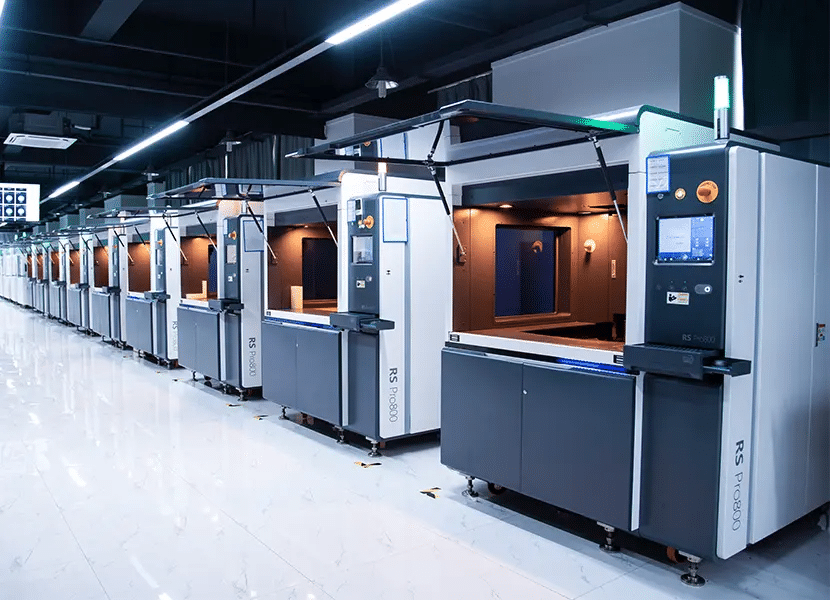
In large industrial systems, multiple lasers may be used to improve efficiency while keeping precision, such as UnionTech RSPro800 X.
- Advantages of SLA
- High Precision: Laser spot size can be extremely fine (often measured in microns), so SLA can achieve intricate details, ideal for parts with thin walls and complex geometry.
- Excellent Surface Finish: Parts printed with an SLA resin printer usually have smooth surfaces. Layer lines are less visible, especially for printers using a splicing algorithm to join the scanning areas of adjacent galvanometers.
- Large Build Volume: Many industrial SLA machines offer large build sizes, as the laser’s precision is not strictly tied to the size of the vat.
- Material Versatility: SLA systems support a wide range of resins, including those with high-temperature resistance, biocompatibility, or high-toughness properties.

What is DLP 3D Printing?
DLP is a high-speed 3D printing solution. Unlike SLA printers, DLP resin printers use a digital projector as their light source.
- Working Principle
DLP uses a digital projector to cast the full cross-section image of each layer onto the resin surface in a single exposure. The illuminated areas are cured, while the dark areas remain liquid.
After curing, the platform moves, and the next image is projected. This layer-by-layer projection continues until the part is complete.
- Advantages of DLP
- Fast Printing Speed: Because each layer is exposed all at once, the curing time stays constant regardless of how complex the layer structure is, so the overall printing speed is usually faster than that of comparable SLA systems.
- Easy Calibration and Maintenance: UV LED light sources have a long service life and are well suited for extended, high-load operation. Plus, it’s easy to maintain, replace, and calibrate.
- Consistency in Small Parts: DLP works well for dental labs and small factories. It can produce the same parts in one job with stable consistency.
- High Resolution at Small Scales: At smaller build volumes, the pixel density of 4K projectors allows for incredible accuracy, making it a staple for jewelry design and orthodontic models.
SLA vs DLP: Differences
To better understand the digital light processing vs stereolithography, below is a direct comparison:
| Feature | SLA | DLP |
| Light Source | Single or multiple UV Laser beams | Digital UV Projector |
| Exposure Method | Point-to-point | Layer-by-layer |
| Printing Speed | Dependent on part complexity & volume | Dependent only on height |
| Precision | High (±0.1mm) | High (±0.05mm – 0.1mm) |
| Build Volume | Generally very large | Generally small to medium |
| Surface Finish | Exceptionally smooth | Smooth, but may show “voxels” (pixels) |
| Material Needs | Diverse | Diverse; compatible with many LED-resins |
| Cost | Higher initial investment (Industrial) | Lower to Mid-range for smaller units |
Choosing Between SLA and DLP
The choice between SLA vs DLP isn’t about which technology is “better,” but which is more fit-for-purpose.
- Key Considerations
- Project Scale: If you need to print a full-scale automotive prototype, architectural models, film, or stage props, an SLA resin printer is the logical choice due to its massive build envelope.
- Production Volume: For a dental lab needing to produce 50 clear aligner models, the DLP resin printer wins for small to medium batch production of small parts.
- Required Precision: While both are high-precision, SLA handles organic, curved surfaces with slightly better aesthetic results. DLP is exceptional for sharp, geometric details, but may require hiding pixelation on curves.
- Budget: While industrial SLA machines represent a significant capital investment, they offer a lower cost-per-part for massive components. DLP often presents a lower barrier to entry for manufacturing or dental offices.
- Use cases for SLA and DLP:
Choose SLA 3D printers for:
- Precision engineering components
- Rapid prototyping in aerospace
- Large investment casting patterns
- Massive auto parts or tire molds
- Surgical models
- Jewelry designs, etc.
Choose DLP 3D printers for:
- Dental models, temporary restorations
- Display models
- Consumer products
- Electronic enclosures
- Education, maker scenarios, etc.
Searching for High-Performance 3D Printers?
If you are evaluating professional solutions for SLA vs DLP, UnionTech is a brand worth considering. UnionTech provides industrial-grade SLA systems and high-performance DLP printing solutions.
- For large-scale industrial needs, the UnionTech RSPro2100 provides a massive build volume of 2100×700×800 mm with an accuracy of ±0.1mm. It’s equipped with a triple-laser scanning system with enhanced efficiency and precision.
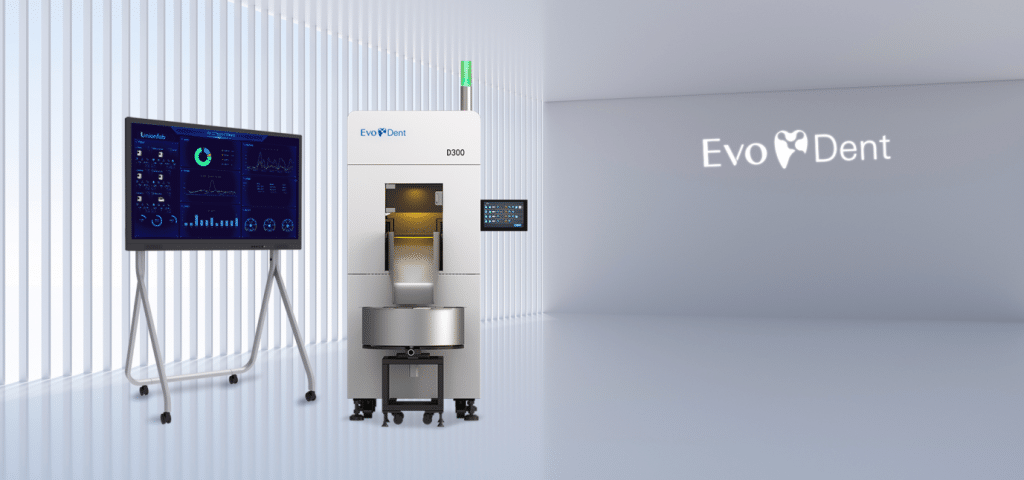
- For those prioritizing speed and high-resolution batching, the EvoDent and Footwear Series utilize advanced digital light processing workflows to deliver 4K precision for the dental and creative industries.
Their equipment is used in automotive, medical, casting, design industries, etc. Stable performance, large build options, and material compatibility make them suitable for demanding projects.
Conclusion
Both DLP vs SLA technologies are essential pillars of the additive manufacturing world. SLA excels in large-scale, ultra-smooth SLA rapid prototyping, while DLP offers unmatched speed for batch production. Contact UnionTech now to select one that aligns with your specific volume and precision requirements!